


All Her Fault Understands That Motherhood Is The Ultimate Thriller
Beneath the missing-child plot in All Her Fault, the show hides a truth every mom knows: survival, guilt, and exhaustion are just different kinds of suspense.

Promo poster for All Her Fault.
Last Updated: 03.46 PM, Nov 20, 2025
Spoilers ahead (but no amount of spoilers in here can prepare you for the climax).
**
WITHIN the first 10 minutes of All Her Fault, a buzzy thriller series on JioHotstar with Sarah Snook and Dakota Fanning in lead roles, the worst that could happen, happens. Or so you’re made to believe. Marissa Irvnie (Sarah Snook) goes to pick up her son Milo from a playdate, only to be told there was no playdate planned, and that her son isn’t in the location he was supposed to be.
As a parent, my heart was in my throat within the first 10 minutes of the series. It surely can’t get worse than the first time the realisation hits that your baby is not safe. But it gets worse, it gets much worse. And the beauty of All Her Fault lies in this exact ability. The minute the viewer takes a breath, thinking, okay, the worst is over, out comes another twist. Not only does this chain you to the narrative (I can bet that most people who start watching the series will not stop until it’s over), but it also makes you introspect while doing so. A mainstream thriller with substantial thematic resonance — who doesn’t love those?

On paper, All Her Fault is a riveting abduction thriller with Abbas-Mastan-esque twists and red herrings, but it’s also an astute commentary on mom-guilt and female friendships. All Her Fault blends the delicious commercial beats of a kidnapping whodunnit with an empathetic take on how isolating mothers feel having to raise children in a society that is (still) largely misogynistic. Not only is the series easy to binge and very edge-of-your-seat, but it also makes a strong point about how impactful power and control dynamics can be within a family.
The abduction of Milo takes the Irvines on a roller-coaster ride where everything they have worked for cracks open. Melissa has lived her life with the privilege of a wealthy white woman, and her husband, Peter (Jake Lacy), has melted into his role as a breadwinner, having to take care of his disabled brother Brian and Lia, his sister, who’s a recovering addict. When you first take a peek into their lives, you make a bunch of premature assumptions. First, there’s something sneaky and devious about Peter, but you can’t really put a finger on it. Second, Melissa needs a nap, maybe a holiday; not only is she the glue that holds the whole family together, but the kidnapping of their child seems to have fallen fully on her shoulders, what with the mom guilt, the sleeplessness caused by the stresses of a missing child, the emotional burden of society that is asking her too many accusatory questions. And third, this can’t be a simple case of a kidnapping, because every character keeps repeating this one dialogue like it’s their bible: “It’s all about the money.” Having watched many a whodunnit in the past, I was able to deduce pretty early on that the kidnapping was not about money.

The thrills are great (at one point, I found myself screaming at the screen, “No way!”), but the real win of All Her Fault is its analysis of the invisible load that mothers take on. Writer and Executive Producer of the series, Megan Gallagher, spells out the ethos of the show in this interview with The Hollywood Reporter: “First and foremost, I want this to be entertaining. It’s a thriller and is absolutely rooted in that, but I hope this sparks a conversation about what women are going through. Every woman I know between the ages of 30 and 55 is breaking down in tears outside the school gates, thinking, “How is it going to get done, and how am I going to do it all?” This feels like such a massive, real, true issue that’s going on with every woman who works and has children; the balance doesn’t feel fair.”

There’s a scene in the show that’s not about the kidnapping, but it stayed with me for days after. Melissa is in the throes of newborn madness and is up at night for the umpteenth time with Milo. Her husband, Peter, sleeps on, oblivious. She’s completely overwhelmed by her baby crying and wakes up her husband to ask for help. He looks at her with the most sympathetic look he can muster and says, “I’m here for you, just tell me what to do, and I’ll do it.” This is subtle, and yet a gut-punch of a take on how skewed parenting is in favour of the fathers. There’s another scene that’s a lot more on-the-nose, when Jenny (Dakota Fanning) speaks to her husband about how he’s not a father but a babysitter. Jenny’s another mom who has been dragged into the kidnapping drama because her nanny is the one who seems to have abducted Milo. Jenny’s struggles with weaponised incompetence mirror Melissa’s struggles. At one point she tells her husband Ritche that it’s funny how when he takes a break from parenting he gets to scroll tiktoks endlessly, get a snack, play a sport or merely “find himself” but for her, as a mother, “breaks” mean time to do laundry, maybe plan ahead for the week, get groceries or if she’s lucky, take an extended bathroom break (this is a fantasy for parents of young children, let’s face it).

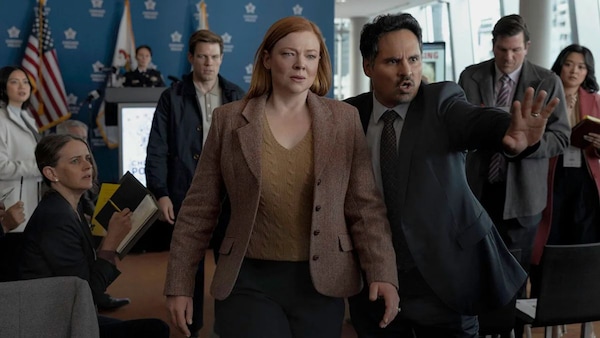
Jenny and Melissa, together, are a force to be reckoned with in All Her Fault. You would expect them to war with one another, given that Jenny’s nanny carries out the abduction, but it brings them closer together, and their bond gives way to a larger take on the beautiful terrain of female camaraderie. All Her Fault really takes the adage “sisters before misters” seriously. It also helps that none of the women in the series are sexualised. There are a lot of turtlenecks, wine glasses devoured in pyjamas, and male characters written with wit and empathy. Special shoutout to Michael Pena’s character, Detective Alcaras, who shows a sensitivity to the women in an endearing way. An emotionally intelligent police officer? Thank the female gaze. It is the same gaze that makes us wonder what is wrong with Peter (the intuition comes fairly early on), that makes us understand the complex nature of the friendship between Jenny and Melissa, and also underlines the subtle digs at a society that villainises women for the smallest of missteps.
All Her Fault is the kind of limited series that leaves you with more questions than when you first entered its world. It’s not like the series lacks closure; in fact, the final frame — Jenny and Melissa watching over their kids with wine in their hands — will definitely make you smile. Here’s a show that throws you twists by the dozen, many jaw-dropping moments through its eight episodes, but nuggets of the show will stay with you way beyond your initial binge-watch. In a world of second-hand viewing and content fatigue, this is the kind of mainstream fare we all deserve.