


Bad Girl: A Magnificent Film That Articulates What We Really Want From Tamil Cinema
Bad Girl is about engaging with the very real experiences of a young woman without slipping into a territory where pity and regret unite for a chokehold. Aditya Shrikrishna reviews.

Last Updated: 07.23 PM, Sep 07, 2025
IN VARSHA BHARATH’S BAD GIRL, the eponymous protagonist keeps returning to one question that hovers over her life like a single dark cloud obscuring the galaxy of stars beyond. “Naa yen ipdi irukken?” (Why am I like this?) The girl is Ramya, a name that is so commonplace in South India that it could be its own Jane Doe for half a country. For a whole generation that grew up between the 1980s and the first decade of the 21st century, the name bears no real characteristic. In a certain class of society, it is as regular as music class after school or the insistence to speak in textbook perfect English outside of the classroom.
Bad Girl begins around the mid-2000s — a generation that was sneaking mobile phones into school and beta tested Orkut before the exodus to Facebook; so probably the last to stick to a name like Ramya. And yet, there are three Ramyas in the classroom. Bad Girl’s Ramya (Anjali Sivaraman), daughter of a teacher (Shanthipriya as Sundari) in the same school, is so feral that she strives to be the main character in her life, a life of banality according to her. The life of all Ramyas.
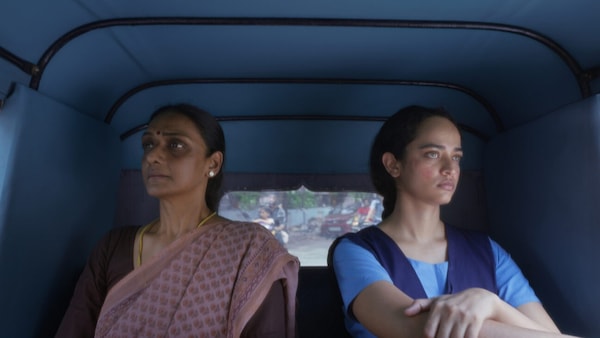
Bad Girl, written by Varsha and produced by Vetrimaaran, premiered earlier this year at the International Film Festival Rotterdam where it won the NETPAC award. After a few more festival stops, it is now in theatres. Ostensibly a coming-of-age tale, the film’s grammar doesn’t betray its festival pedigree. Its registers are very much in the mainstream even if the subject, the protagonist and the treatment, not to mention female crew (Preetha Jayaraman shares cinematography credits with Jagadeesh Ravi and Prince Anderson with editing by Radha Sridhar and costumes by Shruthi Manjari), are Tamil cinema novelty.
It separates Ramya’s story into three distinct timelines: one during her teenage years in school, the second during college, and the third in her early 30s. Belonging to an upper caste, decently well-to-do home, Ramya’s struggles are not with the world but with either herself or with her family and the shackles they bestow on her. The film’s virtues — and Varsha’s as a filmmaker by extension — lie in how it never invalidates Ramya’s inner battles and doesn’t make excuses for her admittedly aggravating self-absorption. Bad Girl is about engaging with the very real experiences of a young woman without slipping into a territory where pity and regret unite for a chokehold.
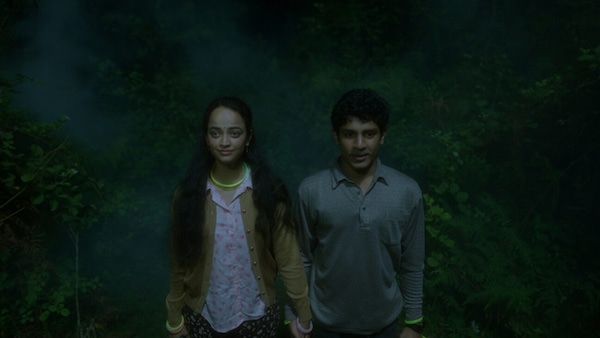
The first third of the film focuses on Ramya’s home and school; her independent days are far away, and the orthodox household’s dogmatic beliefs hold her back even as Ramya’s delirious energy chases after the new cute kid (Hridhu Haroon as Nalan) in class. These portions hold a pyretic charm for halcyon schooldays, when one chat message or a smile could topple hours’ worth of suffering at the hands of parents and teachers. Desires erupt and find expression in Ramya as flippantly (superimposing face on the ceiling fan is somehow both inspired and obvious) as returning from school and flipping through channels to find Devan Ekambaram and Sriya Reddy in SS Music.
Ramya lives in her head and her heart, and the film too mirrors that whiplash into its form; its diegetic and non-diegetic sounds collide into disturbance as if shaking Ramya out of her stupor. Much like in the song Ramya is listening to — “Unnoda Vazhatha” from Amarkalam — in which Shalini’s Mohana imagines household purgatory as a freer society in her head. The film cleverly marries Ramya’s two eternal foes — mother and the educational institution, the former an employee of the latter.
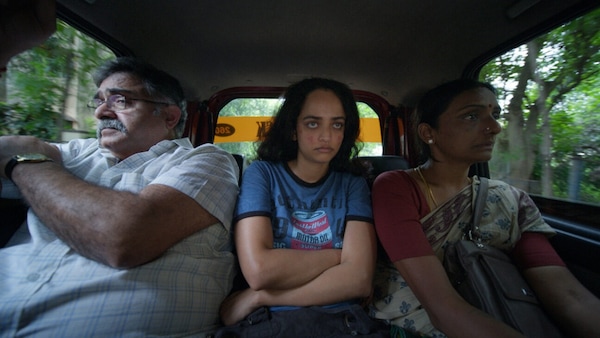
There are plenty of smart formal touches here. The three ages of Ramya receive three different looks. The teenage years get a sun-kissed brightness that both feeds and stings. The college years of impetuous decisions leading to predictable heartbreaks have a more bluish tinge. Ramya’s blue tops mingle with the gloomy indigo of airports, fervent greens of her hostel walls and the dreamy neon blues of pubs. They don’t suggest darkness but only a light that’s more artificial than the sun during more innocent times. As the film cuts to its third act of Ramya in her 30s, Varsha situates her protagonist in more claustrophobic spaces after hours. A closeup within the confines of an auto rickshaw or a car, couple of tiny kitchens or a grocery store aisle.
The film reserves the meet-cute for Nalan and then abandons them altogether; we meet Ramya either in the middle of a relationship or at its end, like with Irfan (Teejay Arunasalam) in her adult life. Varsha is not interested in meet-cutes; she is more curious about the aftermath. Life’s little decisions, crucial cusps and culminations have a more profound and portentous effect than the beginnings. This also gives the film an elliptical structure, a rarity in Tamil mainstream cinema, that makes the film dynamic but Ramya’s life dispiriting, which it can be at times.
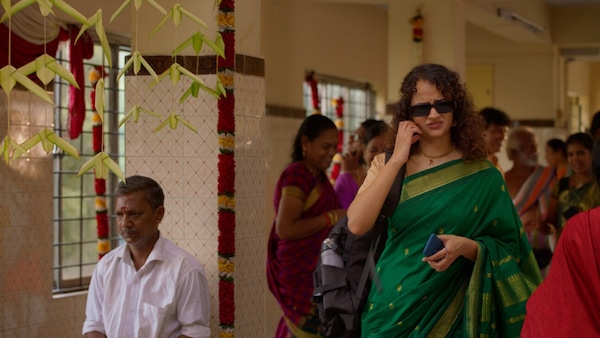
Generational trauma is at the center of Bad Girl. The adult Ramya reconciles with her choices as well as her relationship with her mother as a consequence of the actions of the women in the family that came before her. Patriarchy forces its will upon them in every way with each woman kicking the stone further down the road than one before. There’s a nice touch during Sundari’s retirement felicitation in the end when she’s called to the podium and her husband sitting next to her informs her that she is summoned and she can go. As if she cannot hear for herself! The exchange lasts hardly three seconds, but conveys a lot.
Bad Girl is littered with tiny moments like this that make the film richer. Its use of Amit Trivedi’s raging but melancholic score is wonderful. The needle drop of a rock ballad like “Kalli Kaatil” — that talks about reckoning with life’s many pitfalls — coincides with Ramya’s forceful contact with the ground for a full-bodied penance that her mother pledges for her at the temple. Varsha Bharath films the altercations between Ramya and Sundari with a certain grace; they are not scenes that bring the house down in embarrassing ways for onlookers, the effect is more internal. An implosion that arises out of their lack of vocabulary to communicate with each other, a situation that comes full circle beautifully at the end of the film.
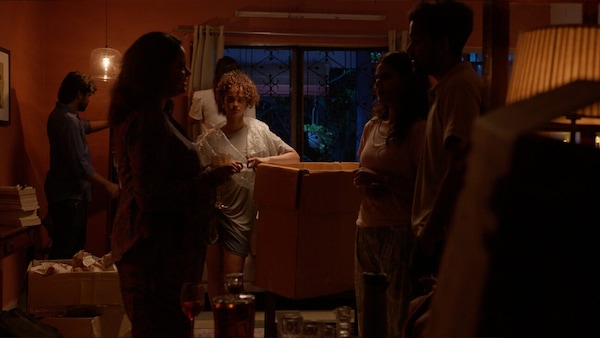
Anjali Sivaraman aces a challenging character, a role which is difficult with its thankless trajectories combined with the requirement to convey a cunning lack of self-awareness. The film holds her in closeup in all its myriad definitions and Anjali always matches it. The film possesses many tiny performances but one of the most dignified portrayals is Saranya Ravichandran’s Selvi. She plays the quintessential best friend who firewalks with Ramya, a demanding and irritable person to be friends with. There’s a single shot of her exchanging looks with a tea stall owner over something that Ramya says, a look whose meaning we understand much later.
Selvi is also interesting because being friends with Ramya surely takes something away from her, it is its own labour. Her college experience would be vastly different to Ramya’s. Just like how Bad Girl makes the many Ramyas of the world feel seen, one would hope that Tamil cinema also comes up with films and filmmakers that tell the parallel stories of many Selvis. It’s also why Bad Girl and Varsha Bharath deserve our applause. Ramya finally figures out what she wants from life. And a magnificent film like Bad Girl lets us articulate what we really want from Tamil cinema.