


Frankenstein: Guillermo del Toro Trades Godliness For Cleanliness
Guillermo del Toro’s geeky love for the wildness and wilderness of storytelling is not as unkempt anymore. There’s a sense of studio-ness about the ingenuity in Frankenstein that’s hard to shake off.
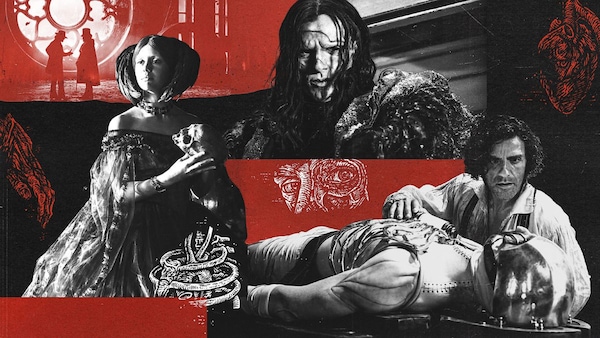
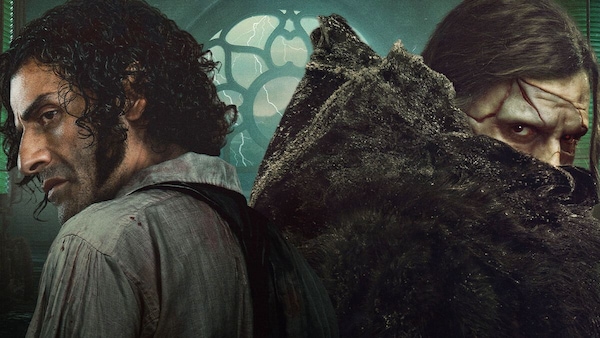
Promo poster for Frankenstein | Netflix
Last Updated: 06.28 PM, Nov 08, 2025
AT ITS BEST, a Guillermo del Toro fantasy is a Tim Burton fable without kooky muscle relaxants. There were times in del Toro’s latest, Frankenstein, when I was reminded of Burton’s greatest, Edward Scissorhands. The first five minutes of that film — where an ‘unfinished’ pale-faced humanoid is lost and lonely after his eccentric old inventor dies — distilled the essence of Mary Shelley’s Frankenstein novel into a gothic satire on suburban America. There were times in del Toro’s film when I was reminded of his own deliciously twisted and darkly romantic Crimson Peak, a nightmarish fairytale that not enough people speak of. There were times I was reminded of Poor Things. There were times I was reminded of Nosferatu, The Shape of Water and King Kong, even. Basically, Frankenstein is reminiscent of every Frankenstein-coded fiction except itself.
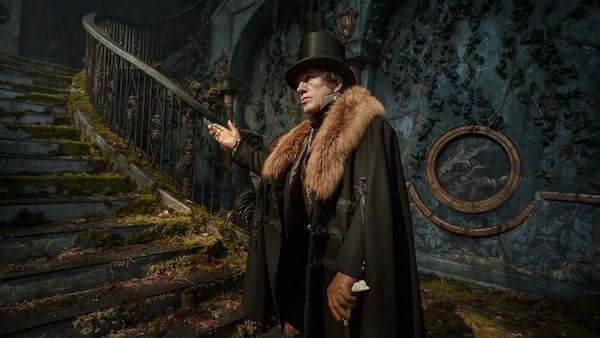
It isn’t the first time del Toro’s made a movie so clinically dreamy that it’s consumed by its own reflection. There’s a lyrical hollowness about it that makes the adaptation look like a digital projection of a heartbeat. It’s hard to imagine how the director doesn’t imagine hard enough. The film is almost dull in its pursuit of staying wide-eyed and faithful — it’s a cinephile’s showy tribute rather than a creator’s risky concoction. It stars Oscar Isaac as Victor Frankenstein, the narcissistic and arrogant surgeon who becomes a ‘monster’ of his own father’s making. After his beloved and not-at-all-oedipal-tension-infused mother dies while giving birth to his younger brother, Victor resents his cold doctor-father for not saving her and, as a reaction, decides to drag science into the realms of divinity himself. He is rejected from medical school after reanimating a corpse and defying the biblical certainty of death. Once a wealthy arms dealer named Harlander (a predictable Christoph Waltz) funds his mad-scientist mission, Victor’s gory quest is peppered with an infatuation — he falls for his brother William’s fiancée, Elizabeth (Mia Goth), a spitting image of their late mother. Yet, despite his entitlement, he succeeds — except the strangely dashing Creature soon attracts the attention of Elizabeth, posing a threat to Victor’s masculinity and mayhem.
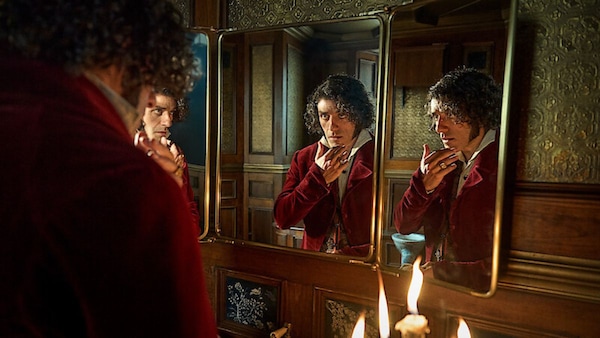
The film stars Jacob Elordi as a Creature going through an identity crisis after it — or he — learns the ability to think and feel. The evolving monster hunts for the maker who abandoned him, in search of answers and possibly a companion who can rescue him from an eternity of loneliness. On his journey, he accumulates the empathy of being human despite embodying death itself. It’s a bit like watching a coming-of-age story about a misfit desperate to know his place in the world. And the only person who can provide those answers is the one who disposed of him.
Much of the subtext stems from the book itself — where the God-complex-crazed surgeon slowly mutates into the very father he detested; where the Creature chooses to be an individual rather than a consequence of a broken family; where generational trauma is a flesh-and-blood metaphor that cannot be undone; where discovery is often used as the license for abuse. The film’s theatrical garnish is interesting — especially the narrative of two perspectives, where Victor recalls his version of the story to a Danish explorer who rescues him from death in the Arctic, and where the Creature then recalls his version to the man who curses him with life. It’s a lot of talking and introspecting, and wondering.
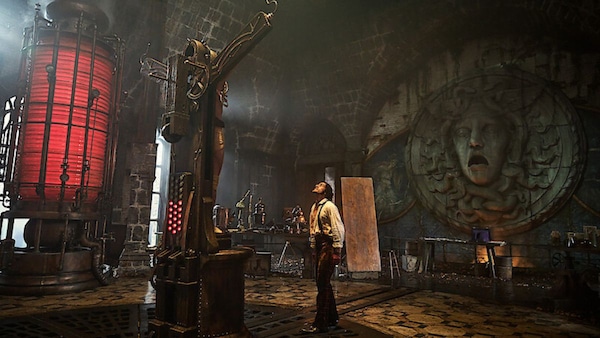
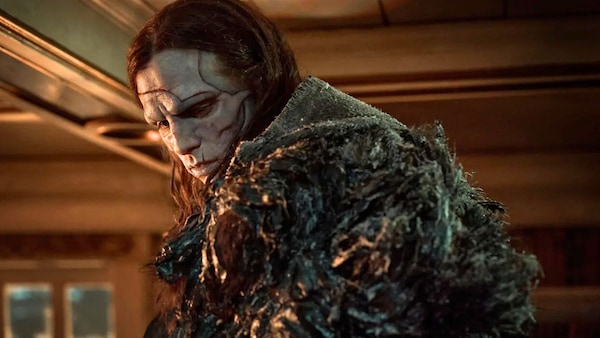
But the film meanders in its non-linearity instead of committing to the design of two intersecting movies. At times, you’re not sure which timeline they’re in (particularly because the hunter and the hunted keep exchanging roles). Who is chasing whom and when? Are there flashbacks within flashbacks? The emotional continuity of the characters is difficult to read. It’s also hard to look past the curated spectacle of it all; laboratory and castles and poetic words and Miltonian angst sacrifice the gravity of reinvention for the safety of restoration. In theory, there should be nobody better than del Toro to interpret the literature. Which is why so much of the movie feels theoretical and overwhelmed by its own desire to unlock the childishness within an adult tale. Making the Creature death-proof and fearful of immortality is one thing, but making him bullet-proof and invincible is a superhero-sized misstep. There’s also the problem of knowing how Elordi looks and therefore seeing the monster through a spoofy-handsome-beast lens. It’s a bit of an in-joke, and one that falls on the deaf ears of Isaac’s derivative depiction of Victor Frankenstein. Mia Goth is too deliberately enigmatic to merit deeper engagement, and too much of the story’s symbolism is spelt out in long-winding dialogue between master, muse and monster.
Perhaps del Toro’s geeky love for the wildness and wilderness of storytelling is not as unkempt anymore. There’s a sense of studio-ness about the ingenuity in Frankenstein that’s hard to shake off. The skylines and the sunsets and the blood and violence — the artifice is no longer a comment on our visual perception of fairytales. I miss the days when he threw paint on the walls and made something out of what didn’t stick. I miss the days he tempered logic with the freedom of not having to follow any rules. The irony is that if this film were a person, it’d be a patched-up Creature shackled by the measured projections and provocations of its maker.
Frankenstein is currently streaming on Netflix.