


Gustaakh Ishq & Single Salma Bring Civility Back On Screen
These films revive a forgotten grammar of politeness, where language, restraint and consent quietly stand against the coarseness of the present.

Last Updated: 08.13 PM, Dec 16, 2025
VIBHU PURI'S Gustaakh Ishq has a timeline, but it is impossible to discern. The dreamy aesthetics, complete with translucent curtains, blinkered pining, resistive romance and a swooning reunion signal a timelessness that betrays the straightforward 1998 setting. The old-world quality to the narrative only suits the simmering love story at the centre. A wayward man, Nawabuddin Saifuddin Rahman (Vijay Varma), meets a resolved woman, Minni (Fatima Sana Shaikh) and loses his heart sooner than he expects. Vishal Bhardwaj’s music, coupled with Gulzar’s words, scores their stolen glances as Gustaakh Ishq brings to mind an era where love was pursued and consent offered.
The extent of softness suffused in every frame makes it anachronistic in the hyperaggressive time we have come to inhabit. But there is something else that makes Gustaakh Ishq rare, antique almost — its insistence on manners. In Puri’s film, mischief is bearable, but misconduct is not. Characters refer to each other with a bashful “aap”, fingers graze but do not intertwine, and gaze throb with longing. The insistence on manners is so intense that a man is reprimanded when he mentions himself as “apun”. In the peace-building of this world, politeness is sacrosanct, even when it comes to oneself.
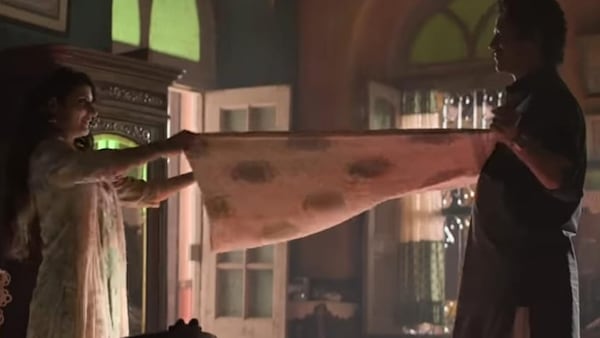
Take, for instance, the central pursuit of Gustaakh Ishq. Nawabuddin is a man who lives in Daryaganj, and all that he has received as inheritance from his father is a printing press. Like a derelict media house that refused to resort to suggestive blind items and thereby risked irrelevance, Nawabuddin resists selling out. Cheap literature is easy to stomach, but he waits it out till he hears about a poet, Aziz Baig (Naseeruddin Shah), his father’s old friend, who famously never printed his work. Reading some of Aziz’s old couplets convinces him that the only way to save the press is by printing Aziz’s poems as his younger brother breathes down his neck to take the easier way out. Nawabuddin arrives in Maler Kotla, Punjab, to convince the recluse but introduces himself as a disciple.
This teacher-student framework is designed as a conceit, but it becomes the central focus of the film. Not least because both actors are tremendous, and Shah towers over all in a way only he can. In the last couple of years, the actor, 75, has infused his performances with a strain of mortality that, once noticed, is impossible to unsee. He keeps playing an old man but also plays them differently, like age is both the device he uses to sharpen his craftsmanship and an accomplice that aids his process.
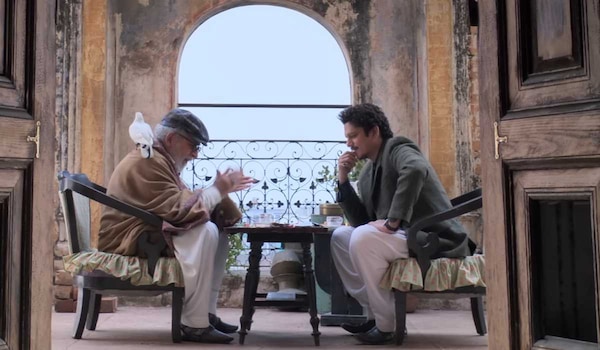
In this film, however, his portrayal feels like a preservation. He is a poet whose artistry drew crowds in his youth and also gave him the leeway to hurt the one person he loved. Once he lost her, he was so broken that he shut his door to the whole world. He lives with his daughter, Minni and a cat, till Nawabuddin wins him over. The latter pretends to hone his skills, and Aziz freely humours and scolds him.
Their relationship is instrumental to the narrative, but it also does something else: it injects the screen with a civility that has long since disappeared. They argue and learn, self-efface and assert, but all the while, Aziz retains an infectious decorum in his conduct that bleeds into Nawabuddin and proves to be the point of the film. Much later, when he and his younger brother have an altercation, it is a casually thrown, irreverent word that wounds Nawabuddin the most. “Is this how you talk to your brother?” appears to be the grouse.

The spirit of conservation in Puri’s film is only amplified by the language the characters use to communicate. Both Aziz and Nawabuddin duel in Urdu, a language that is being rapidly erased from the modern lexicon. It is also so inherently courteous that even affronts feel like jabs inflicted by broken knives. The larger scholarly outline, where an older man patiently teaches someone younger to behave better through words, comes across as a topical intervention, given how public discourse is hastily losing all consideration of attention.

Another recent film that treats the language as a repository of etiquette is Single Salma. Nachiket Samant's recent work is a fairly straightforward rendition of the strife an unmarried woman in her 30s faces in society. Her colleagues reserve indirect digs, and men in the locality resort to annoyance. Her family, however, is dependent on her, and this sense of responsibility impedes her from giving marriage a chance.
Starring Huma Qureshi, Single Salma starts off with all the markers of a stereotypical depiction of a familiar story, only to upend most formulaic shorthands along the way. For instance, the film remains constantly attuned to the fact that even though it is about one woman, Salma, it upholds a larger gendered reality. As a result, it offers distant empathy to the female characters.

This extends to the community at the forefront. Salma and her family live in Lucknow. They speak and fight in chaste Urdu. Samant's film refuses to infect this detail with the inflaming subtext of the current times. They all have their problems, and while the film portrays that, it refuses to make them a problem itself.
In any other time, such details would be too commonplace to be explored separately. But we are not living in the past, and the present seems too tumultuous. Gentility today is a rare find and, suddenly, in the midst of weekly din, two Hindi films made a case for civility — one through its characters and one, for them.