


Huma Qureshi’s Bayaan Is A Frustrating Reiteration Of India's Godmen Culture
OTTplay's critic Ishita Sengupta reports from the Toronto International Film Festival (TIFF) 2025. Here: A review of Bayaan.
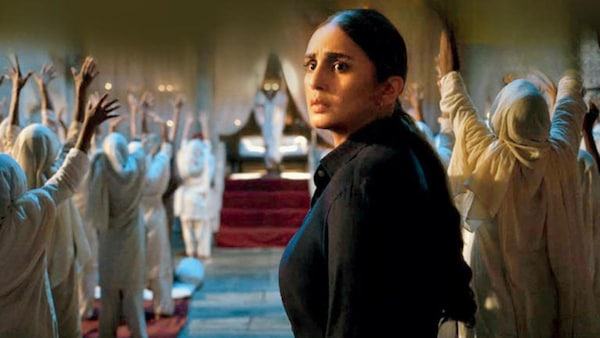
Still from Bayaan.
Last Updated: 08.38 PM, Sep 17, 2025
IN INDIA, the concept of godmen — spiritual leaders elevated to the status of demigod — has spawned a series of narratives. Fiction (Aashram ) and non-fiction (My Daughter Joined a Cult, Cult of Fear: Asaram Bapu, etc) alike have responded to the peculiarity of the culture. Bikas Ranjan Mishra’s new film, Bayaan, a loosely wound police procedural that premiered at the Toronto International Film Festival, is a frustrating reiteration of the template.
To be fair, Bayaan is largely effective and well-made with slight exceptions. The plot is rooted in Rajasthan, where a godman, ‘Maharaj’ (Chandrachur Singh), runs an ashram full of young girls. When one of them tips off about his sexual abuse, a Delhi-based police officer, Roohi (Huma Qureshi), is assigned to the case. She might be a novice, but she knows the way. Her father (Sachin Khedekar) has been in the profession for a long time and is celebrated by peers. Mishra’s film outlines the way in which an anonymous tip opens a can of worms for the godman, only for Roohi to realise that she, a privileged urban woman, inhabits a world as compliant as that of the rural women.
If the premise reeks of familiarity (most stories about godmen tread a similar, if not the same path, with the change in names), then the filmmaker’s treatment makes Bayaan more trite. Granted, the style is slow burn, but Mishra’s film is clogged with typicality seen in several other films. As investigations continue, more layers of the rot unravel. One of Roohi’s own aides (a female officer) reveals herself to be a devotee who refuses to believe that the man who has done so much for women in her community could be a demon.
One of the few interesting strands in Bayaan, apart from the shifting attitude of a local officer towards Roohi, having possibly known her through her father, he initially infantilises her till he takes offence, is its attempt to contextualise abuse in such situations. It does so by acknowledging the lopsided power dynamics and keeping a keen eye on the wider picture. In a country where exploitation of women is rampant, any semblance of male protection deifies men and that unchecked power sanctions them to do anything.
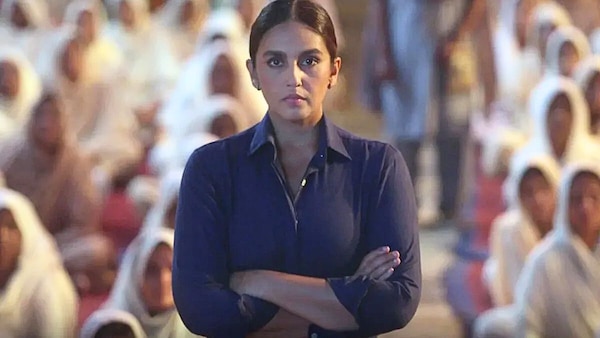
As the film unfolds, this uneven dependence opens up. Many women in the ashram are either from impoverished backgrounds or were saved by the godman. In both cases, the space not just seemed safe, but the man at the centre proved to be a saviour, thereby blurring the lines of transgression. Bayaan goes as far as underlining it, but does nothing beyond that.
This refusal to probe percolates in the way Mishra designs the female protagonist as well. On paper, there was tremendous potential in the idea of a rookie investigator entering a new world and getting subsumed by it. Bayaan, however, keeps Roohi at a distance. The possibility of her getting entrenched in the investigation is neither suggested nor accomplished — a shortcoming, really, because it undercuts the character and denies her a sense of self.
In the filmmaker’s hands, Roohi is reduced to a conduit whose existence merely highlights the difficulty the female devotees face in standing up to a godman. Her personhood is sacrificed at the altar of general dread. For instance, not once do we see where she lives or the ways in which she copes with the change in environment. More crucially, when the time arrives for her reckoning that even her privileged cocoon is as vulnerable to being punctured by powerful men, her realisation and resistance are portrayed as a short fit of tantrum. Mishra’s filmmaking (Udit Khurana is the cinematographer) is exceptionally ineffective in this case, as it is during a tense car-chasing sequence.



A lot of it also comes down to Qureshi’s monotonous rendering of Roohi. At the moment, the Hindi language streaming landscape is dotted with female police officers headlining shows (Shefali Shah in Delhi Crime is a chief example), and there is plenty to draw from. The actor, however, plays it puzzlingly straight, aligning her perpetual scowling to Sonakshi Sinha’s performance in Dahaad.
This is sad because, for the most part, Bayaan brims with possibilities. There is a constant hint of things falling into place, only for the film to culminate as a lost opportunity. Eventually, it makes little sense to craft a police procedural if the police, at the centre of the storm, is given the shorthand. For, however the case turns out to be, that is not the statement one would like to record.