


Literarily Speaking: 30 years of Maya Memsaab (1993)
Ketan Mehta’s adaptation of Madame Bovary gives Maya the fairy tale resolution she deserves
Last Updated: 07.54 PM, Jan 03, 2024
In our column, Literarily Speaking, we recommend specially curated book-to-film adaptations that will leave you spell-bound
In Gustave Flaubert’s 1857 French novel Madame Bovary, the widower Charles Bovary is a health officer who marries the much younger Emma Rouault. Emma is besotted with the idea of romance, mistaking it for love. As the marriage progresses, Emma and Charles have a daughter, Berthe. But Emma becomes listless. She finds her life with Charles dull, far removed from her fantasies of Paris, the opera, elegant dresses and grand declarations of love.
Emma is attracted to Léon Dupuis, a younger man unable to profess his feelings for her, who soon leaves the village. She then has an affair with the rakish Rodolphe Boulanger. Feeling increasingly stifled in her marriage, she beseeches Rodolphe to whisk her away to the dream life she has always sought, but he breaks up with her.
Emma bumps into young Leon once again, now more confident of himself, and she enters a relationship with him. Meanwhile, unbeknownst to Charles, Emma’s debts, incurred to fund the lifestyle she craves, have spiralled out of bounds. She ends up isolated in her plight, and the story ends tragically with her death by arsenic. Over time, Charles Bovary also dies, leaving their little girl orphaned.
Indian Adaptation
The loneliness of the housewife is a subject featured in many movies, with Satyajit Ray’s Charulata being the most prominent. But until Ketan Mehta’s Maya Memsaab (1993), none have been reimagined as a fairy tale for adults.
Two detectives (Shrivallabh Vyas and Satyadev Dubey) arrive at a hill station to investigate an inexplicable incident involving a woman called Maya (Deepa Sahi). As they speak to Maya’s husband, Dr. Charu Das (Farooq Sheikh), we notice some of the furniture in the house being carted away, along with pulp fiction novels.
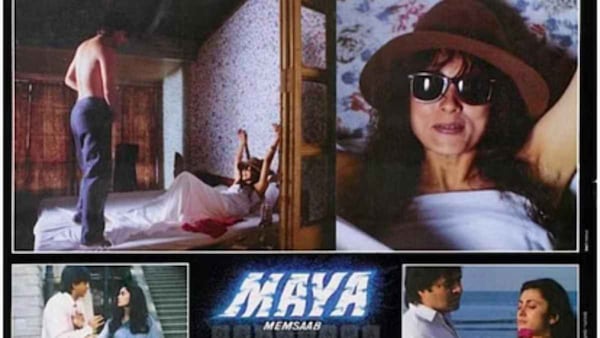
A young servant boy called Chintu steals Maya’s diary in which she alludes to herself as though she was a protagonist in a romantic story. In a movie with multiple unreliable narrators, Maya’s monologues from the diary become a stand-in for her point of view. However, there’s no telling how reliable her own version is.
On the investigator’s insistence, Dr. Charu recollects his first meeting with the whimsical Maya on a stormy night when he arrived at her old mansion to treat her father.
Maya’s father (Dr. Shreeram Lagoo) perhaps best describes the difficulty of finding a partner for Maya as she is “…educated, smart and beautiful...By the time her education is complete, she is no longer of marriageable age. Since she is intelligent, she is a freethinker. She is beautiful, so she dreams of a perfect partner.”
Charu visits Maya on some pretext or other, and becomes enamoured. In her diary, Maya casts Charu as her Prince Charming, given to grand romantic gestures. Charu wittily matches Maya for every whimsical thing she utters, endearing himself to her. One may even wonder if this was Maya’s fantasy, as Charu is a bumbling, tongue-tied older man. Charu barely proposes, but Maya sees the wedding as her happy ending, not realising that the marriage has only just begun.
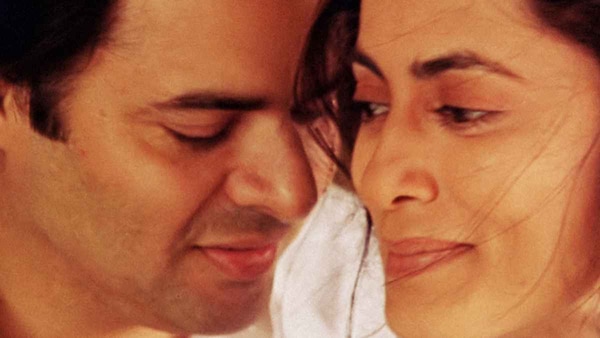
Maya sets about transforming Charu’s disappointingly functional middle-class house to an aesthetically perfect setting for their romantic story to unfold. While Charu goes to work, Maya gradually becomes emotionally needy and unpredictable. Inspired by the pulp novels she reads, she feigns death to test the extent of Charu’s grief. To her disappointment, he doesn’t exhibit the ardent gestures of the Prince Charming that she thought he was. In her diary entries, she is remorseful for having ’settled’ for Charu, dreading the rest of her life with him.
On failing to find a cure for the sadness that affects his usually spirited wife, the ignorant well-meaning Charu decides that a change of scene might help. They move to the house in the hill station where the incident later occurs.
Outside Charu’s house, the investigators meet Lalaji (Paresh Rawal), a trader who claims to have given Maya credit to buy expensive clothes, perfumes, furniture and all manner of things, which he is now reclaiming.
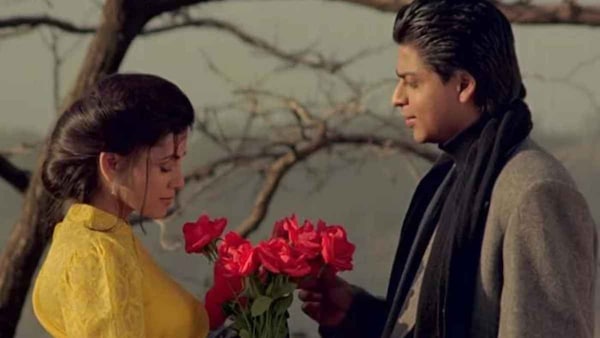
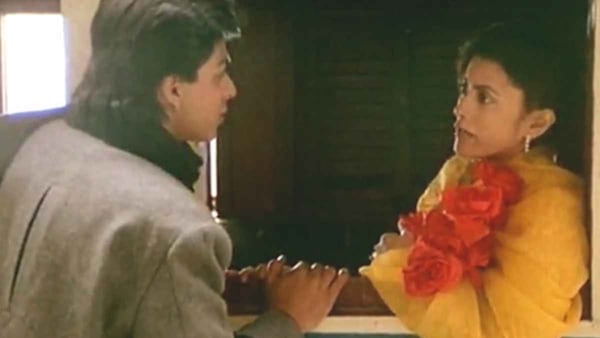
To the investigators, Lalit (Shah Rukh Khan) feigns not knowing Maya personally, but Maya’s diary says otherwise. In a scene reminiscent of the fairytale princess who never smiled, the despondent Maya gazes outside her window overlooking the village square. On seeing Lalit trip and fall, she bursts out laughing. When Maya faints at the chemist’s shop, it is Lalit who holds her, while Charu bustles about gathering their fallen shopping items.
Maya is charmed by Lalit’s rhyming, reminiscent of the time Charu and she bandied rhymes at each other. She fantasises that Lalit is her crazed lover who would endanger himself to woo her, but in reality, he is only a silent admirer. Before long, it is time for Lalit to leave. Meanwhile, Maya gets lured into buying expensive things from Lalaji on credit to fill the gaping emotional hole inside her.
The investigators now arrive at the mansion of Thakur Rudra Pratap Singh (Raj Babbar) who recalls meeting Maya when he was brought seriously wounded to Dr. Charu’s home. Maya and Rudra feel an instant attraction to each other, and Maya’s monologues resume, as do her fantasies of Rudra as the suave Prince Charming. As she embarks on an affair with him, Maya believes that the only person who can rescue her from her stifling marriage is Rudra. But he is particular about keeping their affair a secret.
The investigators meet Lalit again and accuse him of lying about not meeting Maya after leaving the hill station. Lalit reveals that when he bumped into her in the nearby big town, she coerced him into an affair. According to Maya's diary, however, it is Lalit who expresses his ardour for her. She is impressed by the now-confident Lalit, who works in a bank. Soon, Maya sneaks away often to the nearby town for her rendezvous with him. Lalit becomes the passionate lover she has always craved, but after a point, she begins to find him juvenile.
Lalaji is not quite the enabler of Maya’s fairy tale, but a shrewd businessman who puts her house up for auction to collect his debts. Maya is desperate that the unsuspecting Charu and their daughter should not be affected. But Lalaji is insolent, blackmailing her with proof of her infidelity.
We realise that the people she loved, Lalit and Rudra, for whom she would have moved heaven and earth, have been projecting their own gallant and prosperous fantasy selves in response to her fantasy self, as they took their pleasure with her. In the end, they fail to help her.
While Madame Bovary is a cautionary tale and Emma is punished with death by the narrative, Maya’s larger-than-life-persona gets a resolution that befits her, and has the investigators foxed.
Legacy, symbolism and characterisation
Maya Memsaab is an ingenious adaptation of Madame Bovary set in small-town India in the form of a fairy tale. Sadly, it is today regarded as a B-grade movie that features Shah Rukh Khan’s love making scenes early in his career.
Every fairy tale has some common elements. There is a hero, a villain, and allies. The story may include people, objects or events in threes. There is an insurmountable challenge to resolve. And there is magic.
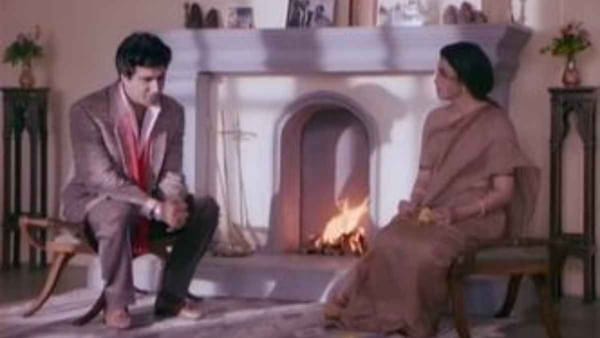
Mehta, along with Gujarati poet and playwright Sitanshu Yashaschandra, Hriday Lani, Gulan Kriplani and Hrishikesh, firmly places at the heart of the story, Maya’s quest for a happily-ever-after. Good and evil in Maya Memsaab are not clearly defined, as interestingly, Maya is both the hero and the villain, and regards some men in her life as her allies and others, her swashbuckling rescuers. There is even an element of magic that leads to the resolution!
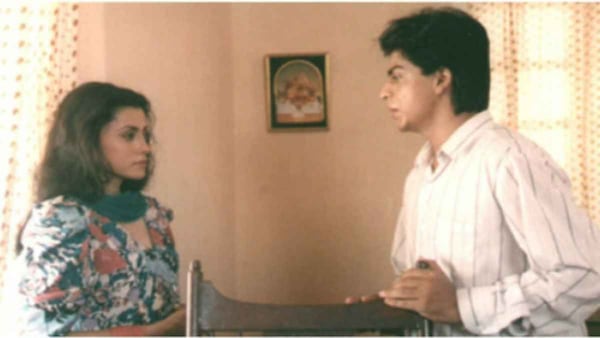
The movie is replete with details that foreshadow the fate of Maya's marriage. For instance, at the wedding ceremony, the knot between Maya’s saree and Charu’s dupatta unravels, and Maya’s father cautions them about it.
Maya’s sartorial choices evolve – she is dressed in simpler clothes initially and becomes increasingly dramatic in her choices as her affairs progress and she begins to live what she believes is her fairy tale.
The songs, written by Gulzar and composed by Hridaynath Mangeshkar maintain focus on Maya as the protagonist in her fairy tale. In the time before she meets Charu, Maya is seen serenading her reflection in a mirror to ‘Khud se baatein’. Each of the three men she loves is a different facet to her perfect Prince Charming, and different stanzas of the song, Ek haseen nigah ka feature Maya serenaded at different points in time by Charu, Rudra and Lalit. But in the end, what stays with you is Raghubir Yadav’s haunting refrain of Sonchidiya, a song about an illusory golden bird that everyone foolishly seeks to cage.
You can watch Maya Memsaab here.
(Views expressed in this piece are those of the author, and do not necessarily represent those of OTTplay)
(Written by Saritha Rao Rayachoti)