


Mayilaa: Semmalar Annam's Debut Feature Intertwines Work, Faith & Fury
Premiering at IFFR 2026, Mayilaa blends humour, ritual and neo-realist detail into a sharp portrait of a mother and daughter navigating loss, labour and dignity.
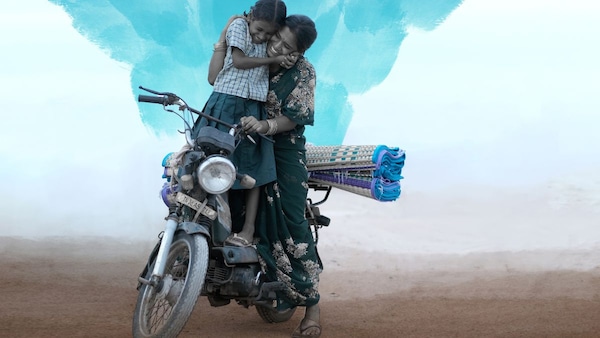
Promo poster for Mayilaa.
Last Updated: 06.30 PM, Feb 01, 2026
IF YOU POSSESS above average knowledge of contemporary Tamil cinema, Semmalar Annam might be familiar. Maybe you cannot place the name, but you will recall the face, a face unfortunately stereotyped by Tamil filmmakers. She is an actor with such ferocious presence that if you give her half a decent role, she will single-handedly lift a film. Films like Leena Manimekalai’s Maadathy and Jaikumar Sedhuraman’s Sennai are a testament to this talent, but my favourite Semmalar performance came in a short film, Arikarasudhan’s Ullangai Nellikkani, an adaptation of Gabriel Garcia Marquez’s The Woman Who Came at Six o'clock. She has also directed short films, and now her debut directorial feature, Mayilaa, premieres at the International Film Festival Rotterdam this week in the Bright Future section. The 97-minute feature, produced by Newton Cinema and presented by Pa. Ranjith, is quite indicative of the promises in this section full of debutantes.
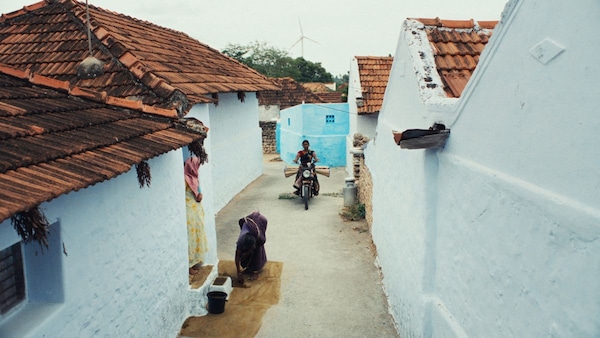
Written by Semmalar Annam and shot by Vinoth Janakiraman (editing by Sreekar Prasad), Mayilaa progresses like a part-humorous, part-dramatic parable, one where past trauma manifests as spiritual possessions and even anger and outrage filter through trance. We meet Mayilaa (Melodi Dorcas) and her daughter Sudar (Shudarkodi Vinesh) as they attend a ritual at dawn. The goddess of worship is our protagonist’s namesake, possibly named because of her penchant to dive into a trance at the drop of a single religious ululation. The womenfolk try to calm Mayilaa while the kids discuss ghost stories and how their mothers’ trance scares them, one of them noting that when it comes to terror, her father trumps all. Mayilaa’s savings are wiped out by her wastrel husband (Semmalar restricts us from witnessing his full physical form; he exists in tiny specks of movements), and the land where she works as a labourer picking metal waste is sold off, leaving her in search of a new livelihood. That’s when her entrepreneurial spirit sparks, and she decides to sell straw mats. Amidst all this, Sudar is constipated.
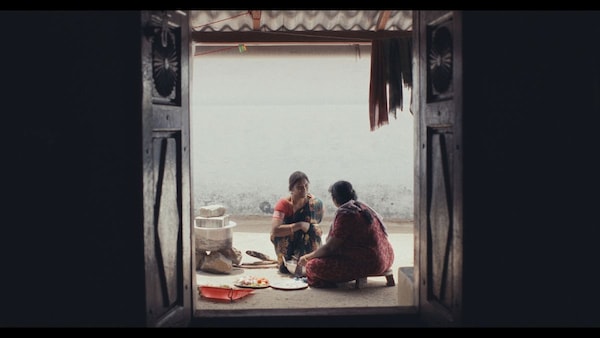
Semmalar fills her frames with women, all of them working class and all of them in their elements when together. Even the little shrine has a priestess performing the sacred duties, no man in sight. We meet a truckload of women singing in jubilation as they travel to work, only to practise dead silence when a man gets on. These are moments where Mayilaa gets a neo-realist treatment, the supporting arcs and stray characters enjoy a moment of their own, unburdened by the principal character’s predicaments. A group of women sing in unison or playfully at each other as they work the land; we only find out later that they are Mayilaa’s colleagues. As Mayilaa embarks on the road to sell mats, she meets another of her kind, a young woman selling books for children, and after a brief tussle in trying to attract customers, the two women bond over their shared struggles in the heat.
While the film is minimalist in its imagery, it is thoughtful and compact in making its point. The background in deep focus stands as a formidable challenge for the petite Mayilaa. We swirl around in full 360 degrees as she looks for potential customers with mats wrapped over her head. We learn about Mayilaa’s literacy over two brilliantly visualised scenes involving paper, pencil and a recipe. Even as class and caste divide simmer in the region, the film steers clear of drawing lines or antagonising its characters. It has its undivided attention on the mother and the daughter, and embraces their life, warts and all. It is razor sharp when searching for levity in the mundane, even when it focuses on the uglier aspects of Mayilaa’s present and past.
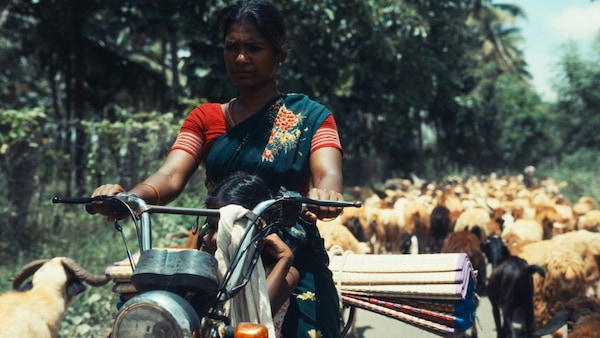
Mayilaa is littered with humour. Sudar’s scatological anxieties come and go, but the film looks for laughs even in other parts. An enthusiastic Mayilaa begins to ululate (this nervous energy comes of use as a loudspeaker advertisement later) in exclamation in front of the goddess and stops herself short, realising the fast-asleep Sudar next to her. The temple poosari herself splashes water on Mayilaa, tired of her persistent trance. In a deft bit of visual pun, the bookseller’s star product is a picture book titled “Potty Time with Elmo”. After yet another disappointing customer interaction, Sudar wonders why they are pushing the vehicle instead of driving it. Semmalar gracefully undercuts many such scenes with humour before they plunge into melodrama.
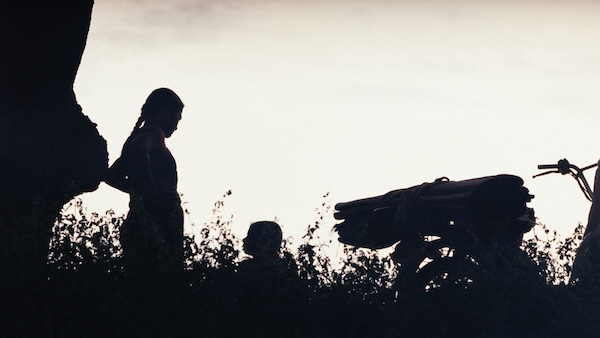
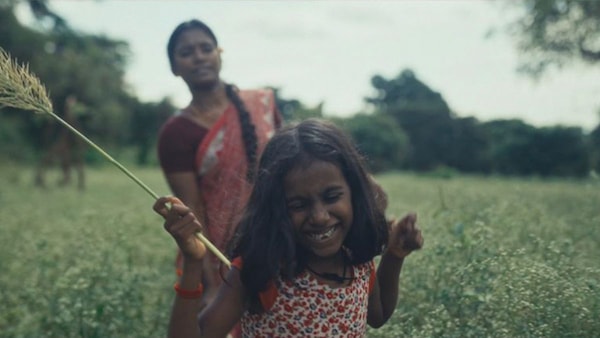
Dorcas offers a tightly controlled physical performance, all jittery rapture that captures the daily toil in her body. It mirrors the handheld nature of the scenes, restless shotmaking that documents the precarious everyday life of effectively a single mother and her daughter. The film briefly describes the legend surrounding the goddess Mayilaatha, one of betrayal and losing what is rightfully owed. Semmalar Annam crafts a neat little film that expands on this, a soft but determined fight for self-respect and economic independence.