


In The Nilgiris, Sandesh Kadur Finds A Wilderness Shared By All
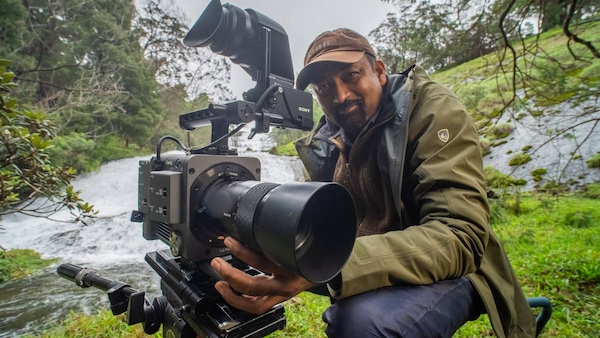
Subha J Rao speaks to Sandesh Kadur about how his documentary Nilgiris: A Shared Wilderness looks past the beauty of the hills to a landscape where humans and wildlife must learn to live side by side.
Last Updated: 05.04 PM, May 07, 2026
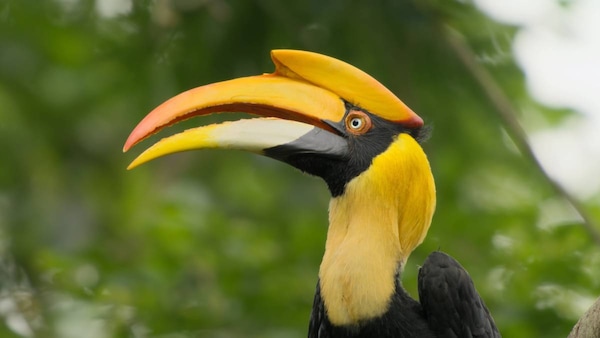
SANDESH KADUR’s documentary Nilgiris: A Shared Wilderness, begins where many other chronicles of the blue mountains don’t really tread — with the great hornbill, that magnificent bird that is a near-threatened species. It then goes beyond the picturesqueness of the hills to showcase the soul of this landscape — shared equally by human beings and wildlife. In doing so, Sandesh moves away from romanticising the beauty of the Nilgiris, and speaks of the everyday struggles, both for people and animals.
The 75-minute documentary premiered on National Geographic in the US and Africa as part of Earth Day celebrations in April. It is slated to premiere in India this June.
“The story of the Nilgiris is incredibly unique in the entire world, because of many things. It is India’s first biosphere reserve, a shared wilderness unlike any other. This biosphere does not alienate humans and wildlife. This is a place where they have no choice but to live together,” says Sandesh.
Much of India’s wildlife — tigers, asiatic elephants, asicatic lions, the one-horned rhino — thrive in protected national parks, wildlife sanctuaries and tiger reserves that make up less than five per cent of India’s landscape, despite the huge population pressure, and that is something unique to the country, says the filmmaker.
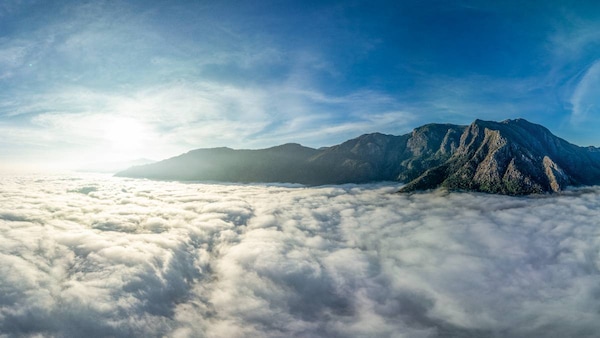
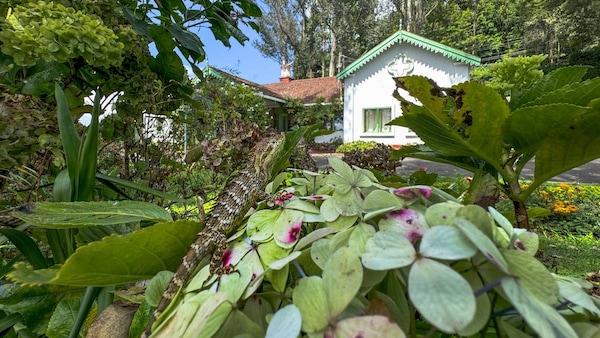
Incidentally, much of what was filmed in the documentary was outside the protected zone, near the backwaters, in the periphery of villages, in tea estates (a black panther family). “I can’t think of any place where something like this exists,” adds Sandesh.
Even five to six decades ago, it was not common to see the gaur or leopard in tea estates. There still existed a hard boundary between humans and wildlife. “Now, that boundary has blurred. The animals are back in big numbers and there is greater understanding. They have learnt to live with us, and we with them. You have to credit the animals for how well they have adapted, carving out niches within our spaces,” says Sandesh.
The human mentality is to take over all spaces, but we need to find ways to allow animals to occupy their niche. “The world would be a better place,” says the director. “And the Nilgiris is an example for the world on how this can happen.”
Sandesh’s childhood was filled with reading. His father was a professor at the University of Agricultural Sciences (UAS) in Bangalore. When he was 14 or 15 years old, in 1997, Sandesh was gifted a pair of binoculars and a bird book. “One very cold winter day, right on the tree canopy, I found quite a few species of flycatchers. I also spotted some Nilgiri laughing thrush, endemic to the Nilgiri plateau,” he says.
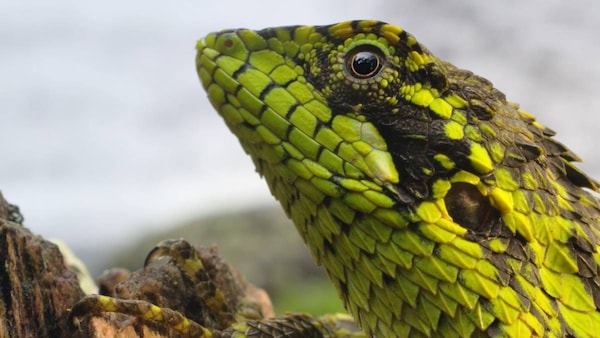
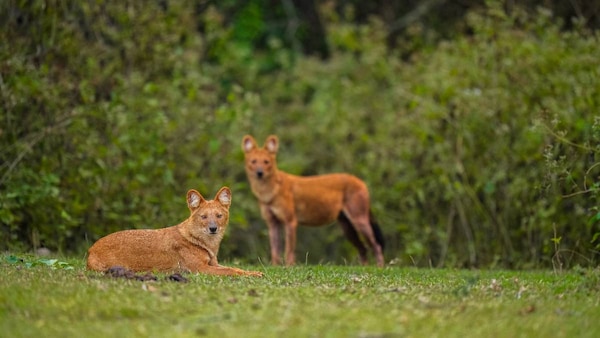
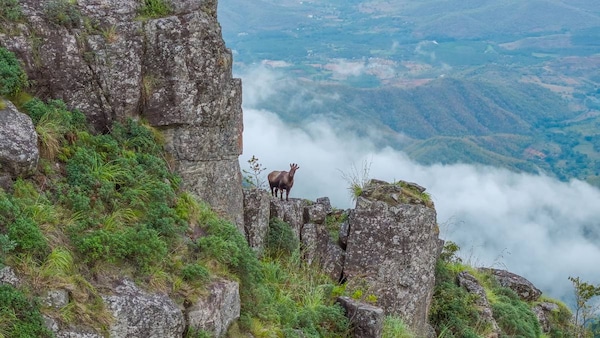
Sandesh explored wildlife across regions in India, and made the award-winning Sahyadris: Mountains Of The Monsoon. But, he kept circling back to the Nilgiris. “I’ve travelled across the Nilgiris many times, and am familiar with where the endemic birds are to be found. This is not a new landscape.” That shows in the documentary, which eschews familiar comforting spots and scenes and opts for things that the Nilgiris only reveals to those who visit her often. The team shot in places such as Avalanche and the Western Catchment, besides the grassy plateaus. They also caught the Dhole, an endangered species, in action, hunting a chital, raising its young in a den, and navigating human-filled landscapes. The stately Nilgiri Tahr makes its presence too.
The documentary offers viewers the comfort of distance as well as the intimacy that comes with capturing the essence of a way of life. “What we wanted to do was to try and immerse people into the landscape…visually draw them in. We wanted to bring in as little narrative as we could,” recalls Sandesh. Once that was done, they turned towards the script — it had to be written with humour, and be measured. “It had to start from the perspective of the vast mountain and come to the macro level — the scales of the lizard (Nilgiri Salea), the fact that not just roses have spines… We wanted to bring in the narrative, with visuals that match, and add information to the moment, but not superfluously.”
Usually documentaries choose a male voice for narration. In Nilgiris, you hear London-born, Australia-based singer Susheela Raman. “It was a well thought-out decision, because this is the Queen of Hills. Susheela is Tamil. She has a beautiful voice, pronounces Indian words correctly, her vocals in the background are haunting and melodic.”
The documentary came about due to the intervention of Rohini Nilekani Philanthropies. “We got talking and discovered there was nothing for kids to watch about the Nilgiris. I recalled making documentaries on the Sahyadri and King cobras, and wondered if we could make a 30-minute educational short documentary about the Nilgiris. Many have done short films about protected areas, but nothing about the imperfect wilderness we live in, and made it relatable to the people living there…”
The result is Nilgiris: A Shared Wilderness, a documentary that speaks of tenuous bonds, of co-existence and its shortcomings, but also of how human beings and animals have learnt to navigate a space they both have come to occupy at the same time.