


Nishaanchi: Anurag Kashyap Calling Anurag Kashyap
Nishaanchi is Kashyap’s flattest work till late. This is saying anything because even at his weakest, he has been at least provocative. He appears beaten here.
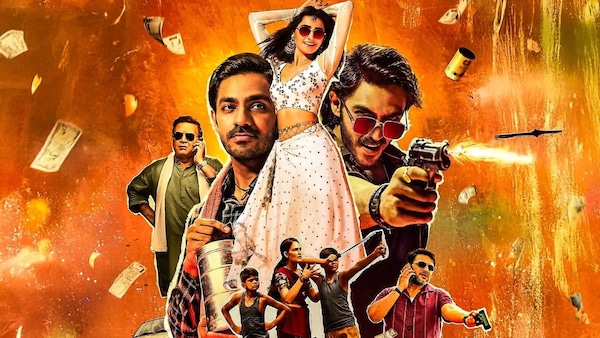
Promo poster for Nishaanchi.
Last Updated: 01.57 PM, Sep 20, 2025
IN ANURAG KASHYAP'S Nishaanchi, one of the lead characters derives his personality from the movies. Although named Babloo, he calls himself Tony Montana, the infamous mafia leader from Scarface (he even inflicts a scar on his face like the character from Brian De Palma’s 1983 film). When primed to kiss the girl he loves, he sticks his tongue out and borrows his action from Dharmesh Darshan’s Raja Hindustani (1996), where the leads passionately kissed under a tree. And when fighting for love, he likens his rebellion against a father-like figure to Mughal-E-Azam (1960). The film follows suit.
The filmmaker’s new work, closely following on the heels of Bandar, which premiered at the Toronto International Film Festival this month, pulsates with love for cinema. An entire song is stitched with the titles of Hindi films — ranging from Dostana to Baghban — but that is embellishment. The writerly bones, too, are drawn from celluloid archetypes. It is all too familiar: a widowed mother and her two sons fated to war against each other. Yash Chopra’s Deewaar (1975) is an obvious source, but Kashyap even draws on his own filmography.

Designed as a generational revenge drama and made in two parts, Nishaanchi is crafted in the same mould as Gangs of Wasseypur (2012), Kashyap’s culture-defining film whose fame persists through unending memes. But a little over a decade later, the cast is broken. He is no longer the same filmmaker; he is also a lesser filmmaker. As a result, his homages play out like empty reiterations, and his self-referencing is like a callback to a lost time.
The year is 2005, and Kanpur-based Babloo and Dabloo (debutant Aaishvary Thackeray, reminiscent of a young Ranveer Singh) are twins. They might look the same, but they are different people, and when a bank robbery goes wrong (conducted by them), the spirited Babloo is arrested. The diffident Dabloo finds his way home. Kashyap treats this as a scaffolding only for one flashback to follow another. Names casually thrown around (one of them is Ambika, a local thug, played by Kumud Mishra) find more footing as the past surfaces.
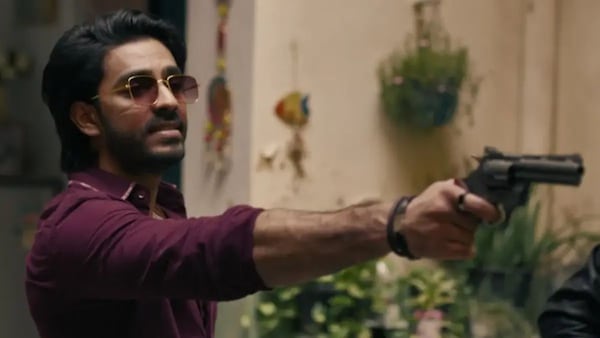
Amibika, it turns out, was a friend of their wrestler-father Jabardast (the ever-effective Vineet Kumar Singh). He was also smitten by their mother, Manjari (Monika Panwar). Back in 1996, Jabardast was imprisoned for killing a man, and Ambika wanted to take responsibility for the household. When rebuffed by Manjari, he took Babloo under his wing and trained him to kill his father’s killer, or so he proclaimed. This also led to the boy going to jail and forging a filial relationship with Ambika.

When released years later as an adult, Babloo becomes Ambika’s henchman. Money flows, but one incident changes things. He is sent to forcibly vacate a house, and the mercurial gangster kills the resident and falls in love with the daughter, Rinku (Vedika Pinto), in the same breath. He wooes her, and although he shares everything, Babloo skips one crucial detail: he killed her father. Standing on the other side is Dabloo, also smitten by Rinku.
It is not difficult to foresee where Nishaanchi will go here, and neither does the film seek to complicate it. Kashyap here is going back to the classics, and with that familiarity in place, he throws everything on the wall to add colour. This is where his own filmography comes to the fore, but while it is amusing in parts, it yields little.
Nishaanchi is Kashyap’s flattest work till late. This is saying anything because even at his weakest, he has been at least provocative. He appears beaten here, caught between the expectations of him and his projection of self, and this constant straddling results in a piece of work that has Kashyap imitating Kashyap.
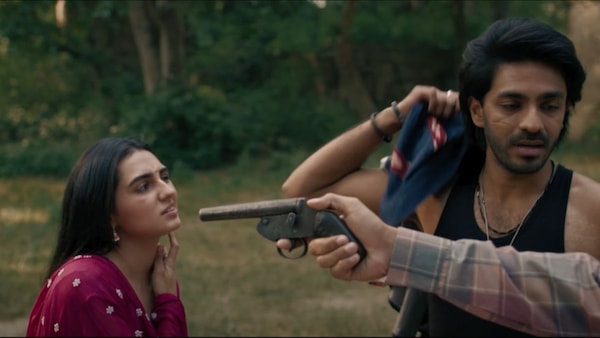
Flashbacks aside, the tone is painfully linear and gives Nishaanchi the cloak of a web show. This is easy to discern given how trained our eyes are to the long-form format, and for the most part, the film plays out in an invisible episodic outline. First episode - bank robbery; second episode - flashback, etc. The length (the runtime is 176 minutes) only compounds things.




For anybody else, a film like Nishaanchi would have marked the onset of fandom. The problem here is that Kashyap not just already enjoys that, but his style has influenced an entire strata of filmmakers. Therefore, what might be clutter-breaking for others comes across as serviceable for him. It is not bad, it is just not good enough.