


Saali Mohabbat: A Slow-Burn Revenge Tale That Lets Women Hold The Knife & The Gaze
In Saali Mohabbat, menace simmers, motives stay private, and women control the frame. Swetha Ramakrishnan reviews.

Last Updated: 08.05 PM, Dec 13, 2025
ON THE HEELS of a major hypermasculine and jingoistic patriotic blockbuster, a film like Saali Mohabbat feels like a breath of fresh air. Released on ZEE5 this week, this atmospheric mystery-drama has many admirable qualities. For one: the cast that feels like a warm hug. With Radhika Apte, Anurag Kashyap, Sharat Saxena, Divyendu, a director in Tisca Chopra and Manish Malhotra as producer, you’re convinced about the quality of the film.
The story and vibe of Saali Mohabbat is quite similar to a viral short film that Chopra starred in a few years ago, Chutney. A dinner party set-up, a small-town setting, atmospheric visuals, a story of a woman fighting (aka taking revenge) for survival, and most of all, the female gaze. Neither films spoonfeed the plot or the intent of its characters to the audience. We’re left to fill in the blanks ourselves, and it doesn’t get too complex because the overall arc is quite predictable. Best of both worlds, I’d say.


The story begins with Smita, a home-bound, introverted woman married to a gambling addict, Pankaj (Anshuman Pushkar). She’s a master of plants and botany; it’s her one big passion in life. Her husband is after her to sell a piece of land that she owns in Muradabad, so he can pay off his debts to a gangster-type honcho (Anurag Kashyap). She flatly denies, knowing fully well that it’s the only asset in her name. Things change when her cousin Shalini (Sauraseni Maitra) comes to live with them, and starts an illicit relationship with the husband. On sensing her life is in danger, Smita concocts a revengeful plan so she can keep her house and get rid of her husband and cousin.
A second and very prominent admiral quality of Saali Mohabbat is its female gaze. In one particularly thought-provoking scene, Smita and Pankaj are in bed, getting intimate, and he’s struggling to reach climax. He looks at a bottle of lotion on the bed stand, with a woman’s picture on it, and finally gets there. Most films end this type of scene here, showing maybe a neglectful face of the wife before cutting. Saali Mohabbat takes this scene further. Not only does Smita go to the washroom to finish herself off (shot very aesthetically and not vulgar at all), it also gives us a deeper understanding of her character. She may be homebound and introverted, but she gets what she wants: quietly and intently.
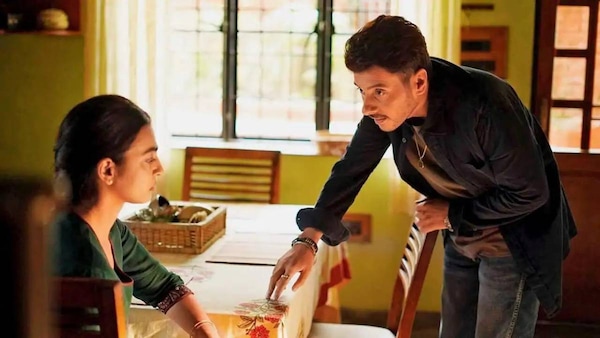

In the scenes where we learn about Shalini’s affair with Smita’s husband, we also see her leading on a corrupt cop, Ratan Pandit (Divyendu). When all these secrets start tumbling out, there’s never any judgment on Shalini for why she’s with two men simultaneously. We see this whole arc playing out from Smita’s perspective. Betrayal is given more importance, rather than slut-shaming. Autonomy of the female characters is an understated theme that is woven into the narrative of Saali Mohabbat.
There’s no big twist in the film, just a slow-burn of events unravelling at a comfortably organic pace. Chopra’s debut feature reminded me of a similar film, A Death In The Gunj, both of which are cerebral, thought-provoking and not interested in treating audiences like children. Radhika Apte plays well to her strengths, getting the accents and demeanour of her character right. She’s not playing a femme fatale; she’s a regular woman who will go to any lengths to protect her peace, and I found this implicit theme of Saali Mohabbat very delicious. It’s not a flawless film (also I don’t understand why the film was named such) but this is a promising direction for Malhotra’s Stage5 Productions.