


Stray: Here's Why The Film Adaptation Won’t Do Justice To The Hit Game
We're not feline it! The movie version of Annapurna Studios' game with its cat protagonist will lack a key element: you.
Last Updated: 01.38 PM, Nov 06, 2023
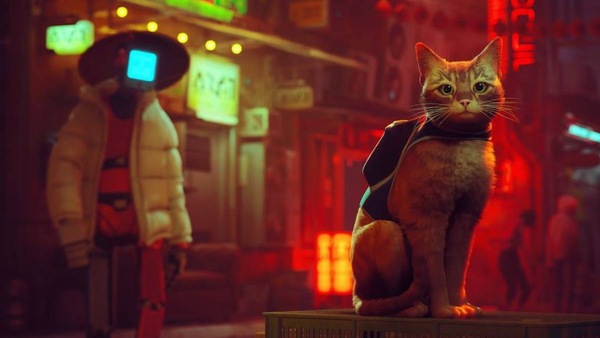
STRAY — the game — released on 19 July last year. Having tracked it since its first announcement trailer at the June 2020 PlayStation Showcase, you can be certain I set about playing it on Day 1. As I had observed for another publication at the time, the game was not particularly long (scaling around eight hours on a completionist run), was devoid of combat and dialogue, and was quite linear.
Why then did I describe it as ‘gaming nirvana’?
Further, why am I skeptical about its translation into the format of film?
And even further, why am I advertising this skepticism in the headline of this piece?
All of these, I assure you, will be answered in good time. Let’s first tackle the raison d’etre of this analysis. It was nearly two months ago that news began trickling in that the BlueTwelve Studio-developed and Annapurna Interactive-published Stray was set to be adapted as an animated feature film.
After the maelstrom of all manner of uwu-ing and other over-the-top reactions on social media began to settle, I revisited the game. Whether as a result of reminiscing about how much I enjoyed the ride the first time around or in order to try and figure out what the impending film might be like, I fired it up one more time. With the plot known, secrets discovered and most trophies unlocked, there was one clear mission for me: Did I miss anything?
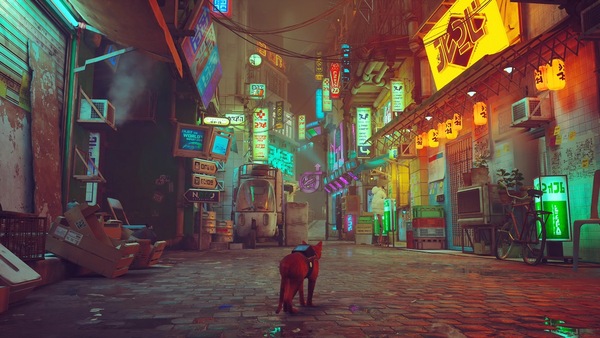
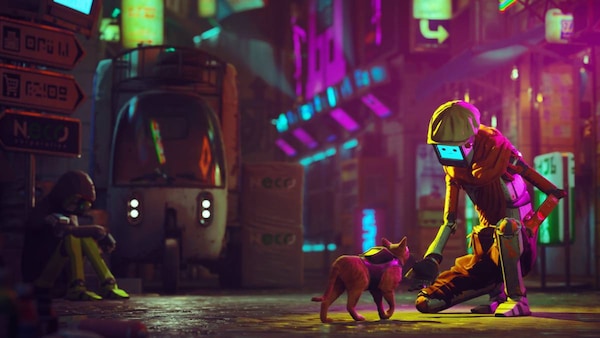
As I traversed the neon-lit alleyways, jumped in and out of the way of zurks — the game’s bug-like antagonists who swarm you like locusts — and explored every nook and cranny for what I might have missed, I was reminded of all the things that made Stray so unique.
Whether it was perspective of the game that forced you to view the world from just under a foot off the ground, or the minimalist dialogue — that was largely conducted by means of a little robot, or the overall proposition of playing as a cat and doing all the cat-like things (napping, knocking things off ledges and the rest) that come with it, Stray was a fresh and singular experience. Just like last year, I began to lose myself in exploring this relatively small but alive world… as a cat.
It was an hour or so away from the gut-wrenching finale when the realisation dawned that turning this game into a film was going to be an extremely tricky task. For starters and not least of the reasons for this was the fact that videogame adaptations are a notoriously hit-or-miss business, replete with more misses than hits. And every now and then, you get the ‘so bad it’s good’ likes of 2005’s Doom.
Without going through the tedious task of naming and shaming every single videogame film that missed the point, it’s easy to zero in on a handful of key factors for failed videogame adaptations. Atop the list sits a complete disconnect and unfamiliarity with the subject matter. Then there’s the unadaptability of certain games which then require force-fitted storylines, characters, drama and sadly, cringe. Following swiftly on its heels is trying to capture the zeitgeist and stick schlocky Marvel humour into the proceedings. And finally, there are studio executives with more dollars than sense, bereft of original ideas and eager to reboot, adapt or remake.
Having got that off my chest, and swiftly returning to Stray, the initial signs were mildly encouraging. After all, Annapurna Animation is making the film, and planning a slate of other games on its roster to be adapted to film. Therefore, the issue of being unfamiliar with the source material is not a major concern in terms of Stray. As such, I found myself far more enthused by the prospect than I was when the likes of Uncharted (2022) were announced.
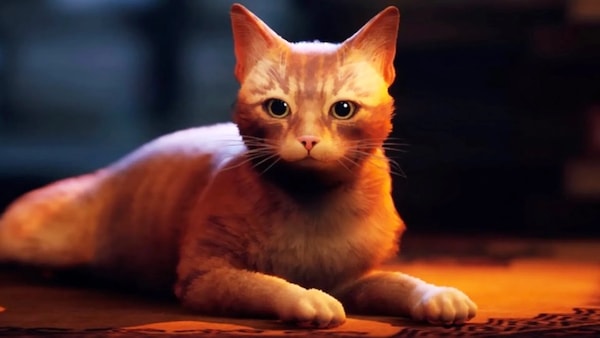
Unfortunately and as much as I’d love to re-enter the Stray universe in a different medium, playing through the game again brought a few cold, hard realities to light. The first of which is that the entire story of the game is told from the perspective of a cat — a non-anthropomorphic one, to be precise. This means that short of turning the film version into one with human expressions and Kevin Hart’s (or heaven forfend, Dwayne Johnson’s) voice, it’s going to be a fairly silent affair that relies heavily on its music to push things forward.
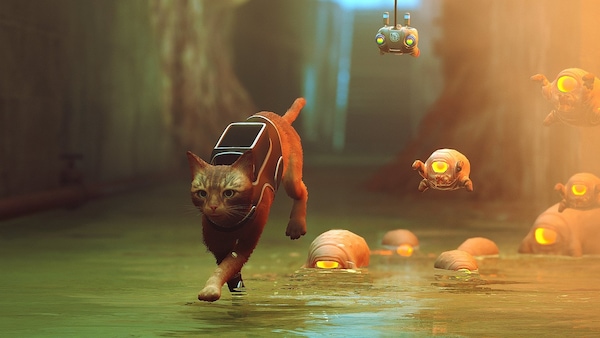
Second, the game relies heavily on the player’s agency as well as the process of having to figure things out. Ranging from the physical puzzles and platforming to putting together clues and evading enemies, a large chunk of Stray requires the player to work out how to progress. In that regard, both the onscreen cat and the player are in the same boat: Lost, confused and trying to make sense of the world into which they’ve been dropped. Turning this experience into a passive exercise like watching will whittle away most of Stray’s allure.
Third, there’s the minimal story, even more minimal dialogue and lack of any tangible Big Bads. In other words, what is on offer works well as a game, because it creates a puzzle for the player: Get to the bottom of things with minimal information. Even the cat’s deeply moving relationship with B12, the little companion robot, is non-verbal — that B12 can speak is largely for the player to understand what is happening.
As a sub-point to the above, there’s also a distinct lack of Big Bads or villains. The antagonists in the game exist not because they have some elaborate scheme, revenge plot or vendetta against the cat. Their existence predates the cat’s appearance in this world. Pulling this together with the paragraph above presents a scenario that will require writers to conjure a new story. Much like the Kevin Hart scenario, the end product will cease to be Stray.
So that’s it then. Doom and gloom with which to send you, dear reader, away? Not quite, because there are still ways, and creative ones, in which Stray can be brought to the silver screen and OTT apps (not sure if people still use cable TV). One of these could be a Tetris-like approach, where rather than attempting to replicate the game on film, viewers are given a behind-the-scenes look at how the game came to be. And I’m not advocating a spy thriller like the Taron Egerton film about the blocky game. Stray’s own developmental history is fascinating, not least is the chapter relating to Murtaugh, Jun and the cats who inspired the game.
For now this is all conjecture and we’ll have a better idea once a trailer emerges. Until then, I’m keeping my hopes and expectations for a Stray film reined in.