


Subedaar: Middling Writing Dents Anil Kapoor Masterclass
This is #CriticalMargin, where Ishita Sengupta gets contemplative over new Hindi films and shows.

Last Updated: 05.55 PM, Mar 07, 2026
IN INDIA, actors neither age well nor are they allowed to. This does not (just) refer to the physicality and all forms of strange outcomes that de-ageing is causing, but also to more tangible upshots. Performers from the past generation, several to list, are stuck in a loop of vanity and self-preservation, where they have the space to be but only as they used to be. In other words, their portrayals are dipped in repetitions and this exercise to fit in, ironically, only makes them more of misfits. Except Anil Kapoor.
Across his over four-decade career, he has imbued a striking singularity — pertaining to the way he looks naturally frozen in time and yet continues to match strides with it. Kapoor is one of the rare actors whose relevance ricocheted in the second half of his career as he continued taking stock roles, that of a father, and injecting them with evolved craft. This not only set him apart from his contemporaries but also built a roadmap for the newer generation, insisting through his choices that there is another way to sustain.

Nowhere does this argument hold more water than Suresh Triveni’s Subedaar, an overdrawn, crowded revenge drama of sorts that finds its footing only because Kapoor headlines it. His presence not just elevates but lends a meta reading that the outing benefits from. For instance, sample the premise: a retired soldier, Arjun Maurya (Subedaar; Kapoor) adjusts to civilian life in the aftermath of his wife’s death (Khushboo). His daughter, Shyama (Radhika Madan), has grown distant and resentful of his prolonged absence.
Kapoor as Maurya carries a perpetual bewildered look on his face as he scans his surroundings. The crumbling space resembles little of the hardline efficiency of his past life. Arjun keeps visiting a bank for work and it keeps getting delayed. Outside, an aggrieved woman threatens to burn herself daily, hoping that the radical act will push things in her favour. Soon, Arjun also confronts a network of sand mafia in the place as he is briefly employed to guard the perpetrator, Prince (Aditya Rawal).
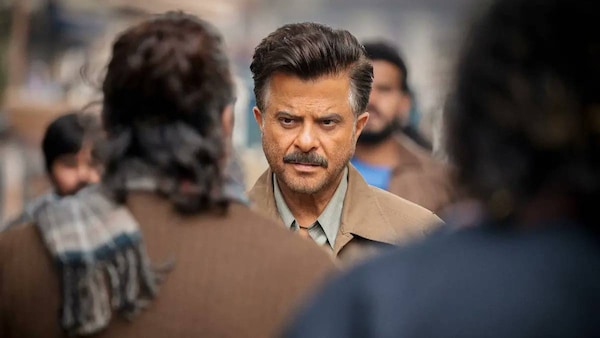
There are two ways of looking at his perplexity: one in the vein of the film, and the other beyond that. As Arjun, a former army officer and guilt-ridden husband, the continual disappointment speaks of a larger issue: is this the country he fought for? Is this the country for which he stayed away from his wife and missed picking up the call when she was on her deathbed? In one scene, when warned by his friend (Saurabh Shukla) of looming enemies in the area, Arjun retorts, “And I thought there are enemies only on the other side of the border.”
His muted patriotism, hinging on wanting to be treated with respect and dignity, is pitted against the flagrant machismo of the two antagonists in the film: Prince, out to get Arjun, and Ranbir, Shyama’s lecherous classmate who refuses to take “no” for an answer. (Triveni naming the character and his cohort after popular Hindi film actors– Ranveer, Kaushal– is a comic highlight). Their manic actions, modelled evidently on the actions of the current male heroes in films, is a far cry from the controlled aggression of Arjun. Triveni, who produced the series Daldal more recently, does something similar here where the pent-up rage of the protagonists is portrayed as imagined acts. In several scenes, Arjun clenches his fist and scowls at Prince, while he has beaten the youngster to pulp in his head.
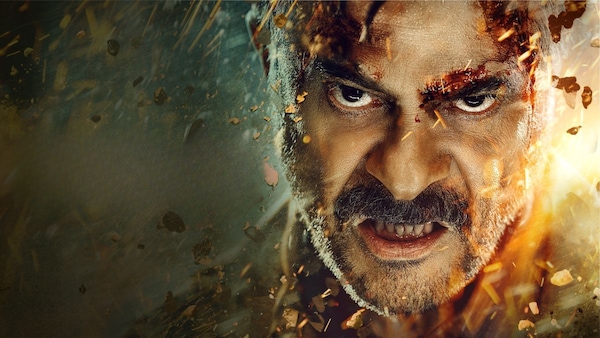
The glowering is even more rewarding beyond the frills of filmmaking. Here the subtext is the context. Kapoor, often taunted as “uncle” by the goons, carries the perpetual look of disillusionment as if questioning the affair of the industry and the state of heroism that have come to be. His only cheerleader is Shukla who cheers him with chants of “hero”. As Arjun, the actor shoulders a performance that does all the heavy-lifting in and with silence. It is a Anil Kapoor masterclass in which he conveys a multitude of emotions with the flicker of an eye or the slant of his head.
Subedaar, however, fails to keep up. Written by Prajwal Chandrashekar and Triveni, the film soon prongs into two narratives: one that it intends to be, and the other that it is tamed into becoming. The commentary gets buried in an overstuffed screenplay that refuses to quit when ahead. It is a strange concoction, speaking clearly of the intrusive demands of streamers that, in its desire to be serviceable, fails to affect. Triveni’s film concludes with a familiar image, replete with gun shots and close-ups of the male hero. All shades of vulnerability, it appears, are robbed.
Subedaar is now streaming on Amazon Prime Video.