


The Girlfriend Is A Twisted Love Triangle In Plain Sight
Based on Michelle Francis’ bestselling novel of the same name, this 6-episode psychological thriller is deceptively poignant and fair beneath its crowd-pleasing body.
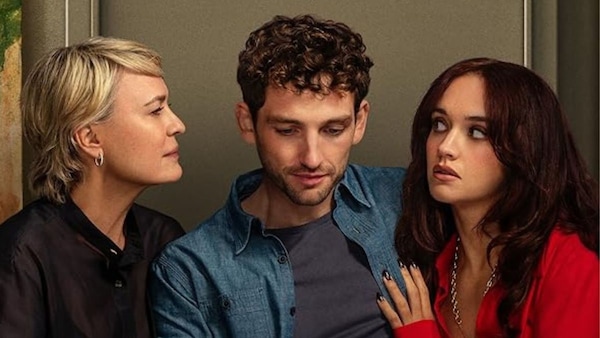
Promo poster for The Girlfriend. Amazon Prime Video
Last Updated: 11.32 AM, Sep 13, 2025
THE GIRLFRIEND is about a wealthy and overprotective mother who does not approve of her 20-something son’s new lover; she’s convinced that the young woman is a beautiful but ruthless social climber preying on the sheltered tenderness of her son. This American mother, Laura, is determined to expose the British girlfriend as a classic gold digger; her obsession is just as cold and calculating as the person she thinks she’s after. Robin Wright, who is also one of the directors of the series, plays Laura as a real-world extension of her House of Cards character Claire Underwood. She’s one half of an upscale London power couple, has an open marriage, carries the crippling grief of losing an infant, and is yet to process an affair that almost broke her family. She’s so possessive of her son that there’s oedipal tension — the lip pecks, unusual physical intimacy and umbilical-cord glitches are twisted but normalised by Laura.
The Girlfriend is about a gi rl from a broken family who grows up to sell prime London real estate to wealthy clients. This ambitious young woman, Cherry, outruns a dark past. When she finds the man of her dreams, she immediately senses the hostility of his mother; she’s convinced that the older woman is a cruel and controlling sociopath who’s feeling threatened by the prospect of sharing her prize. But instead of backing off, she decides to fight fire with more fire. She will stop at nothing to protect her relationship — and future. Olivia Cooke plays Cherry by weaponising the warmth of the characters she usually plays; she toys with the preconceived notions of the audience by being as transparent as she is opaque. Cherry is anything but perfect: she’s accused of not only being a toxic ex but also a potential killer. But she’s so possessive of her boyfriend, Daniel, that this becomes the most twisted “love triangle” she’s ever been in.
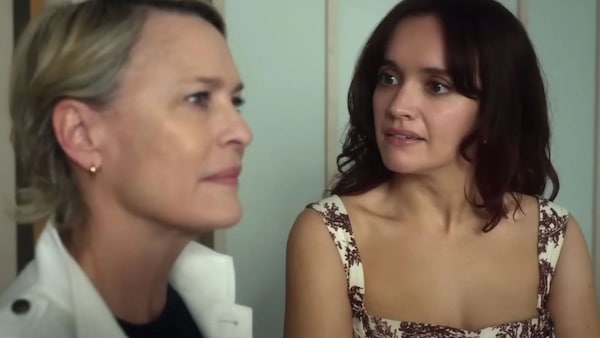
Based on Michelle Francis’ bestselling novel of the same name, the ‘gimmick’ of this 6-episode psychological thriller is that it shows two sides of the same story. Every episode (except the finale) is divided into two perspectives — Laura and Cherry — where similar sequences and events unfold from contrasting points of view. The series has fun with the subtle little variations in the two versions, like (slightly) differing accounts offered during an interrogation. Each version is coloured with distortions and biases; the truth is trapped somewhere in between. Laura sees Cherry the way she wants to see her: a little evil, promiscuous, rude, manipulative and conscious of their rivalry. The parts missing (resulting in jump-cuts) are essentially the parts she erases to justify her suspicions. Similarly, Cherry sees Laura the way she wants to, interpreting their exchanges to suit her own combative nature. When she falls into the water and almost drowns, for instance, she notices Laura standing on the boat and doing nothing about it. But the same incident from Laura’s lens shows the older woman leaping into the ocean to rescue her without a second thought.
The first three episodes are playful with the narrative gimmick because it’s still the meet-the-parents and honeymoon phase: an awkward dinner, a Spanish holiday, a tense-but-covert tug of war for his attention, big little lies. But a tragedy — a literal cliffhanger — at the end of the third episode transforms the series into something darker, nastier and more human. It pushes one of the protagonists into irredeemable territory; her mission mutates into a sickness of sorts and, as viewers, we almost choose a side. We start to feel for the other one, and regardless of whom we relate to as ‘characters’ — a worried parent or an outsider partner — there’s a tangible shift in morality. It starts to emerge that nobody is really winning; it’s like watching the past and the future of the same woman battling to be the present. It’s also a war of trauma. Laura might have been like Cherry when she was younger; she visibly married into money, lost a child and moulded her next child to give her everything she lacks. She considers Cherry a competitor rather than a successor. Once they cross a boundary, it’s like a time-travel conflict; there’s no coming back.
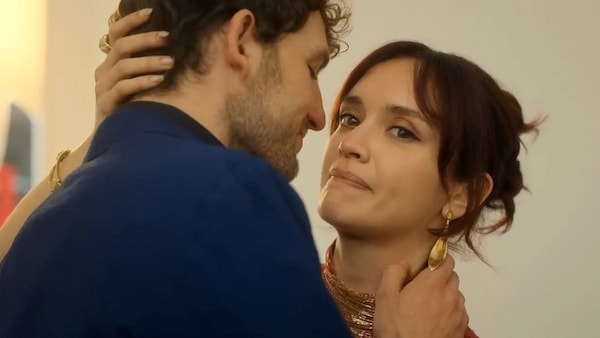
The Girlfriend is deceptively poignant and fair beneath its crowd-pleasing body. You can tell that it’s written, directed and led by female storytellers. For instance, neither of the two central characters is easy to read. They contain many contradictions: each one co-existing with the other. Cherry is flawed but never downright dishonest; there’s always a sense that she actually loves Daniel both because of and in spite of his upbringing. She wants a better life, but she’s also very competent in her career; she likes money, but she also savours the comforts of companionship. She has a history of violence, but her heart breaks harder than most. She resents her mother, but she appreciates her too. She detests Laura, but she’s also shocked by how far she goes to get rid of her.
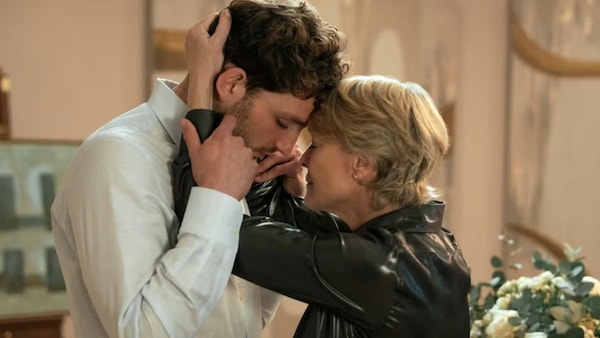
Laura, too, has main-character energy but her hero is her son. She is in a polyamorous marriage, but there is mutual respect. She is vindictive, but also a victim of the persona that Cherry brings out of her. She is relentless but also resilient when her world comes crashing down around her. She is blinded by love in a world dominated by hate. If anything, her fault is that she cares too much. The women may be playing ‘labels’ for the sake of the plot, but they’re as complex and messy as anyone else — almost provoking us to judge them and fall into the patriarchal trap that we approach such stories with.
More notably, the series resists the temptation of seeking cheap thrills or lazy resolutions. Whenever Cherry or Laura does something terrible, the writing is constantly aware that it’s only the viewer who’s in a position to scrutinise them as strangers; the family and friends struggle to cancel them because life is not as simple as walking away from loved ones who sin. Everyone has reservations about them, but there’s too much history to be objective. A lot of the viewer’s anxiety — as well as Cherry’s frustration — is rooted in the fact that the son struggles to comprehend the misdeeds of his mother. He continues to subconsciously defend her without offending Cherry; his denial would drive most girlfriends away. We often want him to break free of Laura’s clutches, her hold is unnatural, but it’s not that Cherry’s concern for him is entirely pristine either.
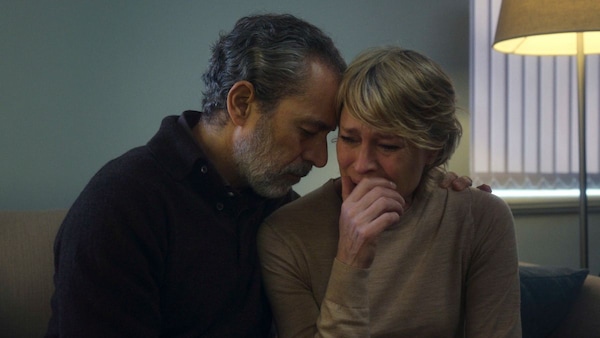
It’s quite enjoyable that the series, at first, appears to treat its men the way male-dominated stories treat women: as trusting, silly, oblivious and hapless showpieces torn between a lack of agency and a derived identity. But the tit-for-tat tone is just a tease. Daniel is in his own coming-of-age thriller where he’s trying to grow out of his privilege and think for himself; you feel sorry for the way he’s pinballed between the two, but you also feel like he deserves it for being so naive. You wonder what it is that Cherry sees in him, but his malleability — the legacy of his mom — is precisely what attracts her as well. He has that exact I-want-to-take-care-of softness about him that men are often drawn to in the women they date. I also like that Howard, Laura’s husband, is not reduced to a rich and womanising stereotype; he is the mature and sensitive one in the marriage, still in love with a difficult person after all these decades. He chooses to believe in the goodness of Cherry too, and it’s plausible because he probably did the same for his wife back in the day.
Having grown up as the only son of a fiercely protective mom myself, The Girlfriend did uncover some buried wounds. I noticed plenty of familiar undercurrents that I may not have detected in my clueless twenties. But life of course isn’t as extreme as cinema; most men survive the crossfire in milder and more boring ways. They survive because they’re born into a world that’s rigged in their favour. The spine doesn’t always stay intact in the process, because we often tend to peddle sexism under the guise of diplomacy. Nobody wins, not least the masculinity that feels flattered for being coveted. Such shows might not be overt about their indictment of who they’re entertaining, but it says something that I’m both afraid and excited about a potential sequel called The Boyfriend. Or perhaps the next season itself: from the poor little rich boy’s point of view.