


Marty Supreme & The Fascism Of Desire
This is #CineFile, where our critic Rahul Desai goes beyond the obvious takes, to dissect movies and shows that are in the news.
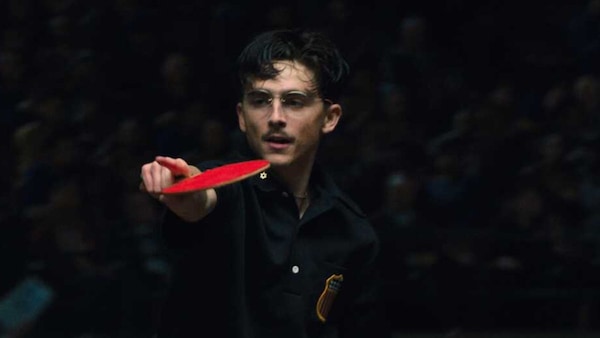
Still from Marty Supreme.
Last Updated: 05.54 PM, Jan 23, 2026
THE “Supreme” in Marty Supreme has dual connotations. The obvious one is that here’s an underdog hero who will stop at nothing to achieve sporting supremacy. Marty Mauser will be an anti-hero, a hustler, a fraud, a narcissist and whoever it takes to summon his destiny of being world champion. Usually, such protagonists have to overcome the system with talent and grit. Here, the talent and grit are almost incidental. It is assumed he has those, so he’d rather game the system in the language of those who run it. As a Jewish shoe salesman in 1950s New York in a post-Holocaust world, he is accustomed to selling his identity more than proving it. America and table tennis are merely his mediums to be seen; he is neither patriotic nor a purist. If he’s an allegory for the entitlement of US capitalism and the illusion of the American Dream — where he upends multiple lives and puts everyone at risk to get what he wants — so be it.
The problem is the ‘selling’ becomes his personality so fully that Marty himself becomes the one customer who struggles to buy it. It would’ve been easy for the film to make him a mediocre player with delusions of grandeur, but the clincher is that Marty is genuinely good at ping-pong — he can’t afford not to be. He has the skill, the drive, the showmanship, because he sees the game as an advertisement to promote himself, not the other way around; it’s not popular enough as a sport yet, so he is desperate to sensationalise it to glorify the one thing he excels at. When he loses in the British Open final to a new Japanese opponent early on, he’s so shaken that he spends the rest of the film hustling to showcase that greatness again — to himself, before anyone else — and bring to life all the fictions he swore by. It’s a nasty self-fulfilment arc, where the ‘training montages’ revolve around him conning people for money to participate in the next tournament; his life descends into a messy crime caper to earn the shot at a rousing sports biopic. (Not dissimilar to Anora, the sex worker whose life spirals into a caper to retrieve the Cinderella-coded romance she was promised). He’s not tricking others into believing in him; he’s tricking others into helping him retain his self-belief. Some of them already do — like Rachel, the married childhood friend he’s having an affair with — but Marty’s vanity is supreme. The message is not to Be Like Marty, it’s to watch Marty mutate into a sociocultural cautionary tale in pursuit of a cinematic fairytale.

The other connotation of “Supreme” defines the essence of the character and the story he wills into existence. One of his primary business ideas is having his own orange ping-pong ball brand with the words “Marty Supreme: Made In America” engraved on them. His plea is that the orange ball is more visible against a player’s all-white attire: an effort to emulate the postcolonial elitism of lawn tennis. But the intrinsic reason cuts deeper. Young Marty gloats and behaves and brainwashes like a “Supreme Leader” — the term otherwise used to describe an unchallenged religious, political or cult ruler — in a veiled democracy that’s averse to his ways. He operates like a primal and autocratic king who refuses to accept his pauper-coded fate: enforcing himself onto allies and friends, sweet-talking and seducing strangers, convincing the rich and the marginalised to believe in his grand purpose, manufacturing the smokescreen of persecution and rebellion, swindling his way into VIP treatment and private jets. The decay of his conscience knows no bounds; he’d coax a dying cancer patient into signing their pension over if he could. In other words, he’s a Jewish immigrant using Nazi shorthand to show the world that even the West can produce such power and ruthlessness; that ‘Supreme’ leaders and capitalists can be Made in America too.
He doesn’t mind weaponising the facets of post-war Jewish and Japanese victimhood to get another shot. Ideology is a game to him: the dimensions are table-tennis-sized, but he plays and lunges like it’s tennis. He creates the spectacle of outdoor-sport drama and heel-versus-hero narratives to sell the indoor game. Marty is born to mine this dissonance between him and the settings he occupies. The beauty is that the film keeps humbling him; the country makes it nearly impossible for him to be that guy. The reason we empathise with him (despite Marty being an A-grade fool) is that he perseveres in his quest against the rules of both storytelling and American dominance. By the end, he takes it upon himself to earn and reframe the Supreme in the title — he would rather be the best than the most powerful. He would rather drop the performance, leaving the debris of hope and aspirations in his wake. It’s almost moving that he arrives and abandons and deflects and distracts on his own terms; that he’s reclaiming the perception of the little monster that Hitler had once sold to a compliant Germany.

Josh Safdie’s breakneck filmmaking ranges from Uncut Gems and The Talented Mr. Ripley to Dog Day Afternoon and Catch Me If You Can. It’s almost as if the camera is trying to scrutinise the protagonist, not capture him; Marty acts like the lens is one of the many characters he’s aiming to deceive and outrun. At 152 minutes, this chase never lags, even when Marty’s entire journey becomes a diversion of sorts; every ‘detour’ — a mobster and his dog; a bowling-alley scam; a gas-pump explosion; an affair with a wealthy older celebrity; a hotel disaster and a shootout — expands the stakes and entertains at once. The violence comes out of nowhere, the extremity of every incident is dialled up, and it’s like Marty’s a videogame figure having to pass multiple stages and summon multiple selves to reach his pot of gold. The ‘80s needle drops reveal the cinema and theatricality in his head, reiterating his hunch that he’s someone ahead of his time. The irony is that Marty doesn’t afford himself the space to be passionate about the sport. The desire to justify his God complex is what sends him on a spiral into adulthood.
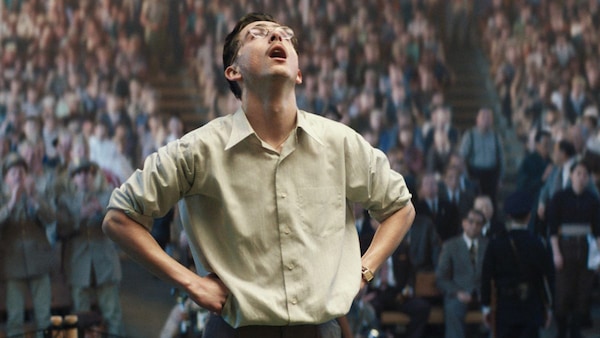
I can’t think of anyone better than Timothee Chalamet as an insufferable and cocky boy-wonder who insists on immortality. The young actor has made no bones about his ambition ever since he broke out in Call Me By Your Name. His roles since have only cemented his image as an artist’s artist — someone who wants to alter acting history, but also someone who takes himself so seriously that he’s constantly playing catch-up with himself. (He’d be Brian Cox’s No. 1 whipping boy). He’s one of the performers who speaks about raising the bar — even if it divides fans and contemporaries — so that he’s held accountable to his own claims. Marty Mauser might be loosely based on a real-life American player, but he’s an auto-fictional version of Chalamet; the unfiltered conviction in the character brings to mind Shia LaBeouf's bleeding portrayal of his own father in Honey Boy (2019). He’s all tics and self-motivational toxicity, crafting the kind of man that people can see through yet fail to resist. He preys on their insecurities without being sinister, a balance that Chalamet strikes while somehow inviting us to root for his madness. Morality is often the entry point into such characters, so it’s quite a feat that a baby-faced Marty turns the viewer into one of the many allies swindled by him.

The title-credit sequence reflects the premise — a sexual encounter scored to ‘Forever Young’ transitions to the inside of the woman’s body, where one of Marty’s many sperms sneaks into the egg, which morphs into the moon, which further morphs into a table-tennis ball. Chalamet encapsulates this sequence in every way possible, ping-ponging between spheres of belonging and believing. The supporting cast is equally, if not more, inspired. Gwyneth Paltrow’s Kay Stone is a retired actress with an arrogant pen-magnate husband (Shark Tank’s Kevin O ’Leary; right at home). It’s hard not to see Paltrow’s own bemusement with the younger generation of method-actors in Kay’s morbid curiosity about Marty. She gives in to him, but rarely at the cost of herself, even reclaiming her own ‘film’ during a lovely moment in which a wave of delight ripples across her face when she hears the applause on taking the stage. It’s her comeback, and she’s missed the sound of validation, a sound that opportunists like Marty crave and mythologise until they actually receive it. There are shades of Paltrow’s Great Expectations performance, if the mysterious Estella grew older but no wiser.

Odessa A’zion’s Rachel is the wildcard in the film, though. She starts out as a bit of a punching bag: abusive husband, pregnant out of wedlock, needy for Marty, clinging to him through the chaos. But she soon becomes more of a spunky Bonnie-and-Clyde-like conspirator, so ‘committed’ to Marty’s image that her love is inextricable from his manipulations; she treats his week-long dash as a vessel to prove that she is one of two survivalist peas in the same pod. She uses it as a chance to be indispensable and unconditional, absorbing his blows only to unleash a few invisible ones of her own. Her influence slowly punctures his main-character energy, dragging them into lovebomb-triangle territory — convention is what happens to him while he’s busy making other plans.
It’s never ideal when someone as bent as Marty hits close to home. No, it’s not me, though I wish I were a bullshitter with the brilliance to back my (orange) balls. That didn’t come out right, but you get the gist. Watching young Marty Mauser reverse-engineer the concept of greatness reminded me of an old man I know closely. Or at least I think I do. My 73-year-old father used to be a supreme student and marketing prodigy, destined for dizzying heights and corporate fame. He talked a big game and walked it. At some point, though, he overdosed on his own Kool-Aid. The expectations surpassed the potential, but instead of chasing that promised land of potential, he began to expand the myth of expectation. He vowed more than he wowed. His family — including me — could see through it; he blamed everyone but himself, even accusing us of being negative if we called him out. The chasm between story and teller increased with every decade; jobs came and went, but he stubbornly pursued the next one, and the next. The film is rooted in the intersection of cinema and reality: Marty humanises his delusions, stomping over hearts and bodies to catch up with — and legitimise — his pompous attitude.

My dad hasn’t been as callous as Marty (as far as I know, he hasn’t held a mobster’s dog hostage for money to pay a fine). If anything, he could be faulted for being too honest; the rejection of his integrity is what might have turned him into a bitter and hungry antihero. He almost won so early in life that every decision since has revolved around revising that almost-ness. It’s been a hopeful and frustrating odyssey to nowhere. He is currently at a stage where all that matters is one last shot at greatness. But it’s more Crook than Hook now. In the last decade, he has lied and leveraged and taken and talked big and used and destroyed. He’s forged his age and accomplishments, stayed in denial about his declining health, shied away from responsibility, emptied his separated-and-sick wife’s bank account, chipped away at his son’s sanity, alienated trusting relatives, inflated his self-worth, faked his whereabouts, and built castles in the clouds about last-stage interviews. He orates and self-mythologises like the right-wing politicians he detests; the propaganda here is personal. When I recently visited him, I couldn’t last a minute without exposing his crisis of humility; I argued but kept hitting a wall of calibrated mirages. He truly believes that one last employment letter will undo all the irrevocable trauma he’s caused; that one plum position will erase decades of liberal patriarchy. It’s almost poignant that he does.
If he were a conceited movie character, he’d earn a grudge match to prove his credentials to everyone else, and most of all, himself. And after his lust for scaling his own Everest is satiated, he would perhaps give it all up in service of his twilight years. Or maybe he would use his twilight years as an excuse to give it all up. Either way, he’d “settle down,” whatever that means at 75. He might finally quit hawking a sense of resistance in a culture that thrives on traditionalism. But he remains a Marty yet to realise his Supreme. He remains a reckless tragedy yet to traverse the creaky bridge between reckoning and closure. As we speak, he walks like an infant after repeated falls and infections; he smokes with bruised lungs and a swollen ego. If the ping-pong ball were once a moon, every indefatigable rally he plays alters the gravitational force of the planet and wreaks havoc on his own people. I’m emotionally estranged, but if he’s in trouble, I let myself be inconvenienced and indulge in his futile missions. He may even end up selling my childhood home — the only thing we’ve ever owned — to fund his flight to that mythical moon. He continues to reach for the orange carrot at the end of the stick. It’s a stick he replaces and a carrot he keeps plucking out of the wilderness. For better or worse, it keeps him going: from the bedroom to the laptop, from darkness to light, from a past he’s weaponised to a future he’s fabricated. After all, egotism is the antidote to self-doubt. Simulated supremacy is the vaccine for humane mediocrity.