

Vaa Vaathiyaar Is A Fun, Campy Vigilante Film
In Vaa Vaathiyaar, Nalan Kumaraswamy weaponises the idea of MGR, the screen hero, staging a pulpy vigilante drama that is as much about cinema’s myths as it is about the state’s abuse of power.
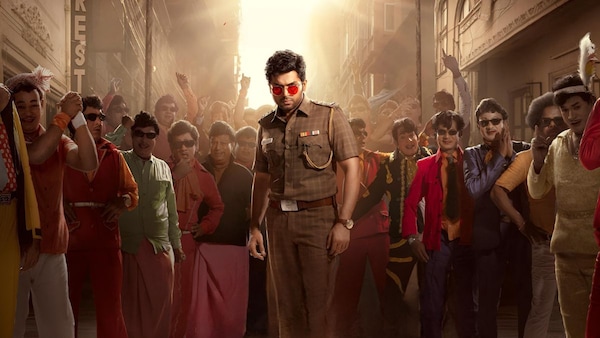
Promo poster for Vaa Vaathiyaar
Last Updated: 01.40 PM, Jan 16, 2026
NALAN KUMARASWAMY has been around Tamil cinema forever now. Yet the first winner of Naalaya Iyakkunar, the programme that gave us a handful of new-age filmmakers still working today, has only made three films. It’s surprising, considering the prolific output of his contemporaries and the value of the singular voice he brings to cinema. Thirteen years after his debut, his third film, Vaa Vaathiyaar, finally made it to theatres this week. The one quality that stands out in Nalan’s work is the postmodernism that permeates his characters and extends beyond mere window dressing in his frames. It is present in entirety of Soodhu Kavvum (2013) and very much central to his script contributions in Thiagarajan Kumararaja’s Super Deluxe (2019). Funnily enough, his sophomore film Kadhalum Kadanthu Pogum (2016) is far from cynical and serves as one of the best romantic films from Tamil in the past two decades. Vaa Vaathiyaar is marketed as a masala or commercial fare from Nalan, and it is easy to see why.
Vaa Vaathiyaar possesses all of Nalan’s staples in its design. It is about Rameshwaran (Karthi in terrific form in a scenery-chewing role) who came into this world just as MG Ramachandran, the star, actor, leader and politician, breathed his last. Ramu’s grandfather (Rajkiran) is one of the MGR crazies, one for whom the matinee idol is life-sustaining oxygen itself. He realises Ramu is MGR reborn and nurtures him in his hero image. Ramu learns to fight, he learns to question injustice and playfully pretends to be the neighbourhood vigilante long before his adult life. A freak admonishment from his grandfather turns him away and into the dark side of MN Nambiar. While the grandfather always wanted him to be an upright police officer (incidentally, MGR’s first-ever film role), Ramu grows up to be the cookie-cutter corrupt cop. To stand out, he wears a checks-laden uniform he stitched out of a safari suit that’s not exactly khaki-coloured. He is unapologetic about his wicked ways and hides them from his grandfather out of love. While MGR’s film references and songs waft in and out, Nalan sets this up in a fictitious city of Masila (from that song, yes), which is pulpy in its veneer, and SMK is the party in power. These bits recall a more tongue-in-cheek Nalan as does giving Sathyaraj — as business magnate Periyasamy — the same buck teeth his famous character, Ammavasai, sported in Amaidhi Padai (1994).
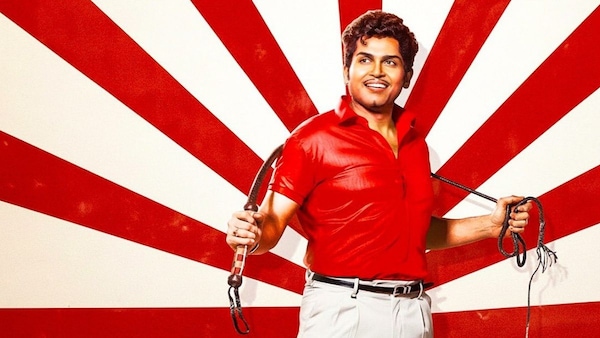
The film’s outer façade has an ironic finger wagging — a fictitious city, B-movie aesthetics of the surroundings, slightly exaggerated antagonists and non sequiturs involving puliyamaram (tamarind trees). But look closer, and the film is played straight and serious. It is very much in the masala genre where grave injustice occurs, and there is a hero to save the day. And these may or may not include resting on shoulders and conversing with dead souls. Nalan’s script guides Ramu from being a corrupt cop who gets suspended to a cop who is used by more nefarious criminals to catch hacktivists exposing an evil government-industrialists nexus. Almost like a sudden tremor, the film thrusts us into multiple genres — we are watching part procedural, part vigilante justice. A hilarious bait to nab the hacktivists involves politicians pretending (assuming they are being surveilled) to discuss ordering extrajudicial killings with a ready phone call script on hand. As if misusing authority at will is not a regular Tuesday for them. The film cuts between planning and execution in this procedural with admirable rhythm and intensity, and a chase succeeds in suspending our disbelief in very unexpected ways. The first half of Vaa Vaathiyaar is an enjoyable ride through Masila city, which always had only one destination — Ramu realising his folly and turning into a vigilante himself. If MGR’s real-life death brought Ramu into this world, his biggest fan’s passing brings MGR into Ramu. And the sequence where Ramu encounters the MGR within him in front of a mirror is a deft yet campy bit of visual pun from Nalan. Cinematographer George C Williams and Nalan combine to give a film that’s shot quite exquisitely, with the colours popping out just enough and the frames containing just the right information.
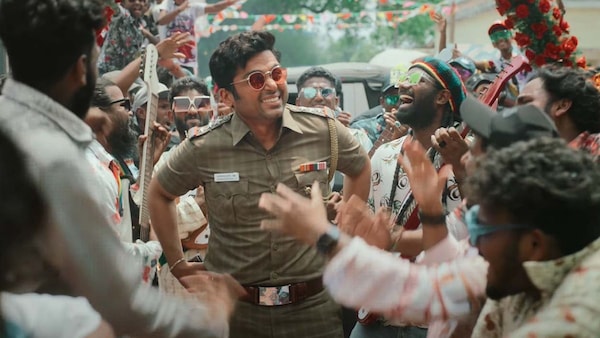
Nalan’s world of Masila is sufficiently modern in its sense of state apparatus and the fourth estate. The nexus preys on the underclass as much as it does on the country’s resources, and the media is hand-in-glove with them — the very presence of hacktivists and radical social media channels tells that story. There is even a hilarious offhand comment where Ramu’s mother talks about his grandfather reading something in the paper, and his reply is “enna paper”? It’s an unnatural response, maybe twenty-five years ago, but today Ramu’s confusion is uncanny. Newspapers? What are they?! This is a film with a hero who fights crimes at night like MGR, a superhero who has his own “guy in the chair”, in fact, an army of them, who provide tech support. Nalan’s intentions are admirable; he doesn’t valorise the police (a background dialogue goes — "adikarthukku edhukku warrant"), making them effectively the villains of this whole enterprise. Even as MGR is a talking, breathing character here, it is only the idea of MG Ramachandran, the screen hero, that is weaponised, not the man himself (there is a twisted reference to Chief Minister MGR’s violent anti-Naxal crackdown Operation Ajantha).
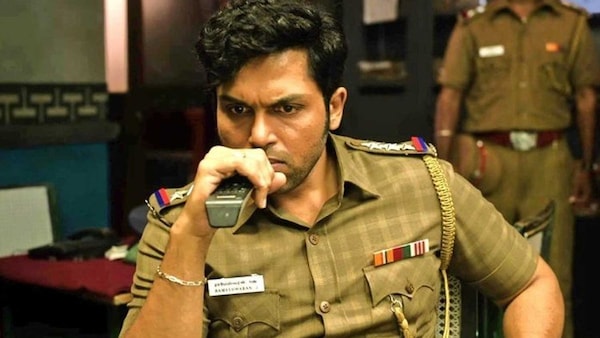
Nalan throws a lot of things in the second half, including an unnecessary song and an overlong, stylised fight sequence. Not everything lands here, and the tonal inconsistencies could have been smoothed. The intermission should have ended as a soaring high point, but it whimpers like a wet towel following a zany action montage. The climax is similarly rushed. But in between all this, the middle portions of Vaa Vaathiyaar make for a fun masala film, one that doesn’t ever let us forget that we are watching a Nalan film.