


At The Kumbh, Between Love & Sin: The Story Of In Search Of The Sky
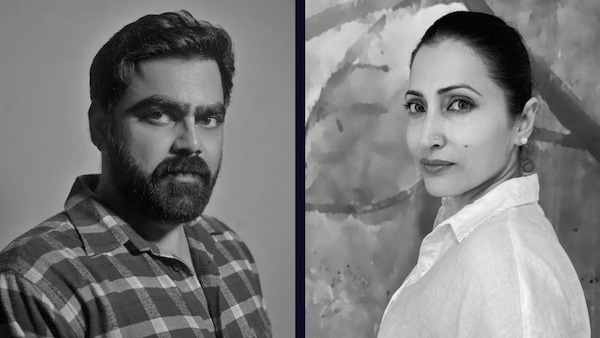
OTTplay's critic Ishita Sengupta reports from the Toronto International Film Festival (TIFF) 2025. Here: An interview with In Search Of The Sky makers, Jitank Singh Gurjar and Pooja Vishal Sharma.
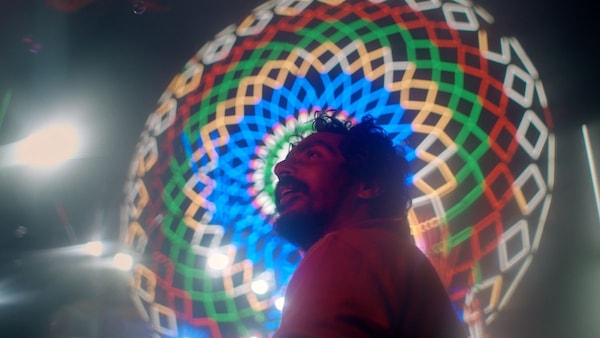
Still from In Search of the Sky.
Last Updated: 01.51 PM, Sep 10, 2025
IN JITANK SINGH GURJAR'S short film Baasan (2023), rural folklore assumes the centrality of a protagonist. Characters are lured in by mystical forces as they get wrapped in greed and confront a fatal outcome. His feature debut, In Search Of The Sky, is more sobering in comparison, but the preoccupation with the human psyche remains intact.
Written by Pooja Vishal Sharma, In Search Of The Sky is a tender exposition of a family caught between survival and love. Jasrath and Vidya, a married couple living in a village in Madhya Pradesh, struggle to make ends meet. Their grown-up son, however, is oblivious. He plays in the field, climbs trees with abandon and brings home a piglet, mistaking it for a puppy. Naran is specially-abled, and his condition evokes distinct reactions in his parents: the mother is concerned, but the father is ashamed. People in the village are convinced that it is a manifestation of Jasrath’s past sins.
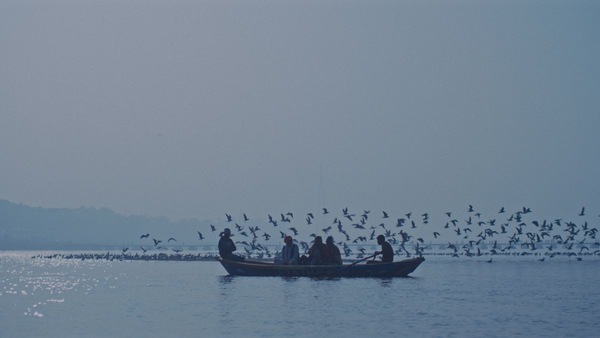
The concept of sin looms large in In Search Of The Sky, not as a question hurtling towards an answer but as a philosophical strand waiting to be unspooled. As the film unfolds, the idea continues to shapeshift, and so does the face of the sinner(s). Setting the second half of the film against the spiritual backdrop of Kumbh Mela, a famed Hindu pilgrimage site, the makers raise queries that move from binarised culpability and halt at the multiplicity of perspectives, lending In Search Of The Sky an existential core in keeping with the title. The film has been selected in the Centrepiece program at the ongoing Toronto International Film Festival, and ahead of the premiere, the writer and filmmaker spoke to me. Edited excerpts below:
Where did the story come from?
Pooja: It came to me last year from a deep moment of silence. When I was travelling to rural India, my friend took me to a home where people with special abilities lived. I met many kids and people of different age groups; seeing them, I wondered how they landed up there. I was told that many were abandoned and even deserted. Even after returning from the trip, I kept thinking of them and their families. Those connections became a story. Maha Kumbh was also around the corner, so it all added up.
On paper, it comes across a little cruel — that parents want to abandon the child. The merit of the film is also that we feel for all the characters. All of them could have been protagonists. Jitank, when you were shooting, was this clear in your head?
Jitank: The story helped a lot. The cruelty that you are referring to was borne out of circumstances. No one is an antagonist; the situation demands it. The father has shades of grey, but he was constantly mocked by society. He has no money and is on the verge of losing his hand. He is in a state of constant pain, so he chooses a more definite cause to trade for the smaller pains.
Jitank, you have a background in psychology. Did that help while directing this film?
J: Yeah, definitely. Much like life, psychology doesn’t follow one particular pattern, so I am always drawn to contradiction in emotions. I loved the story because every character is teeming with paradoxes.
Pooja, after you wrote the script and when Jitank came into the picture, what did the collaboration look like? I am also asking this because the film has overlapping titles. Shelly Sharma, the cinematographer, is also credited as a creative director…
P: I had the outline of the story in mind, and I wrote the beginning, middle and end. When I was sure how I wanted to shoot, I reached out to Jitank because I had watched his previous short film (Baasan) and was impressed with the style. I locked him, and he introduced me to Shelly. Once she came, everything changed. Initially, I was a little unsure if a girl could shoot in a chaotic setting like Kumbh. She is not that tall, but her confidence swayed me.
We sat together at the scripting stage a lot. Jitank was in Madhya Pradesh, and Shelly and I were in Mumbai, so many virtual meetings would happen. We developed the story together. We had a small team. People call it home production, but I say this is a production that got completed at home. I didn’t have an office; I still don’t have one. We first shot the climax. The idea was that if any issues arise, then we will scrap the project altogether. We completed shooting in 11 days.
Jitank, given that you are from Madhya Pradesh and the story is set there, did you bring your cultural sensibilities?
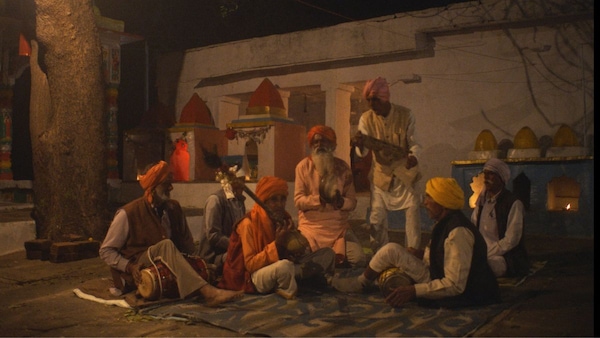
J: Yes, the culture that you see in the film is my addition. I come from an indigenous tribe, and I lived in that particular village. The music, the nuances of the village and the jungle are all familiar to me. There are also personal anecdotes. When my sister was young, she brought home a piglet instead of a puppy like Naran does in the film.
P: The mandali [a gathering of music performers] was also his idea.
J: I was not sure about the climax. I feared that it would be too commercial. I believe we have made two films in one. At the beginning, the aspect ratio is 4:3, and we have used a steadicam. In the village, the filmmaking is more realistic; when it moves to Kumbh, the aspect ratio opens up and the style becomes more surrealist.

It is interesting that you mentioned the climax because I have been thinking about it. On the surface, it might seem trite, but layers of reading open up as one keeps engaging with it. Pooja, were you sure about the ending?
P: I was very sure. When I was writing, I kept thinking that all of us have multiple lives in one life. Even for Naran, his life in the village was one of the many lives. He is on a journey and goes through a sort of rebirth.
How important was it to figure out the team? The music is tremendous.
J: I was lucky to have Manish Kumar for the music. I have known him for 15 years. He was the tabla player with Zakir Hussain and is a thespian. I have learnt a lot from him; we worked together on my last film as well. The assistants were mostly my friends and theatre companions.
Talk to me about deciding to make the film in the Braj language. Did the thought come at the writing stage?
P: I was very clear that the story is going to be set in MP. I didn’t know the language, but I knew it had to be authentic. When Jitank came into the picture, things fell into place.
J: There is no industry in the Braj language; when I was doing theatre, I wrote the first drama in that language, and also my first film. This time too, I proposed the same because not much authentic work is being done.
How did you find the actors?
J: Pooja found Nikhil Yadav (who essays Naran). Raghvendra Bhadoriya (the father) played the lead in Baasan. He has been doing local theatre for two decades now, and also does local farming. Meghna Agarwal, the woman who plays the mother, is from MP.
How difficult was it to shoot an independent film in a chaotic setting like Kumbh? In several crowd scenes, people are looking directly into the camera, and the film assumes a sort of non-fiction quality…
J: We had actually planned to insert characters in the crowd in such a way that they seem part of it. We did that in some scenes. In other instances, when people would keep turning and looking at the camera, we asked the ADs to create a fake distraction and make noise so that the attention would go there. It worked!


Subscribe to our newsletter for top content, delivered fast.
