


Anuj Gulati on his directorial WingMan: 'Biggest constraint was actually taking the approach of doing a short film in the feature format' | Exclusive
Anuj Gulati discusses his debut feature, WingMan. Challenges included self-producing and letting go of initial ideas. The film explores self-love and the irony of searching for love.
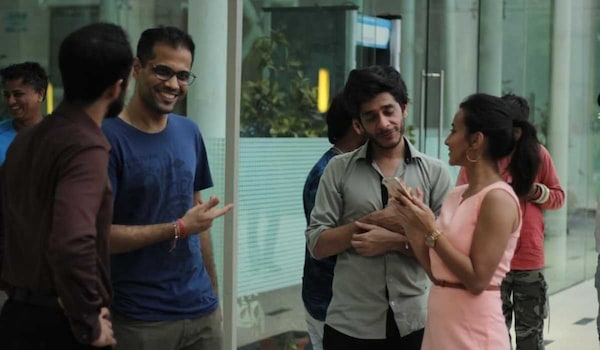
Anuj Gulati with Shashank Arora on the sets of WingMan (The Universal Irony of Love)
Last Updated: 08.54 AM, Nov 20, 2025
In this exclusive conversation with OTTplay, filmmaker Anuj Gulati dives deep into his feature-length debut, WingMan (The Universal Irony of Love), which is now streaming on Lionsgate Play (OTTplay Premium). Gulati, who took on the demanding triple role of writer, director, and producer, discusses the challenges of scaling up from short-form cinema to a feature film. He offers insights into the tragicomic nature of the film, the profound meaning behind its title, and the creative decisions—including casting Shashank Arora and utilising repetitive locations—that brought the story of the lonely, searching protagonist Omi to life.
Edited excerpts below...
It's been a few weeks since WingMan came out on Lionsgate Play. Have you gotten any responses, and what have those been?
I haven't, like, I have no way to gauge the response right now, apart from personal contacts. But I think, mainly for me, the exciting bit is to move on to the next things, to be honest.

WingMan is your debut feature. What was the single biggest operational or creative challenge you faced when moving from the short-form constraint to managing the scale and depth of a feature film?
I think the biggest constraint was actually taking the approach of doing a short film by myself—producing, directing, and writing—in the feature format. And I realised in hindsight that because it's just a larger project, it just keeps going on and on and on and on. I guess for me the learning has been that as the scale of the projects grows, it's important as a filmmaker or a creative to get more people invested in the vision or the journey that this might be earlier. This is again more challenging than just doing it yourself, because it's hard to convince when you're doing your earlier projects as to what your approach is and what your point of view is. I think one of the biggest learnings or constraints in this case was producing, actually producing the whole project from scratch, from raising investments to getting the production underway to managing the festival journey and the release. So, apart from managing the creatives, the main challenge was producing, along with writing and directing.
The film's title, "The Universal Irony of Love", is profound. What is the specific irony you were most keen to explore through the life of the protagonist, Omi?
The tagline actually came, like, earlier. I did not have this idea. I think the process of making this film was that when I had written this draft, I just jumped into it. I think there was no time to understand what this might be. I think a lot of the understanding of what this film is has come after shooting it or even during editing, to even understand what this is about. I think it has themes of self-love; it is also a warning to the youth about a journey that is best avoided, but the takeaway is that it's about a guy who is looking for love but is unable to love himself. I feel this journey that he goes through is important for him to even understand the loop that he is stuck within unconsciously. I feel like the tagline came while we were editing, and it came because I realised that all of us kind of go through this process in our own way, where we realise our own patterns or our own limitations about loving ourselves. I feel it's important to go through it to even open ourselves to receiving love.
You chose a call centre at a dating service for the setting. What aspects of this environment made it the ideal setting for exploring themes of modern loneliness and hyper-connection?
That is a good question because it makes me track back as to how that element of the call centre came. What I remember is when I was juggling with ideas about deciding what the next one should be, and considering that it's the first longer project, there was always the seed of exploring call centres. I always wanted to do, maybe a comedy around a call centre because I thought it had layers to explore, and also, as you say, I think subconsciously I was attracted to the loneliness of the people who are sitting behind these desks. I don't think a call centre exists, the one that is depicted in this film, where there is a matchmaker, but again, that's how it evolved, right? Once I decided, okay, this guy works at this dating service called WingMan, and earlier drafts of this film actually had more of the call centre, which kind of dropped off as the story became leaner. It came because I wanted it to be based on a call centre, but then because of this character that I started to explore, it became this: him working in this dating service and juxtaposing his personal life with how he doesn't have his own relationships together. But earlier, as I said, like the title of WingMan, it actually came because I decided there is a dating service called WingMan where people connect other people. As things proceeded, even in the edit, this was actually a longer film with more sequences within that call centre, but as you see right now, it's just the opening. So all of that got dropped off because it became a more narrow story about him, more than the service itself.
The film is described as a tragicomedy. How did you find a balance between the humour of the situations and the deeper, more melancholic themes of Omi’s loneliness?
I feel like, because when I started working with this character, the character actually popped up while I was doing some other writing, and this guy Omi showed up, and he was just walking into other people's spaces and being a little intrusive, and I thought that was funny. Because the humour was already there—what is this guy doing? It's my curiosity about why he's doing that which drove me into pursuing this film. I feel like, because the humour was already there about the awkwardness that he is getting himself into, that is what actually drew me to it also. But then, you're right, there is the melancholic side of it, the dark side of it, because he is actually running away from himself and has a fear of being alone. All these themes are there, but again, all of this has just come about because I chose to pursue this character. As I understood this character more—even looking at the earlier drafts, this was the fifth draft we decided to shoot—but if I could go back and study the earlier drafts, the underlying humour was always there.
Shashank Arora has been noted for his raw performance. What specific instructions or brief did you provide to him to help him embody a character who is "searching, pretending, performing, and, at times, breaking"?
I think because I knew once I had the last draft written, I also had seen a couple of interviews of him around the same time. I think it influenced me even to write the last draft because I was like, what if I take it in this direction? Where I thought he organically brought within—he's an urban person—and I thought there was something about him that was also aligning with maybe the oddness of this character. And so that made me approach him right after. I was pretty insistent or pretty convinced, actually, that he is the right person to play this character. Our process was, during pre-production, what we did was, I think we spoke very frankly about there not being a lot to control. We had a few meetings where we went for walks, and he was like, "Just let me be; this is going to come by itself." So what we decided was we did table reads. What we used to do was we used to bring Shashank in and Trimala (Adhikari) in, and for about two to three sessions, we basically just read the script over and over again till we kind of found the tone that was working for us. Then we did no workshops, because he just wanted some time by himself to get into this space. It was a lot of just spending time together, but then on set, once you do that, I think it just becomes clear and very action-based directions on set. Because we both understand what we are trying to do. So then it's just about, okay, do this faster, do this slower, a little more, and then it just comes. I think the main work was done through just spending time with each other and discussing why we are doing this and what this is and what it could be.

The repetition of locations is said to reinforce the cyclical nature of Omi's life. Could you please discuss the visual or symbolic elements you intentionally included to convey his feeling of being "stuck in a loop"?
That's a good catch because the cyclical nature, him being stuck, and him going through this loop are part of his character. I think it also comes from the decision, or the awareness, okay, we're making our first film, we're not going to get a lot of money, we have to repeat locations. A lot of it—again, that's probably also, if you're also thinking from a producer's perspective—you're also choosing a character accordingly: it's a lean, narrow story about this person, and one clarity was that I have to repeat locations because he is stuck in a loop. So that came again with the understanding of who this person is and also from the understanding that it needs to be a producing-friendly film. Once we had that, then we just spent time choosing these locations quite carefully, because each of them still had to have their own character, because then it was just the process.
Every film teaches its director something new. What is the single most valuable, non-technical lesson about storytelling or human nature that Anuj Gulati learned during the rigorous process of making WingMan?
"Kill your darlings." (laughs) I think there are so many learnings, but, as a storyteller, there's a lot. One of the main challenges I had was I had a longer edit earlier, and because I was so closely attached to this project, there was a part of me that was refusing to let go of things that clearly. Now I can see objectively that you had to let go of this. If I could put it in other ways: as a creative, there is a creative seed that a creative acts on to make an entire project that builds on that seed, but when the project is ready, sometimes the project will ask you to delete that seed. That is where sometimes we hold on, because you're like, "How can I delete that when that's where the whole thing started?" But my biggest learning is to let go, because the project has become built on that seed; it has become its own thing, to not hold on to that seed and let it go. Which means in this case, I was actually editing out things that I felt were crucial to this film, but when I removed them, the story of this character became much clearer, and hence it made much more sense.
FAQs:
What is WingMan (The Universal Irony of Love) about?
WingMan (The Universal Irony of Love) is a tragicomedy that follows Omi, a lonely young man who works as a call center agent at a dating service called WingMan. Ironically, while he helps others find love, his own romantic life is in turmoil. The film explores themes of modern loneliness, self-love, and the cyclical journey one takes to find true connection.
Who is the director of the film WingMan?
The director of WingMan (The Universal Irony of Love) is Anuj Gulati. The film marks his feature-length debut, for which he also took on the roles of writer and producer.
Where can I watch WingMan (The Universal Irony of Love)?
WingMan (The Universal Irony of Love) is currently streaming on Lionsgate Play.
Subscribe to our newsletter for top content, delivered fast.
