


Haq ending explained: Does Yami Gautam's Shazia Bano win the landmark case against Emraan Hashmi's Abbas Khan?
Haq stars Yami Gautam as Shazia Bano, fighting for maintenance after Triple Talaq. Based on the Shah Bano case, it depicts her historic victory for secular law and gender justice in India.
Last Updated: 12.36 PM, Jan 03, 2026
On January 2, 2026, after its theatrical run ended in November 2025, the courtroom drama Haq was made available to stream on Netflix. The film is directed by Suparn S. Varma; it stars Yami Gautam Dhar and Emraan Hashmi. Inspired by the landmark 1985 Shah Bano case and the book Bano: Bharat Ki Beti by Jigna Vora, the film explores the intersection of personal law, secular statutes, and gender justice in India.
Who are central characters in Haq?
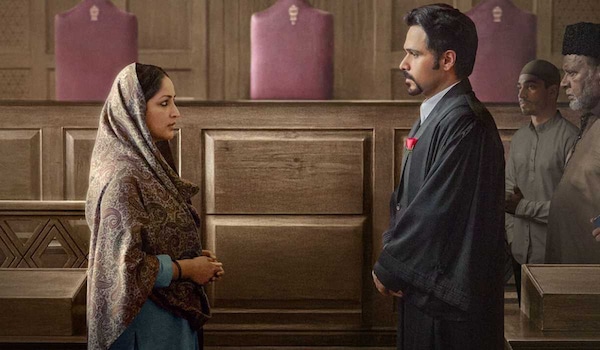
A dedicated wife and mother named Shazia Bano (Yami Gautam) has her world turned upside down when her famous lawyer husband, Abbas Khan (Emraan Hashmi), remarries. A ten-year legal struggle that questions the very basis of Indian personal law develops out of what starts as a family disagreement.

The majority of the film takes place in the 1980s and 1970s. In Aligarh, Shazia and Abbas's life is reasonably decent; they have three children. Problems arise in their marriage, though, when Abbas goes to Pakistan to settle an ancestral property dispute and then comes back with a second wife, Saira (Vartika Singh), shattering the stability of their marriage.
What specific moment of abandonment forces Shazia to seek refuge?
Shazia tries to adjust to the new household situation, but Abbas's emotional and financial abandonment becomes too much. When Abbas disregards Shazia's request for his time on their wedding anniversary, the tension escalates, leading her and her children to flee to her father's house.
Even though he is a religious scholar, Shazia's father, Maulvi Basheer (Danish Husain), approves of her decision to seek maintenance. Shazia goes to the local courts when Abbas stops giving her the pitiful ₹400 monthly payment that he had promised. Consequently, Abbas makes use of his religious status and legal training to issue a Triple Talaq, formally dissolving the marriage and asserting that, after the Iddat period, he is exempt from providing for her according to Sharia law.
Who represents Shazia in court and what secular law do they use?
The film's second act primarily revolves around the confrontation in court. Sheeba Chaddha portrays Shazia as Bela Jain, while Aseem Hattangady portrays Faraz Ansari. Their petition invokes Section 125 of the Code of Criminal Procedure (CrPC), a secular statute that requires a husband to support a woman who cannot do so on her own.
Abbas Khan, representing himself, asserts that Muslim Personal Law governs his marriage duties. He argues that providing Shazia maintenance would be an invasion of religious freedom and that secular courts do not have the authority to interfere in matters of faith.
How does the case transition from a local dispute to a national controversy?
The case escalates from a "small domestic skirmish" to a "big national war" as it progresses through lower courts, the High Court, and ultimately the Supreme Court of India. Overshadowed by the political and religious figures involved, the film focuses on how Shazia's case became a political and religious flashpoint.
At the film's climax, Haq focuses on the Supreme Court's last arguments. The ending leaves the audience with an intellectual reckoning and a final resolution to Shazia's legal odyssey.
What historic ruling does the Supreme Court deliver regarding secular support?
At the end of the film, Shazia Bano achieves a historic triumph. Judges of India's highest court have ruled that all citizens, irrespective of faith, are subject to Section 125 of the Criminal Procedure Code. The court argues that the fundamental goal of the law is to protect citizens against secular concerns like homelessness and vagrancy. It is stressed by the judges that if a divorced wife is unable to support herself, the husband's duty to do so continues even after the Iddat term ends.
The final conversation between Shazia and Abbas marks a pivotal moment in the narrative. As the trial progresses, Abbas presents the matter as a "contractual" one, stating that Islam views marriage as a civil contract that can be terminated in accordance with particular religious regulations. Shazia rebuts the claim in her last speech by highlighting the partial implementation of religious legislation. She wonders why society never uses Sharia's punitive parts—like lashes for Triple Talaq abusers—but uses men's rights as a "fig leaf" to get out of their essential humanitarian duties.
Beyond the legal win, how does Shazia find personal restoration?
In the film, Shazia finds solace in the restoration of her dignity as well as the financial support she receives. Despite losing her father during the trial and facing social isolation from her town, she maintains her composure.
Instead of transforming Abbas into a cartoon villain, the film opts to give him a human side. We see him as a man whose strict adherence to the law and sense of entitlement cause him to lose sight of reality. The film suggests that Shazia's fight for the "right" (Haq) was about more than money; it was about her voice, too, despite her court loss.
What does Haq say about the power of education?
The key to Haq is its examination of the "casual cruelty of tradition" and the "male entitlement" that upholds it. The film contends that religious interpretations that prioritise one gender over another should not take precedence over human rights and dignity. Subtly but surely, the story revolves around the power of education and how Shazia uses her profound knowledge of the Quran to confront the "custodians of faith" despite her lack of a formal education. The climax stresses the need for the judiciary to safeguard vulnerable people through secular laws in cases where personal laws do not offer justice.
Despite the film's steadfast adherence to the 1980s, the post-credit scenes seamlessly transition to the present day. Using Shazia Bano's 1985 triumph as a stepping stone, it recognises the lengthy process of legal reform in India, highlighting the 2019 prohibition on Triple Talaq in particular.

Why does Haq focus on the individual woman’s victory over political aftermath?
Haq deconstructs a changing legal system in a clinical and emotive way. The filmmakers chose to finish the film with the Supreme Court verdict, celebrating the "moment of victory" for the individual woman, instead of exploring the political ramifications of the 1986 legislation that aimed to overturn the ruling. The emphasis remains squarely on Shazia's strength and her fruitful search for her Haq (Right) because of this decision.
Haq FAQs:
Q: Is the movie Haq based on a true story?
A: Yes, Haq is heavily inspired by the landmark 1985 Shah Bano case (Mohd. Ahmed Khan v. Shah Bano Begum).
Q: Where can I watch the movie Haq?
A: Haq is currently available for streaming on Netflix. It began streaming on the platform on January 2, 2026, following its successful theatrical release in November 2025.
Q: Who is in the cast of Haq?
A: Haq features Yami Gautam Dhar as the protagonist Shazia Bano and Emraan Hashmi as her husband, the lawyer Abbas Khan. The supporting cast includes Sheeba Chaddha as Bela Jain, Danish Husain as Maulvi Basheer, Vartika Singh as Saira, and Aseem Hattangady as Faraz Ansari.