


Thriller Thursdays: Jaws – A Summer of the Great White Shark!
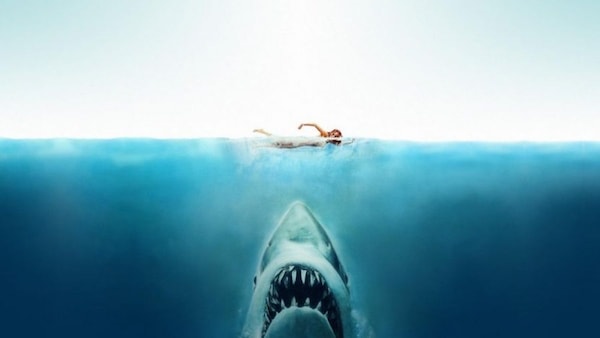
One summer, a massive shark embarks on a killing spree on residents and tourists of an island in the Atlantic Ocean. Three men from diverse backgrounds come together to hunt it down before it kills anyone else.
Last Updated: 06.59 PM, Feb 03, 2022
Intro: In our new weekly column, Thriller Thursdays, we recommend specially-curated thrillers that’ll send a familiar chill down your spine.
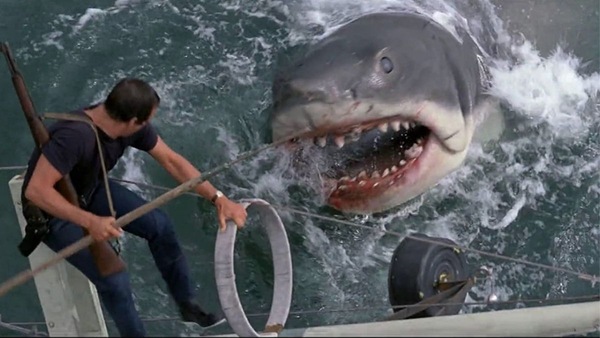
When you finally see the shark as a complete mean gigantic machine in the film Jaws, 1.21 hours into the two-hour film, it still freezes your blood. The incredible thing about the scene (a feature common with all the scenes including the shark) is that it has been conceived with no graphics, no digital overlays, no VFX. It is literally a shark – albeit created animatronics in a workshop where there were three prototypes created – tossed into the Atlantic Sea near Martha’s Vineyard, USA, in the summer of 1975.

Amity is a typical holiday island, living on the largesse of tourists who tumble into its streets in the summer to spend time in its pristine beaches and shimmering waters. And it sparkles with the warmth and conviviality of friends and strangers out to have a good time. All is well, till a young girl, high on life, decides to go for a late-night skinny-dip, and is pulled into the dark lonely waters, her terrified screams going unheard. The Amity Island Chief of Police, Martin Brody (Roy Scheider) is the first responder, and what he discovers on the beach is a chewed-off female hand, strewn with crabs, and a deputy vomiting beside it.
A medical examiner concludes that the death is due to a shark attack. Brody immediately searches for “Beaches Closed. No Swimming” signs but the town doesn’t have any because they’ve never had sharks. Enter the mayor, Larry Vaugh (Murray Hamilton), a smooth talker in striped suits. The problem, he says, is that it’s June 29 and the bumper 4th of July weekend is just around the corner, with its array of tourists and the constant influx of dollars. He gets the coroner to say that the girl’s body had been caught in the propeller of a boat and got mangled. No sharks, hence no panic, no restrictions.
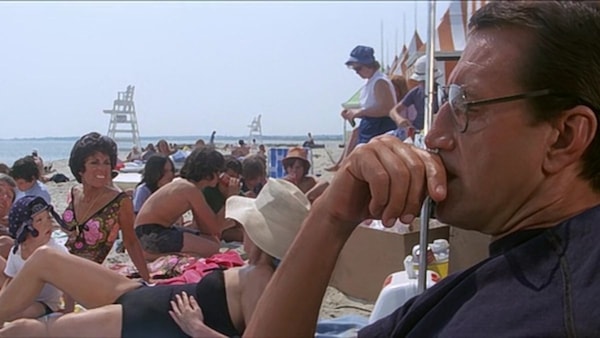
And 4th of July comes with its hordes of holidaymakers, and the beautiful happiness of a summer afternoon and the calm sea waters with dogs jumping on the shore, girls floating in the pristine waters, lovers kissing – and suddenly, there’s a false alarm of a shark in the waters! After the initial panic, everyone gives up worrying and decides to have a good time! Till the one with the large fin comes stealthily, attacks ruthlessly, and leaves behind a torn rubber floater and a kid pulled into the silent sea, with only a pool of blood left in its wake.
Amidst the mayhem comes the sensible voice of Matt Hooper (Richard Dreyfuss) from the Oceanographic Institute, who informs the town authorities that what they are dealing with is a monster, a great white shark – Carcharodon carcharias. A man-eating machine, whose only job is to consume and procreate.
Brody and Hooper combine forces along with a professional shark hunter Quint (Robert Shaw) and set off to hunt the beast. The three characters are sketched out deftly and as they set out to sea in Quint’s rickety boat, whose every part seems to be straining at its end, one can see the relations run amok. Quint is a boor (“You’re on board my vessel, I’m mate, master, pilot, and I’m captain.”) — arrogant, vulgar, acerbic, garrulous. Hooper is methodical, systematic and modern. A lot of tension is derived from wondering what will break at the seams first — the boat or the dynamics between the different characters.
They plan on enticing the shark with bait to lure him into a position where he could be harpooned and killed. Soon enough, they get to see the Great White Shark as it comes unawares — a 30 foot-long, 3 ton-heavy killing machine. They manage to harpoon it with a line attached to a flotation barrel, but the shark pulls the barrel underwater and disappears. And the cat-and-mouse game begins. The film, in its final stretch, is a tension-packed battleground of doggedness, guts and luck, leading to an explosive finale, drenched in a paroxysm of blood, skin, clots and flesh.
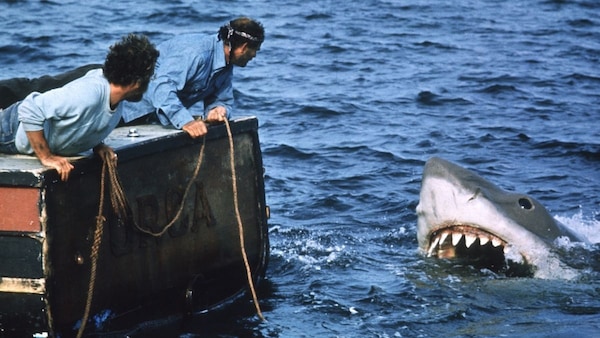
Spielberg has leavened the action with patches of camaraderie and banter, particularly with Quint talking about his past encounters with sharks. Knowing that the beast is roaming around with a harpoon stuck in its back, there is a thread of tension underlying all interpersonal equations. It doesn’t help to have Quint’s boat creaking its old bones out with every toss of the waves. As viewers, we are forever at the edge of our seats because we don’t know when the shark would attack again.
Jaws has gone into the annals of film history for several reasons, not least because it’s such a fine film. Even today, almost 50 years since its release, its thrills have not dimmed. Its linear structure enables it to focus on principal things only — the dread of the beast and the battle to neutralise it. But more than that, it is Hitchcockian in its approach — it hints before it shows. The fact that the mechanical shark which Spielberg had insisted on, frequently malfunctioned on sets, made him work on the effects of a shark attack, without showing the actual shark. And the music by John Williams, with its intense bars of frightening and instantly recognisable notes, makes the fear immediate and tangible.
The film was slated for 55 days of shooting and ended up taking 159 days, and had an initial budget of $4 million but ended up costing $9 million. Yet, such was its marketing and hype that it had recovered its cost within 10 days of its release. The film went on to redefine how movies could be marketed and released — with maximum number of halls at a go, and soon summers became synonymous with easy-concept, high-decibel films.
At once a thriller, an action movie, a horror film and a film about growing friendship, Jaws is truly one for the history books.
Trivia:
- Whilst the shark was being built in a workshop, director Steven Spielberg and his friends Martin Scorsese and George Lucas dropped in to oversee the progress. Lucas stuck his head in the shark’s mouth to see how it worked. And just to tease him, Spielberg clamped the jaws shut on Lucas’ head! As it turns out, the clasp of the dummy shark got stuck and Lucas had to remain stuck in the shark’s mouth momentarily. The event shook up the filmmaker and it’s said that he dashed out of the workshop once he was able to retrieve his head from the dummy shark’s clasp.
- The making of Jaws is another story altogether, and I would urge you to checkout the first season of the podcast Blockbuster, for a dramatised version of the story.
- Peter Benchley, the author of the book on which the film is based, appears in a small scene in the film as a reporter.
Watch Jaws here .
(Views expressed in this piece are those of the author, and do not necessarily represent those of OTTplay)
(Written by Sunil Bhandari, a published poet and host of the podcast ‘Uncut Poetry’)