


Why Dahaad remains gold standard for Cyanide Mohan adaptation over Bhagwat and Kalamkaval
Kalamkaval, Bhagwat and Dahaad adapt the Cyanide Mohan case. Dahaad excels, using its series format to provide social depth and character nuance that the condensed film versions lack.
Last Updated: 02.07 PM, Jan 18, 2026
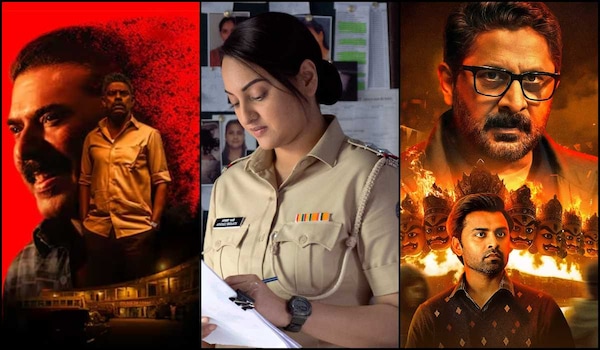
Sony LIV's (OTTplay Premium) recent streaming of the Malayalam crime thriller Kalamkaval (2025) has rekindled debates about a subgenre of Indian true-crime films: the adaptations of the "Cyanide Mohan" case. After a tremendous run in theatres, where it earned more than ₹75 crores in just three weeks, the film, which starred Mammootty and Vinayakan, made the switch to digital streaming on January 16, 2026. Some have drawn parallels between it and two other titles since its release: series Dahaad (2023) on Amazon Prime Video and film Bhagwat: Chapter One – Raakshas (2025) on ZEE5 (OTTplay Premium).
Who is the real-life figure behind these three adaptations?
Each of the three shows is based on the true story of Mohan Kumar, a serial murderer from Karnataka who killed twenty women in the years between 2003 and 2009. The three titles showcase the changing face of Indian crime fiction and the benefits of the long-form series format. The source material is unchanged, but the execution, narrative focus, and reaction are all different.

The terrifyingly repetitious gameplay of the antagonists in Kalamkaval, Bhagwat, and Dahaad is a unifying theme. Cyanide Mohan really preyed on emotionally or financially weak women, particularly those who were single, widowed, or had little means to pay a dowry, all of which contributed to the societal shame that these women faced. He would befriend them, offer them marriage vows, encourage them to run away, and then use cyanide pills disguised as birth control to murder them in public restrooms.
Kalamkaval (2025)
Kalamkaval is a Jithin K. Jose film that takes place in the early 2000s on the border between Tamil Nadu and Kerala. An unexpected turn in the plot occurs when the killer, Stanley Das (Mammootty), turns out to be a police officer. He guides the investigation headed by SI Jayakrishnan (Vinayakan) and manipulates evidence with his intimate knowledge.
The film's psychological framework is a "cat-and-mouse" game. Unlike more conventional whodunits, the film reveals Stanley's identity early on. The conflict revolves around Jayakrishnan's decision to expose his double existence as a predator and a family man. Despite receiving positive reviews for Mammootty's "enigmatic presence," critics questioned the film's logic in Kerala, where the disappearance of a prominent figure involved in numerous murders seemed improbable.
Bhagwat: Chapter One – Raakshas (2025)
Directed by Akshay Shere and released in October 2025 on ZEE5 (OTTplay Premium), Bhagwat features Arshad Warsi as the title character, Vishwas Bhagwat, a police officer, and Jitendra Kumar as Rajkumar, also known as Sameer, the antagonist. Poonam Mishra, a young woman, goes missing in this film set in Robertsganj, Uttar Pradesh.
This rendition maintains the procedural and legal elements of the case. Following the crimes, the film explores the subsequent events, including the killer's attempts at self-representation in court. The film was frequently called "Dahaad Lite" by audiences, even though Warsi and Kumar gave excellent performances. Some felt the film lacked originality beyond its status as a "good one-time watch" due to its slow pace and non-linear storyline.
Dahaad (2023)
Dahaad is the most critically appreciated of the three titles that Reema Kagti and Zoya Akhtar created. The story follows the lead detective, Anjali Bhaati (Sonakshi Sinha), as she investigates a string of 27 women's disappearances in Mandawa, Rajasthan. Vijay Varma portrays the serial killer, Anand Swarnakar, as a family man and a college lecturer.
Dahaad distinguished itself by subverting patriarchy and casteism through the use of the crime thriller genre. It made history by making its world premiere at the Berlin International Film Festival, making it the first Indian series to do so.
Why did Kalamkaval and Bhagwat struggle to achieve the same critical standing as Dahaad?
A robust theatrical release in Kerala and the Gulf Cooperation Council (GCC) helped Kalamkaval work well at the box office, but the film's "leave-your-brains-at-home" logic in the last act caused some people to question its validity. Bhagwat suffered from being released too close to Dahaad, making its plot feel "tiringly familiar" to Hindi-speaking audiences who had already consumed the same story in a more detailed format.
Both critics and viewers agree that the longer series version of Dahaad was better than the condensed film adaptations. The 2023 series is still considered the best in its genre for a number of structural reasons.
How does the series format allow for a deeper exploration of the antagonist’s daily life?
A two-hour film like Kalamkaval or Bhagwat will typically depict brief montages of the antagonist's home life. You may lose yourself in Anand Swarnakar's world for hours on end in Dahaad because of the show's premise. We watch him deal with a troubled marriage, engage with his son, and teach underprivileged children. His abrupt transitions towards predatory behaviour are far more startling and effective because of this gradual exposure. There is no way that a 120-minute film could have given Varma the opportunity to create a "banality of evil" in that amount of time.
Serial killer films frequently depict victims as objects of narrative or statistics. The eight episodes of Dahaad provided ample screen time to explore the women's backstories before their murders. The audience could relate to the family's struggles, desperation, and how easily they fell for Anand's charms. The finding of their deaths in public restrooms had a considerably greater impact due to this emotional engagement than the fast-paced murder scenes portrayed in the movies.
In what ways did Dahaad integrate social and religious subtext more effectively than the films?
Dahaad deftly wove religious tension (the "love jihad" angle) and caste discrimination (Anjali Bhaati's personal battles) into the central probe. Bhagwat treated these parts as mere "virtue signals" or checklist items. Kalamkaval significantly underemphasised the social background of the victims due to its excessive focus on the Mammootty-Vinayakan duel. The format of the series made these "atmospheric" details an asset to the story, not a weakness.
Both Kalamkaval and Bhagwat frequently struggle with the film's final act, which intensifies the investigation to meet the running time constraints. Checking phone records, tracking SIM cards, and forensic analysis were depicted in the latter episodes of Dahaad as the monotonous and grinding work of police processes. The eventual arrest felt earned because of this patience. In contrast, several critics thought the "complex twist" in Kalamkaval involving a retired forensic expert to be "deeply implausible" and lacking in logic.
Can the star power of Kalamkaval compete with the legacy of Dahaad?
With the premiere of Kalamkaval on Sony LIV (OTTplay Premium), the Cyanide Mohan case has been adapted into three high-profile films. Both Kalamkaval and Bhagwat try to depart from the Dahaad legacy, but neither succeeds despite the star power and distinctive "killer cop" viewpoint of the former.




The 2023 true-crime series demonstrated that the serial format is the best vehicle for stories with intricate social layers and recurring patterns. This enabled the narrative to go further into the "why" of a culture that permits such predators to flourish in its oblivious places, rather than only focusing on the "how" of the killings.
Kalamkaval FAQs:
Q: Is Kalamkaval based on a true story?
A: Yes, Kalamkaval is loosely inspired by the real-life crimes of Mohan Kumar, notoriously known as "Cyanide Mohan."
Q: Where can I watch Kalamkaval online?
A: Following its successful theatrical run in late 2025, Kalamkaval is currently available for streaming on Sony LIV (OTTplay Premium). It premiered on the platform on January 16, 2026, and includes dubbed versions in Hindi, Tamil, and Telugu for a pan-India audience.
Q: Who plays the serial killer in Kalamkaval?
A: Malayalam superstar Mammootty portrays the antagonist, Stanley Das. Unlike traditional whodunits, Kalamkaval reveals his identity early on, focusing instead on the psychological "cat-and-mouse" game between him and the investigator, played by Vinayakan.