


Accused review: Konkona Sen Sharma’s cold brilliance and Pratibha Rannta’s mounting doubt anchor a bold, messy, and necessary queer thriller
Accused stars Konkona Sen Sharma as a queer surgeon facing misconduct claims. This sharp #MeToo thriller explores gender bias, medical misogyny, and how public perception can distort the truth.

Last Updated: 01.31 PM, Feb 27, 2026
Accused story:
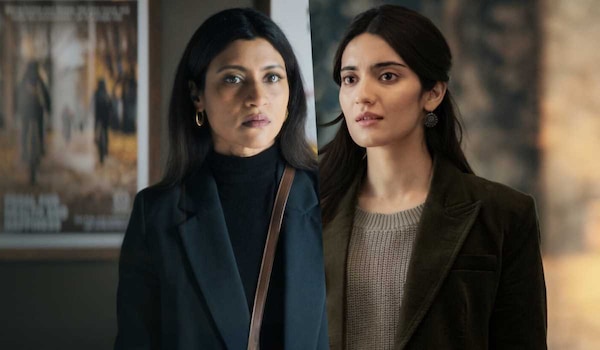
Starring Konkona Sen Sharma and Pratibha Rannta, Accused is a riveting psychological thriller directed by Anubhuti Kashyap. The protagonist, Dr. Geetika, is a renowned gynaecologist and surgeon from London whose life takes a dramatic turn when she faces allegations of sexual misconduct at work. With the scandal's meteoric rise comes a terrifying social media witch-hunt, professional disaster for Geetika, and a strain on her marriage to Meera as suspicion and doubt mount. The film examines the delicate balance between truth and public perception in the #MeToo age—particularly from the perspective of a female accused—set against the backdrop of an ongoing adoption process.
Accused review:
We have seen many recent films and series where women in leadership positions disrupt the status quo, often leading to unforeseen consequences. While men frequently face criticism for their aggressive behaviours in the workplace, the repercussions are usually minimal. In contrast, women are expected to be sensitive and empathetic; they are discouraged from being "tough" and expected to be more forgiving. The result is a persistent gender bias—and one wonders if there is an end to it. Look at the world we are living in! Furthermore, what happens if a female boss makes even a slight mistake? There is often no room for discussion or forgiveness. Be it at home or at work, women are rarely allowed to make mistakes, and that is precisely what Accused explores.

In the film, Konkona Sen Sharma plays Dr. Geetika, a top surgeon living happily with her wife, Dr. Meera, a paediatrician. They are preparing to move, as Geetika has been promoted to Dean, and they are also set to adopt a baby girl, further cementing their family life. However, just as they gear up for this transition, Geetika's senior begins receiving emails alleging sexual misconduct.
Accused features an intriguing cast. Konkona plays a tough, queer doctor who loves her job despite knowing the risks and the fact that medical mistakes can be fatal. As she stands accused, the film progresses by instilling a sense of doubt in the viewers regarding her guilt, which contributes to the ongoing twists and turns.
The film is less than two hours long, but every minute is so gripping that you constantly anticipate a massive twist. While that twist does occur, its impact may not align with your expectations, and the subsequent aftermath is surprising. Accused explores how others refuse to let Geetika keep her personal and professional lives separate. This issue surfaces during Meera’s interrogation, when she realises she lacks certain information about her partner—a situation she had somewhat accepted earlier. However, the accusation becomes a "can of worms" even for Geetika, who realises the intense, judgemental gaze set on her by those around her.
There is also Meera's friend, played by Aditya Nanda. He is a colleague, and they share an inseparable bond. Even if his character doesn't strictly drive the central plot, his perspective is important; he looks at his friend like an unrequited lover despite knowing her sexual identity. There is a subtle, biting line delivered by Meera that suggests that if he were truly a friend, he wouldn't have hidden things from her, noting that such secrecy isn't "protection."
Writers Sima Agarwal and Yash Keswani attempt to balance the script by navigating the delicate line of how a narrative shifts when the gender of the accused changes. Moreover, making the protagonist a gynaecologist adds depth to her character beyond initial appearances. These factors successfully drive curiosity about how the story will unravel.
Ultimately, I felt that Accused was incomplete, despite clearly conveying its message. The story takes a subdued turn, yet it is the aftereffects and the surrounding discussion that carry the most weight. When framed as a thriller, there is a hope that the "reveal" will be eye-opening; however, the thriller elements eventually become an undercurrent to the real issue of sexual misconduct. Despite occasionally showing empathy towards survivors, the film portrays the accuser in a different light.
This narrative shift highlights how much has changed for women in two decades. More than twenty years ago, Abbas-Mustan explored a similar power dynamic in the film Aitraaz, which illustrated how the narrative shifts when the victim of sexual harassment is a man. In that film, the female antagonist—played by Priyanka Chopra Jonas—is portrayed as a clear-cut "predator" who, once proven guilty, is given no path to redemption or escape, ultimately taking her life.
Things have changed significantly since then—for better and for worse. The #MeToo era is far from over, and hopefully, it won't be until a proper safety net exists globally. Lately, I have been reading posts on X regarding "medical misogyny", where women describe how male doctors often assume female patients are "faking it" even when they are in deep pain. Why? Women are conditioned to endure pain, even to the point of death, minute by minute.
In this way, Accused also addresses medical misogyny. When Geetika takes over a case from a male doctor who handled it poorly, he doesn't take it well, allowing his ego to drive his response. For some, it doesn't seem to matter if a patient lived or died; they simply cannot handle being called out—especially by a woman.
The film Accused does not portray Geetika as a flawless partner either. We see her mixing different cuisines to satisfy her hunger, which serves as a metaphor for the complexity and lack of straightforwardness in her character. Even her partner, Meera, wants to thoroughly investigate the allegations, not only regarding the misconduct but also to determine if Geetika has been cheating on her all along. Yes, the film provides all the hints that suggest it is possible for Meera to doubt Geetika, even when she is laughing with her ex.
While the film reduces Rannta's character to that of a doubting wife, I wish they had also depicted her as having a professional life. There are hardly any scenes of her in the hospital with her patients, while Geetika is drowned in work. In one scene, Meera is even asked why, if she is also a doctor, Geetika is so much busier. It also made me question whether there would have been an exploration of her professional life as well. Rannta just becomes a catalyst of sorts for Geetika's life to come full circle, which, to be honest, didn't sit well with me.
Performance-wise, there's no doubt that Konkona is the best choice for this character. The actor can just slip into any role, and it fits her like a glove. She commands the frame in every sequence, and you can feel that her dominance comes from all the effort she has put in to reach this stage of her character. The actor knows when to show that she is ready to break down or take charge, and you just can't take your eyes off her.




Having Rannta as Meera is also a casting coup. Despite the limitations of her character's writing, she infuses the film with the necessary depth and softness. The actor has the charm of wishing to be equal to her partner but is also aware that she still has a long way to go to build a "reputation", as she is constantly reminded of it. I truly liked how Konkona and Rannta came together to become a couple in the film—a rarity that is much needed.
Anubhuti Kashyap has a specific subgenre she likes to explore. She started with Ayushmann Khurrana playing a male gynaecologist in Doctor G and took it a step further by featuring a queer gynaecologist accused of sexual misconduct in Accused. The filmmaker has an important eye, which she utilises well. Even though the ending doesn't entirely land in the right place, it's the narrative that takes the cake eventually.
Having the title Accused means that somebody has done something wrong or broken the law. But when it comes to certain sections of people, it's already a declaration of guilt without trial. The film's "she-said-she-said" situation is sensitive and equally important, showing how one might take advantage of the situation while the other acknowledges the wrongdoings.
Accused verdict:
Accused is a sharp, gender-flipped dive into the #MeToo era that swaps predictable tropes for psychological nuance. Konkona Sen Sharma is magnetic, anchoring the film’s heavy themes of medical misogyny and public trial with effortless gravity. While the "thriller" payoff feels slightly muted, the film succeeds as a biting social commentary.
Subscribe to our newsletter for top content, delivered fast.
