


Four Years Later Review: A piercing tale of marriage, migration, and the mess we carry
Four Years Later Review: A show with an impeccable lead pair, a story that is very relatable, and an execution that mostly lands right.

Last Updated: 06.03 PM, Jul 10, 2025
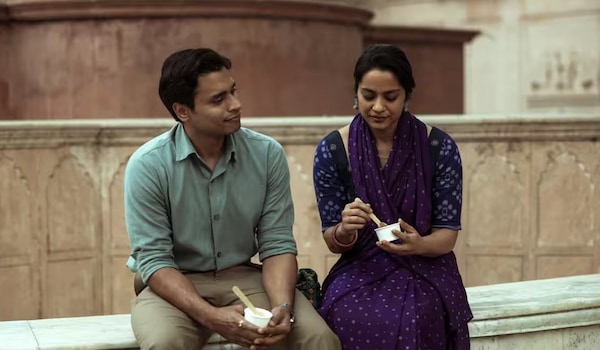
Four Years Later Story: Sridevi (Shahana Goswami) and Yash (Akshay Ajit Singh) are two youngsters in Jaipur looking for suitors to get married. As the star-crossed stories unfold, their meeting is set and the families come together. It is also like fire getting married to water, but a couple of evenings spent together in Jaipur makes them believe they can flow parallelly. But luck takes Yash away to study in Australia for four years, and Sri is left to suffer with her patriarchal in-laws. An SOS call for Yash later, Sri lands in Australia, taking a bold step. But their dynamic is not the same anymore — distance has played its role, and now they must mend the bridge they had once built to dwell together.
Four Years Later Review:
What do two people in love look like? Do they look the same all their lives? Is falling out of love an option? Is a momentary pause supposed to make one guilty? To watch filmmakers dissect love and everything around it is one of my favourite genres in movies, and this month is turning out to be a blessing. Last week, it was Anurag Basu exploring the alleys of love in cities across India in his puzzle of a film Metro... In Dino, and this week it is Four Years Later, created by Mithila Gupta. Two supremely different humans decide they can spend their lives together and even make peace with their families that are equally distinct. But is falling in love and sailing through it that simple? Let Gupta take you on a ride as she tells you to become a lizard on the wall and travel with the two.
Four Years Later in its grammar is not a show that is seeking drama — it is dramatic, but the drama is lived in. There is no attempt to make things more campy because life in itself is enough camp. Here are two people like two pieces of a different jigsaw puzzle trying to get attached to each other. And it is not new that in India, the rest of the pieces of those puzzles are the family members. As the show opens, the middleman in the process of arranging this marriage says these families both belong to upper castes, are well-to-do, and are elite people. To add to it, the mother (who comes across as an educated woman) says their daughter (Sri) is an ultimate homemaker, like the first dream post her puberty was to be someone's doormat. And that is how Four Years Later begins. A woman is being marketed to be intact, fertile, and completely useful for all purposes the patriarchy wants her to be.

Written by Mithila Gupta, Nicole Reddy, and S. Shakthidharan, with Fadia Abboud and Mohini Herse as directors, Four Years Later taps into this very pool of selling children the dream of a perfect marriage. It is a show that looks at a woman who was independent enough to make the man she is about to marry taste liberation for the first time, and has now succumbed to his patriarchal father and family because — love. But till when? Does she not miss the taste of liberation herself? And we meet her on a flight to Australia. Here she is, a woman who holds her culture close but can also strip down to her lingerie for a swim in the ocean. She can make friends and move around while taking care of her husband.
Four Years Later blooms into a show that wants to say a lot of things — immigrant lives, distance that ruins relationships, families that feel ownership over daughters-in-law, and so much more. The writing is shaped like a pressure cooker. The world around Sri only keeps triggering the heat until she cannot control it anymore and bursts. The fact that the father-in-law not once even cares to ask if Sri is alive after she has had a miscarriage makes you, as an audience, angry. Mithila makes sure she reaffirms the fact every single time that each person in this frame belongs to an upper-middle-class family of all educated folks. Education does not mean a person is also progressive, and that message comes out so beautifully in here.
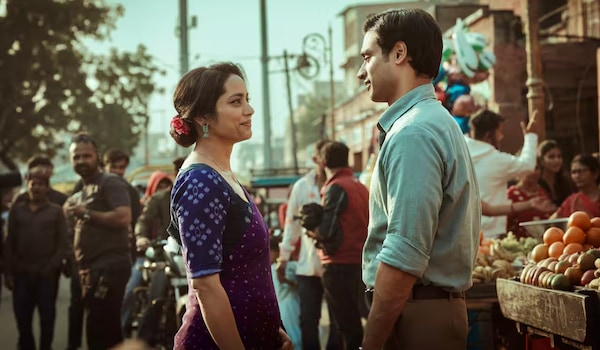
The characters are written in the most relatable blueprint. They have done mistakes that will haunt them forever, but the other person also has the same darkness in him somewhere. They both can probably meet at a midpoint where they forgive each other or brush it all under the carpet they might probably get intimate on the next day. Relationships are so beautifully explored in Four Years Later that you will feel the realness of it all. The intimacy is so beautiful and raw. Both Shahana Goswami and Akshay Ajit Singh bring the most vulnerable sides of themselves in front of the camera, and it is not easy.
Goswami goes through waves of emotions and scenarios, and she makes sure you feel each one of them through the screens — her helplessness in Jaipur when Yash is away, her guilt that eats her each day in Australia, the sparkle in her eyes that comes with packets of liberation. Each moment is so well-acted. Akshay Ajit Singh is a marvellous actor. He literally shapes two different people through his performance — the guy in Jaipur and the responsibility-ridden man in Australia. The actor, in his silences, brings out the best, and together he and Shahana create magic on screen.


The only thing that bothers in Four Years Later is the pacing of the show, which gets abrupt at certain points, and the balance between Hindi and English. In Jaipur, to imagine a middle-class family speaking only in English is next to impossible. That is where the realism takes a short break every time. It is also very sad that Sri never gets to give it back to the father-in-law who once slapped her for no reason.
Four Years Later Review: Final Verdict
Four Years Later is not a cup of everyone's tea, but for the ones who can dig their teeth deep into drama that replicates life and is not amped up for wild reactions — this is for you. Feel the love, the pain, the longing, and everything in between.
Four Years Later will be released on Lionsgate Play on July 11, 2025. You can also watch it with your OTTplay Premium subscription. For more reviews like this, stay tuned to OTTplay.
Subscribe to our newsletter for top content, delivered fast.
