


Tere Ishk Mein review: Aanand L Rai's fiery spiritual 'Raanjhanaa' sequel traps Dhanush and Kriti Sanon in a saga mistaking obsession for epic romance
A morally troubling "spiritual sequel" to Raanjhanaa, Tere Ishk Mein glorifies destructive, non-consensual love. The 3-hour film is an exhausting melodrama that incinerates viewer empathy.

Last Updated: 02.08 PM, Nov 28, 2025
Tere Ishk Mein story:
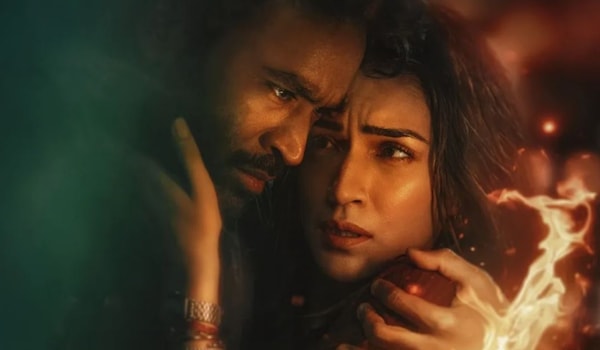
Tere Ishk Mein is a raw and intense romantic drama that takes place in the emotionally resonant setting of Delhi. It is about Shankar and Mukti's (Dhanush and Kriti Sanon) all-consuming love, which leads them into a storm of overwhelming emotions, impossible choices, and heartbreak. Circumstances drive a wedge between Shankar, whose limitless, ferocious devotion defines him, and Mukti, a woman battling with inner anguish and tragic memories. Tragic themes such as surrender, loss, vengeance, and the transformative—yet destructive—power of eternal love are explored throughout the story as Shankar, who is dealing with personal loss and betrayal, confronts Mukti during her wedding rituals, setting the stage for their destructive journey.
Tere Ishk Mein review:
Are we still living in a world where "no" is still a negative word? Are we still living in a world where it's ok when a man threatens to burn the city if his love is rejected? Are we still in a world where knowing whether the girl's love is consensual or not is not important at all? Well, in the world that Aanand L. Rai has been creating from Raanjhanaa (2009), this is the ideal way to live. When we see movies with extremism, we as viewers are expected to be smart enough to understand that all things shown with every rule broken should not be taken seriously and it's only for fictional purposes. However, the jarring pattern is repeated to constantly remind viewers not to take these elements seriously, which highlights a hypocrisy that is clearly evident.

We are still living in times where films like Kabir Singh, Animal, Raanjhanaa, Ek Deewane ki Deewaniyat, and many more are being made to show the extreme love of a man irrespective of the fact that it's reciprocated in similar ways or not. We have seen love which is forced, threatened, and leaves no stone unturned in self-destruction, which has been hailed as a real romance. Yes, ok, fine, I agree that such people might exist in real life as well, but showing them as a good person underneath the layers of worst nature is still tough to digest.
ALSO READ: Tere Ishk Mein: CBFC greenlights Dhanush-Kriti Sanon's romantic drama; only one dialogue modified
Tere Ishk Mein begins with a prim and proper Dhanush as Shankar, an Indian Air Force pilot and the best that they have ever seen. We see that he takes his job very seriously, which causes him to experience a sense of angst. On the other hand, immediately, we see Kriti Sanon as Mukti, who is popping pills, has alcohol near the washbasin and is contemplating killing herself. Oh well, the concept of self-destruction in love has evolved to affect both genders significantly! In no time, we see Shankar and Mukti cross paths, because he has been grounded for breaking rules and needs to be fit mentally to fly his fighter jet once again. And who is his counsellor? The one who herself needs intense healing desperately. Furthermore, she is a nine-month pregnant woman now!
As they see each other after many years, we are taken back to seven years in Delhi, where Mukti, who is seeking a PhD, decides to make violent Shankar her subject of thesis and help him reform into a non-violent person as her pet project. Bottom line, the film is all about the "coming-of-age" of Shankar and his evolution from being a good-for-nothing college boy to becoming an IAF pilot while fighting for the country.
No, it's not as inspirational as Lakshya, although it seemed like Rai thought it would be! The rules are clear in their setting that if he falls in love with her, that's his problem, as she will never love him. However, that expectation must be challenged, right?
Within the first 45 minutes of the film, I was offended at least four times by Shankar's actions and words. Yes, they have well-defined that he is ill-mannered, and being a psychologist, Mukti is also aware of that. But her way of "handling" him becomes such a cliché act of a woman saving the man and expecting only ill-treatment in return. In one of the scenes, Shankar accuses her of having a "God" syndrome, failing to understand that her well-intentioned act was meant to get him back on track.
The script penned by Himanshu Sharma and Neeraj Yadav brings in all topical tropes into the film, which includes a war backdrop as well as how childhood trauma is so important to be addressed. But all these are just on the surface, and they come as situations with the underlying and over-the-top issues of getting rejected in love and self-destruction, which is a must.
In one of the scenes, Mukti does talk about how Shankar's angst comes from his childhood trauma and how it has harmed him in his growing years and continues to do so. And then we immediately see her as an alcoholic pregnant woman who wants to bring the child into this world for a bizarre reason. I mean, respect your profession at least!
In the film, fire serves as the most important prop, and it is depicted in various ways. The film depicts fire in various ways, including throwing fireworks at college lovers, burning down a house in the name of rejection, showcasing terrorist attacks, and lighting a pyre after a loved one dies. But my eyes were getting burnt the most in frustration over seeing what bizarre turn the film is taking when the climax should have happened during the climax scene itself.
It just becomes disturbing and impatient to watch how the film wants us to take the topic of love so seriously and feel worse for the lead actors when all I felt was they just deserve what they are going through only because of their actions. All my empathy was for the friends and family of the lead characters who suffer the most.
It was a delight in the beginning to see Prakash Raj playing Dhanush's onscreen father after their incredible collaboration in Thiruchitrambalam, where the estranged relation between them is justified beautifully. But here, you feel bad for Raj's character having to mellow down and bear the pain of being the father of a son who refuses to grow up or have to live a good life.
The music for the film is composed by AR Rahman, which, although it is intense just as the emotions of the film and fitting too, is what makes it an antithesis.
Yes, the film is definitely the spiritual sequel to Raanjhanaa and floats the same boat, which should be sinking to the bottom immediately.
If this was a Ranjhanaa redemption and course correction, I seriously don't know how Rai thought that this was the right way to go about it. I am still processing all that I witnessed in the three-hour runtime on a Friday morning. I still have so much more to say, but what's the point even?


Tere Ishk Mein verdict:
Tere Ishk Mein's overblown melodrama and toxic definitions of devotion demand patience rather than praise. Aanand L Rai continues his frustrating pattern of mistaking obsession for epic romance. The entire three-hour runtime is less about passion and more about the destructive persistence of a male lead whose actions burn viewer empathy. It’s a loud, fiery sequel that leaves one simply exhausted by the broken moral compass on display.
Subscribe to our newsletter for top content, delivered fast.
