

28 Years Later: The Bone Temple — 2026 Begins With A Zombie-Cold Masterpiece
Nia DaCosta's masterfully written zombie thriller does the unthinkable: it strips the genre of its dangerous flights of fancy, reclaiming the Zombie as a monster of science, not faith.
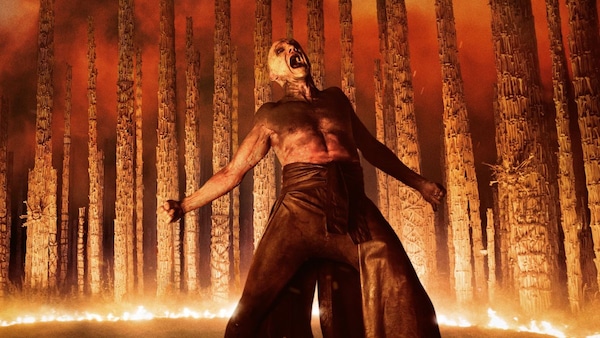
Still from 28 Years Later: The Bone Temple
Last Updated: 05.24 PM, Jan 18, 2026
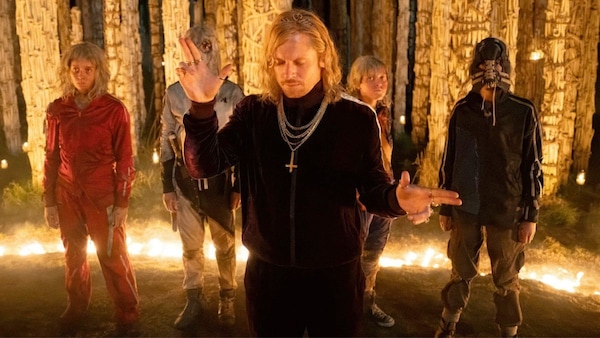
NIA DACOSTA'S 28 Years Later: The Bone Temple directly takes off from where Danny Boyle’s 28 Years Later (2025) left off. The setting is quarantined Britain, 28 full years after the Rage Virus — a mutated strain that transformed its victims into hyperaggressive zombie-like creatures — tore through the continent in 28 Days Later (2002). Few humans have survived. Young Spike (Alfie Williams) leaves the sheltered isle after the death of his cancer-riddled mother (Jodie Comer) to “come of age” on his own terms in the zombie-infested mainland. This film opens with him getting roped into the weird ‘gang’ that rescued him at the end of the last film — except they turn out to be a toxic Satanic cult run by a psychopath named Sir Lord Jimmy Crystal (Sinners’ Jack O’Connell). Spike is too scared to escape the Jimmys, a group that spends their days skinning and killing survivors as a sacrifice to the devil. Parallely, a lonely Dr Kelson (Ralph Fiennes), who urged Spike to find his own way, forges an unlikely bond with Samson (Chi Lewis-Parry), the Alpha leader who terrorised them not too long ago. It’s apparent that, at some point, the paths of the iodine-smothered orange-skinned doctor and a Jimmy’d Spike will cross. What’s not apparent is how a post-apocalyptic zombie thriller can be unexpectedly funny and profound at once: not spoofy-Shaun of the Dead funny, more like Tarantino-Spike-Lee-revisionism funny.
Alex Garland’s script might be a continuation across this double bill, but the contrast in filmmaking (and directors) tells a story. Boyle’s sensory, provocative and disorienting craft channelled the conflict in the first film; much of the gore and violence was inflicted by humans and zombies on each other. The filmmaking kind of reflected the unrest and dissonance between the two worlds. DaCosta’s craft, though, has an unnerving stillness to it; even the score — which was previously designed to contradict the chaos of the images — sounds more inevitable. The style reflects a more ‘conventional’ world, in which the biggest threat posed to humans comes from other humans. Most of the bloodshed and attacks (bar one) involve the gang terrorising survivors on a farm, and some of the gang members (‘Fingers’) themselves falling to gruesome deaths. The infected are almost a footnote; the lack of creature-inflicted violence is a running theme, highlighting the irony of zombies being sidelined in their own genre. Nature is healing in the most depressing way possible. It’s as if to ask: who needs the undead when the living can do the damage? And if the humans begin to behave like zombies, it’s almost lyrical that the Alpha being ‘treated’ by the doctor starts to show signs of the human he once was.
The role reversal is affecting, because it ties into the core philosophy of any good dystopian thriller. Given how often we half-jokingly suggest that the only way for modern civilisation to undo its evils is to be wiped out and start over, such movies — like the recent Planet of the Apes franchise — thrive on revealing the futility of this doomsday scenario: history will conspire to repeat itself even if the planet gets another shot at life. Humanity becomes the deadliest virus; there’s already distrust, betrayal, powerplay, cultdom, bigotry, post-truth communities, patriarchy and political posturing. It’s why the protagonists — whether it’s the doctor, a struggling Spike, the one gang-member who protects Spike and doubts their manipulative leader, or even the stoned Alpha — are destined to be empaths; they represent the smallest of glitches in the matrix, a tiny rip in the canon of the new world order. They become the reason civilisation can start from scratch with a glimmer of hope; they face an uphill battle to preserve their morality, conscience and their ability to grieve and repent, the near-extinct traits that distinguish man from beast.
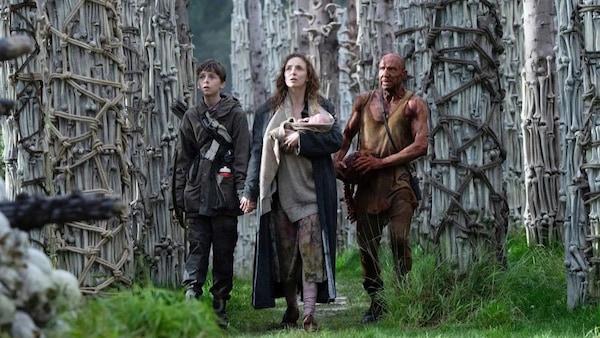
In the context of 28 Years Later, the Rage Virus felt like a specific cultural allegory: of British isolationism in a post-Brexit era; of a nation weaponising its return to a ‘normal’ after the Covid-19 pandemic; of a general disconnect with the rest of the continent (Europe is fine); of boredom-induced outrage turning people and sides against each other with ghoulish ferocity. But The Bone Temple zooms out and reframes the dystopia as a universal symptom; you can almost sense an alternative origin story of mankind, their familiar faults, and their self-serving instincts, as well as the inherently dark decisions they make in a crisis. It’s not an easy balance to strike. DaCosta’s direction sedates the franchise a notch and recognises the tragic circularity of society; it’s like watching even the most outlandish fiction running out of choices and ultimately resembling reality. Except this film reframes reality as a truth — a truth that modern storytelling often sacrifices in pursuit of social entertainment.
The thing about zombie movies as a subgenre is that it’s rooted in the supernatural. The rotting and flesh-hungry corpses are metaphors for real-world cracks and anxieties, yes, but too many filmmakers literalise their physicality to the point of spirituality. The ‘Undead’ is about as paranormal a concept as demonic possession, vengeful ghosts and freelance exorcists — which, by nature, extends into the realms of religious propaganda and catholic extremism. We are wired to simply trust the holy existence of zombies, just as most of us are conditioned into accepting the existence of God and higher powers. The smarter movies remind us of the allegories again and again — using the visual medium to penetrate our everyday minds. But the masterfully written The Bone Temple goes a step further and does the unthinkable: it strips the genre of its dangerous flights of fancy, reclaiming the Zombie as a monster of science and not faith. The “infected” is a medical condition here, not some irreversible act of heaven and hell. The deconstruction of the genre is everywhere — from the doctor’s moments with the ‘healing’ Alpha, the Alpha’s reverse-Frankenstein journey, the sickness revealed as a mass psychosis, Jimmy Crystal’s farcical exchange with the atheist doctor, and the murmurs of scepticism in the godman-like cult.
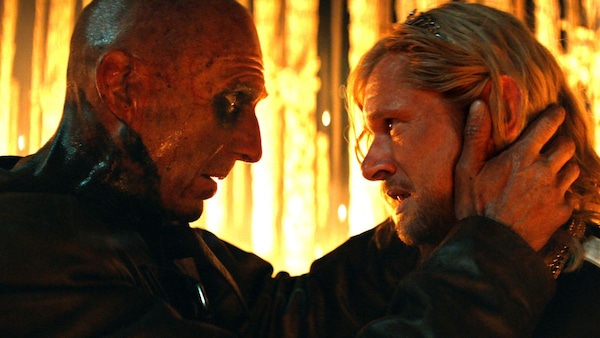
The first film even opens with a young Jimmy seeing his priest father devoured in the church by zombies; the euphoric priest insists it’s a harbinger of the end, and Jimmy inherits his father’s ‘Christianity’ and escapes with an inverted-cross necklace that he eventually extrapolates into his Satanism. All of these little details seamlessly find fruition in the climax of Bone Temple, where religion is crucified at the altar of evolution and compassion. In a way, the fiction isn’t running out of choice so much as exposing the pitfalls of choice. A human exists to spread his make-believe doctrines across the land, only to be confronted with the persuasive powers of science; it’s the rest of the Jimmys — except Spike and his new friend — who look more zombified and hypnotised than the actual creatures. It’s like the film itself changes shape to puncture the leader’s deceptions and prove him wrong.
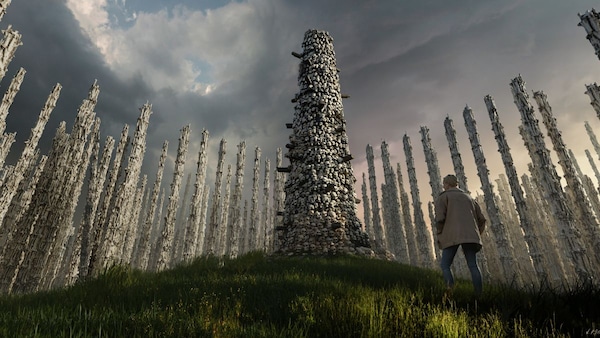
It does this in an unusually droll and tender manner, excavating the bridge between what we see and how we cope; between natural storytelling and the stories we tell ourselves. In that sense, The Bone Temple is an antidote to occult-cementing hits like The Conjuring; it defies all the tropes and jump scares we fetishise in the name of devotion. It demystifies the cinema of rage and horror by suggesting that it perhaps wasn’t cinema and horror all along. Perhaps it was never about rationalising mayhem through myth. After all, a Stonehenge-coded graveyard composed from the bones of victims — the titular setting of the story — is a monument to memory and mourning, not worship and wonder. It’s an ode to remembering why we fall and who we fail: without seeking refuge in scripture, without abdicating the throne of accountability, and without hiding behind the walls of temples, mosques and churches. It’s an invitation to gaze at the sky without attributing its darkness to the stars.