


7 Breakthrough Performers Of Malayalam Cinema In 2025 (So Far)
From Noila Francy in Alappuzha Gymkhana to Prakash Varma in Thudarum, these performers lit up the screen and signalled the arrival of exciting new voices in Malayalam cinema.

FROM LEFT: Prakash Varma, Sushmitha Bhat, Anand Manmadhan and Noila Francy.
Last Updated: 05.17 PM, Aug 20, 2025
FROM DEBUTANTES who brought surprising depth to complex characters, to relatively new faces who turned supporting parts into unforgettable presences, these performers inhabited their roles, leaving us with moments that linger long after the credits rolled. Here are seven actors whose performances lit up the screen and signalled the arrival of exciting new voices in Malayalam cinema.
PRAKASH VARMA | Thudarum:
When CI George Mathan first steps into the frame, there’s no hint of menace. For taxi driver Shanmugan (Mohanlal), already worn down by the insolence of Mathan’s subordinates, George’s genial wit feels almost like a reprieve. But just as Shanmugan begins to warm to him, we begin to see the fissures — a flash of coldness in the eyes, a pause too long before a smile, or a joke that lands with a strange aftertaste. What then emerges is a predator draped in authority, ruthlessly bending situations to his will, reshaping the moral compass of those around him with quiet, almost playful malice.
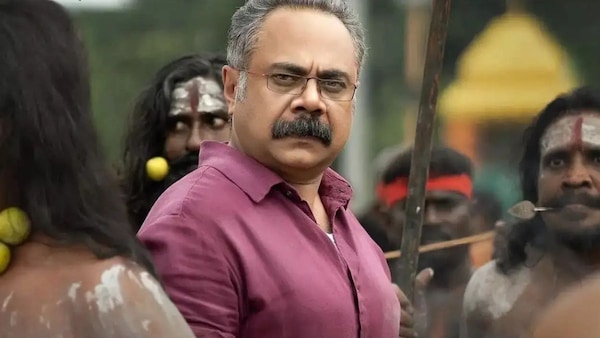
And the descent is made compelling by Prakash Varma’s debut performance. He wears George like a second skin. The moronic laughter, the sardonic grin, the unfiltered expletives delivered with the ease of small talk, or casualness in which he sizes up his crimes to an incredulous Shanmugan are all performed with a chilling nonchalance. There’s an elasticity to his expressions, with each emotion landing with surgical precision. On paper, George could have been a stock antagonist, but in Varma’s hands, he becomes a portrait of layered wickedness — part charm, part brutality.
SUSHMITHA BHAT | Dominic and the Ladies' Purse:
It isn’t hard to understand why Dominic (Mammootty) is instantly drawn to Nanditha. There’s something about her presence that’s enigmatic and elegant, and an allure that finds its sharpest expression when she dances. Sushmitha Bhat is near-flawless as Nanditha, a classical dancer who knows the quiet power she wields over men yet seems unbothered by it, as though it exists in a parallel world to her own.

For a debutante, this is no small feat — portraying a woman’s grace and poise while inhabiting the reality of someone who is, in truth, a man, locked inside that illusion, carrying the weight of both personas. It’s a role that demands restraint, subtlety, and a steady undercurrent of tension, and Bhat delivers on every count. Especially her third act, after the truth unravels. The confrontation with Dominic turns almost physical, and in those charged moments, her performance takes on a raw, electric intensity. Anger surges, denial hardens, and abject hatred flickers — each emotion flashing across her face like quicksilver. And yet, beneath all of it, there’s a quiet tide of sadness, as if we’re seeing not just the collapse of an illusion, but the exposure of a wound.
GARGI & THOMAS | Narayaneente Moonnaanmakkal:
When Athira first meets her NRI cousin Nikhil, there’s an unspoken pull between the two. Nikhil is still piecing himself together after a heartbreak; Athira is quietly navigating the tug-of-war between her aspirations and the controlling presence of a difficult mother. Their connection begins innocuously — shared verses of poetry, fragments of family lore — but it deepens quickly, gaining a rhythm of its own. Soon, it crosses into forbidden territory, a space where desire collides with duty and moral lines blur. What keeps this relationship from collapsing under the weight of its transgression is the performances.

Gargi lends Athira a quiet strength, layering her with maturity, restraint, and an undercurrent of longing that feels lived-in. Thomas, in contrast, is all open-hearted innocence, his Nikhil marked by a charm that never feels calculated. He nails the NRI bearing, the easy physicality, the unforced mix of accents, even while still letting us see the vulnerability beneath. Together, they make the taboo feel achingly human.
SANDEEP | Padakkalam:
When we first meet Jithin, he’s anxious about his girlfriend’s emotional distance, only to be blindsided by her decision to end things. His mild-mannered nature, bordering on timid, takes his time absorbing the blow. But then comes the body-swapping twist, with his cocky, self-assured professor. Suddenly, Jithin’s physical shell houses a persona that’s brash, confident, and alien to his core.
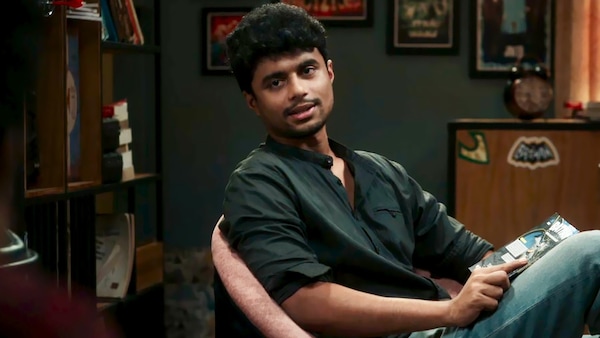
Sandeep’s performance thrives in this duality. He moves seamlessly from soft vulnerability to alpha assertiveness, never letting one bleed messily into the other. The shift isn’t just in voice or posture — it’s in the eyes, in the tempo of a sentence, in the way he carries his frame. There’s especially a moment when Jithin, now charged with the professor’s swagger, loudly smirks at the man himself. It’s a small beat, but one that sets the actor’s knack for turning a high-concept role into something sharply human.
NOILA FRANCY | Alappuzha Gymkhana:
Sherin is a Betty Cooper archetype, but with a welcome twist — she doesn’t wear her heart on her sleeve. Her bond with Jojo (Naslen) is rooted in warmth and ease, a friendship she isn’t secretly wagering will turn into romance, yet she steadfastly nurtures it. She’s the quiet constant in his life, offering presence rather than promises.
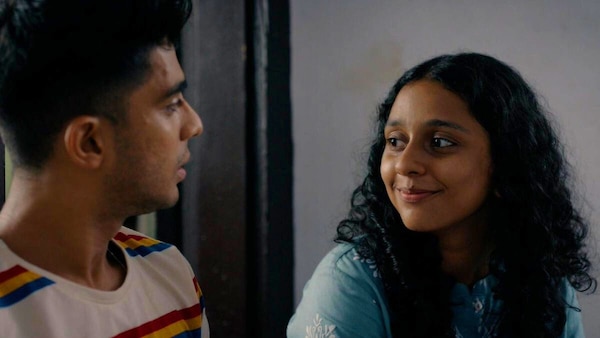
One of the film’s loveliest moments belongs to her: Jojo, feeling insecure about his appeal to women, is met not with pep talks or pity, but with a simple, instinctive act of love that cuts right through his doubt. It’s understated, intimate, and all the more moving for its lack of theatrics. Though Noila Francy’s screen time is limited, she leaves her mark through quiet steadfastness, and in doing so, becomes one of the film’s most endearing presences.
ANAND MANMADHAN | Ponman:
Bruno is the kind of party worker we all recognise — the perennial troublemaker who hides behind party loyalty to dodge personal responsibility. At home, his mother is quietly struggling to scrape together gold for his sister’s wedding, but Bruno’s waywardness has alienated both the church and the party, leaving the family in a deepening bind. Anand Manmadhan slips into Bruno’s skin effortlessly, making us oscillate between sympathy and frustration.

There’s a striking moment when Bruno’s sister (Lijomol) confronts him about his recklessness — the actor’s face registers a complex mix of shame and wounded pride. Later, when Bruno contemplates suicide, only to be met with a sharp, almost brutal reality check from Ajeesh (Basil), Manmadhan plays the scene with a raw vulnerability that never feels forced. Manmadhan inhabits Bruno, making us believe in a man caught between defiance, defeat, and the faint hope of redemption.