


Aap Jaisa Koi: Leave Bengalis Alone
With Vivek Soni’s directorial feature Aap Jaisa Koi, both Dharma and Netflix (the streamer) operate on the lowest level of creativity. It unfolds as a masterclass in vacuity.
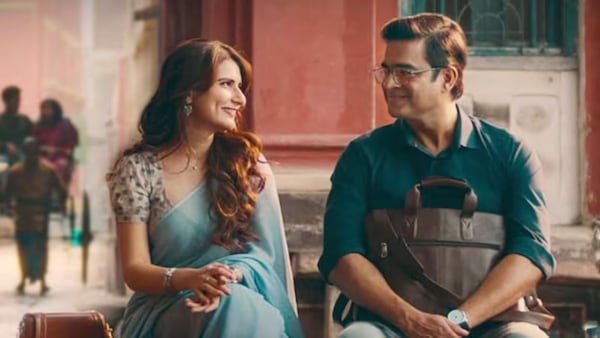
Still from Aap Jaisa Koi | Netflix
Last Updated: 04.40 PM, Jul 11, 2025
SUCCESS IMPROVES MOST THINGS except Hindi cinema. Past proves that acceptance of a certain kind of film often spawns inferior versions of the same. Many are guilty, but perhaps none more than Dharma, the production company that has made a business model out of a single premise: youth sparring with age. In Kabhi Khushi Kabhie Gham (2001), filmmaker Karan Johar, also the co-owner of Dharma, played with traditional trappings as a young man resisted parental pressure without standing up against it. Success followed, and so did similar iterations; in 2023, he fortified the defiance of young love in Rocky Aur Rani Kii Prem Kahaani (2023) and two years later, his banner has bankrolled Aap Jaisa Koi, a shell of a film that is all framing.
The point of contention remains the same: tradition holds the sword to love. But Vivek Soni’s film is also generously influenced by Rocky Rani, and as a result, the discord comprises as much old order stacked against new as the new carrying the vestige of the old. And, yet again, women and the Bengali community (I will circle back to this) shoulder the responsibility for the moral rehabilitation of the men.
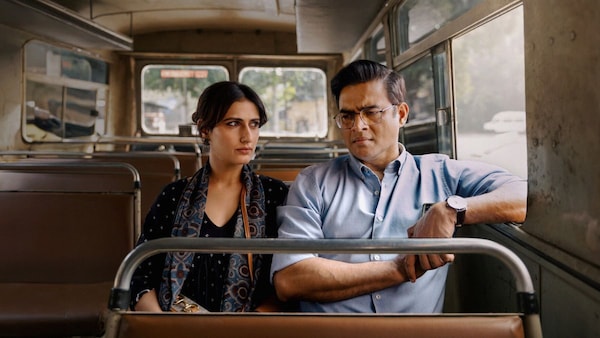
Although repetitive, there is always scope for ingenuity. Hindi films confirm this. But Soni’s directorial feature unfolds as a masterclass in vacuity. It is emptier than a paper bag, more performative than men sharing women's emancipation quotes on dating apps, and more aesthetically curated than Sabyasachi’s Instagram posts. This isn’t a great combination, and Aap Jaisa Koi exists to prove why. Dissections will follow, but here’s a glimpse: the end credits have male and female figures designed like Jamini Roy’s paintings. And before you ask why, the answer is because in the dark world of Dharma, Bengalis have somehow made an impression of being the most reformed of all.
Tagore knows we have our problems. Bengali men take at least four decades to mature emotionally and five to be less dependent on their mothers. Beyond the sheen of literature and music, there is as much orthodoxy to be found as elsewhere, but twice in a row, Johar’s production house has gone to extreme lengths to prove Bengalis’ incorruptible liberal leanings. The misreading refuses to be offset by putting women in the centre. If anything, it proves to be burdensome. Somehow, women are supposed to know better, teach better, and effect transform better for the sake of companionship. If Ranveer Singh’s sensitive Rocky made the effort worthwhile, then R Madhavan’s irredeemable Shrirenu Tripathi makes the exercise look defeatist.
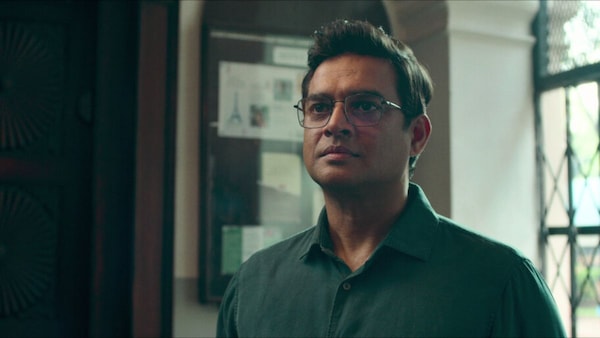
Tripathi is a Sanskrit professor in Jamshedpur. He is also a 42-year-old virgin. Many years back, a girl had not just rejected him but also cursed that he would never find a girl. Time passed, but the jinx stayed. Over time, different complications presented themselves. Either it was his off-kilter name or his quaint field of expertise. Everything, however, added up to him not finding a companion. His elder brother (the inimitable Manish Chaudhari) is as unhappy about this as the rest. Then Shrirenu’s close friend (Namit Das) comes up with a solution: join a sex-chat app (called aap jaisa koi) and find a cure to loneliness. Shrirenu laps it up and soon is besotted with a voice. So far, so Her.
Soni, who previously helmed Meenakshi Sundareshwar, appears to be quite taken by the concept of arranged marriage. The set-up returns yet again as Shrirenu’s sister-in-law finds a prospective bride for him. Enter Madhu Bose (Fatima Sana Shaikh), a French-speaking, Kolkata-based, outspoken Bengali who takes a quick liking to Shrirenu. Everyone is as surprised as him but Ms Bose decodes their rom-com appeal by describing themselves as “cute girl and nerdy boy”.
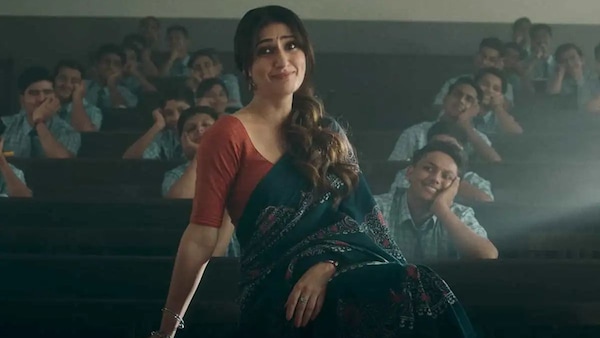
It should be amply clear from this that dialogue is not the strongest suit of Aap Jaisa Koi (in one scene, a teary Madhu tells Shrirenu, “you touched me without touching me”). The worrying bit is that nothing is. Radhika Anand and Jehan Handa’s writing is dismal on all fronts. Stereotypes are not just relied upon but actively perpetuated by using easy shorthands for characterisations.
I can hear the conversations in the writing room. “How do we depict Shrirenu as an old-world?” Let him be the professor of an ancient language. “How do we depict Madhu to be progressive?” Make her a Bengali, throw in a conversation about sexual freedom and let her teach French (even though she says only one French word in the film).”How do we show that Shrirenu’s brother is all muscle and no brain?” Let him be a builder by profession. “How do we bring in a male character who brings joy to a lonely woman’s life? Just name him Joy.
It would have been funny if it were untrue. With Aap Jaisa Koi, both Dharma and Netflix (the streamer) operate on the lowest level of creativity. Conflicts are as manufactured as they come (it is easy to guess), and they are resolved with less effort. One conversation, one fight, one meeting, one instance of a woman voicing her dissatisfaction are all that it takes for the plot to move forward and people to change radically. Such broadness is not uncommon in films like this, but Soni refuses to even try. In the midst, a fight between the two sets of family is scored to Western classical notes, and pillow talks include orgasmic, “Oh Mommy” “Oh Daddy” utterances (I can’t even).
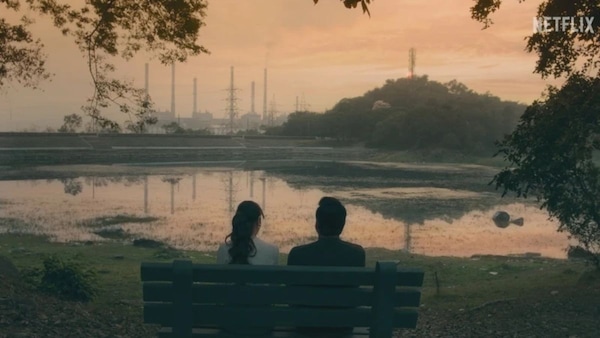
This randomness leaks everywhere, distilling with fuller force in the uncharismatic leads. The younger Madhu is besotted with Shrirenu. It makes sense the way certain manipulations in a story do, but Soni does not justify it, even when the male lead appears increasingly obnoxious and the woman chooses to be forgiving. Both Madhavan and Shaikh are tangibly awkward. They are miscast and saddled with roles they cannot elevate, even if they had tried. Mercifully, they don’t. Shaikh looks particularly unconvincing, and it is strange seeing her so beaten, especially after her visceral turn in Anurag Basu’s Metro... In Dino last week.
Soni has a distinct visual language. This was evident in Meenakshi Sundareshwar as it is in Aap Jaisa Koi. But an aesthetic without purpose is difficult to invest in. Both Jamshedpur and Kolkata look striking but also unimaginative. His gaze is perpetually distant or, as this Bengali would say, performative. Much like his film.
Aap Jaisa Koi is now streaming on Netflix.