


De De Pyaar De 2: Luv Ranjan’s Film Updates Gender Politics, But Through A Man's Lens
De De Pyaar De 2 works like two films at once — the one it presents and the one it wishes to be — and the ideological rift is clearest when it returns to Ranjan’s trademark conservatism.
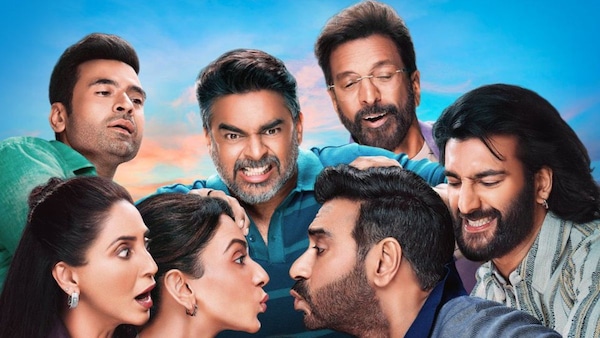
Promo poster for De De Pyaar De 2.
Last Updated: 02.44 PM, Nov 15, 2025
IT MIGHT BE FUN to take a peek inside Luv Ranjan’s head. To find a man-sized hole and witness every emotion hooping through one circle. It ought to be amusing to watch ideas shaped by such a specific outlook — and the stories built around it — with a commitment so absolute that the filmmaker’s default mode of writing assumes a man as the protagonist, the audience, and the gaze. And even when he decides to update his gender politics, he does so through the lens of just one gender: male.
These are not conjectures. Ranjan’s filmography subscribes to this. All his directorial features, barring one, are obviously and frustratingly dedicated to a male audience. This bias has leaked into even the stories he has penned. De De Pyaar De (2019) is a telling example. Designed as an age-gap romance, the outing really breaks down to two women, both financially empowered, holding space and making excuses for a man who puts more effort into holding a whiskey glass than keeping them in his life. They talk, he nods. They sob, he nods. Despite his dismal labour, the narrative allows the man to sleep with one and end up with another; the impunity of his actions translated to commercial success and the start of a franchise. Therefore, in De De Pyaar De 2 (Ranjan has furnished the story), the 50-something Ashish (Ajay Devgn) and 26-year-old Ayesha (Rakul Preet Singh) are back and ready to get married. If in the first part it was Ashish’s estranged wife and children who needed convincing, this time it is Ayesha's parents.
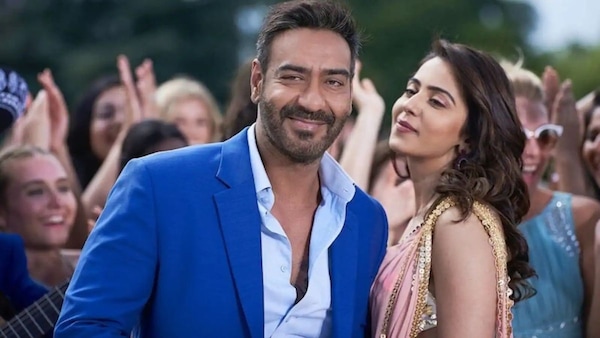
Directed by Anshul Sharma and written by Tarun Jain and Ranjan, De De Pyaar De 2 is distinctly two films – one that it is, and one that it pretends to be. The difference is in the ideologies, and the outing evokes curiosity when it leans on Ranjan’s familiar school of conservatism. For instance, Ayesha’s family is straight out of a picture book. Her parents, Rajji (R Madhavan) and Anju (Gautami Kapoor), are “progressive, educated and modern”. They are deeply in love and treat their pregnant daughter-in-law (Kittu, played by Ishita Dutta) with stifling care (this bit feels an extension of Tu Jhoothi Main Makkaar). On the surface, Ayesha’s confession about wanting to marry someone that older should not be a problem, but turns out, it is.
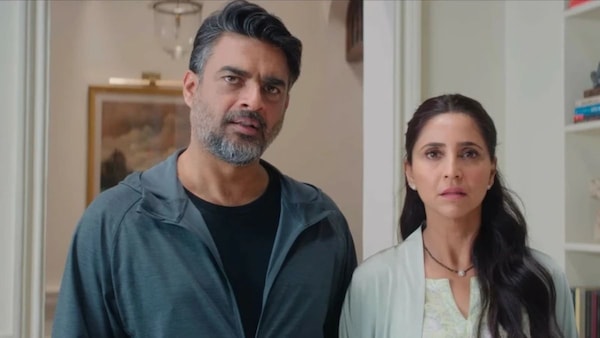
Designed in constant gags, De De Pyaar De 2 is effective when it takes a scalpel to the double standards of a liberal cohort. The unease of Rajji and Anju is played for laughs but exposes the contradictions rooted in such households and people. Pre-interval, the intrigue heightens. The tone shifts, and the cover of humour slips — Rajji and Ashish meet as adults. There is persuasive writing at play when a father makes his case of not approving his daughter’s decisions, and a man, who makes minimum effort in life, promises not to try even less.
NOW TRENDING | Watch Ajay Devgn-R Madhavan's Shaitaan and De De Pyaar De 2 crossover on the internet
One can argue that De De Pyaar De 2 reiterates Ranjan’s tested stance by becoming about two men, but there is honesty in his prejudice which squanders in the second half. Soon, the outing starts posturing, aiming to please everyone. After letting the men call the shots, the film reveals it to be a subterfuge. On the narrative level, it is long and winding (Jaaved Jaaferi, reprising his role of a therapist, provides the laughs), with characters running from Chandigarh to London like it is next door. But it is also deceptive and at par with the fake progressive bubble of Ayesha’s parents.

There are tangible upshots. Ayesha is written with more deliberation, if not thought, and grants Singh a wider field to showcase her acting prowess. It only reveals her shortcomings (she might be the worst crier we have), but there are optics. The more concerning thing, however, is this: the makers of De De Pyaar De 2 transition from traditionalists to liberals and retain their male gaze while doing that. Contrary to what the film offers, the premise of a 26-year-old wanting to marry a 51-year-old, with the woman mistaking her voice as an agency, should be a starting point of a troubling story about grooming rather than a fun-and-games film that ends with it. And that Ranjan and co completely bypass this reveals their blind spots and facile belief that a powerful woman is an empowered one, and probing her choice is infantilising her. Such a sham continues to benefit the older man, and by espousing this, Ranjan finally sits at the same table with male liberals.