


Dharmendra: From Punjab's Fields To Showbiz Dreams, The Making Of An Icon
Rajiv Vijayakar captures how a boy from Punjab chased a dream all the way to Bombay’s silver screen.
Last Updated: 09.14 PM, Nov 24, 2025
EDITOR'S NOTE: We mourn the passing of Dharmendra at age 89, the actor who rose from a village in Ludhiana to become Bollywood’s original action-star and cultural icon. In the excerpt below, drawn from Dharmendra: Not Just a He‑Man by Rajiv Vijayakar and reproduced with due permission from Rupa Publications, you’ll find the story of how a young boy from Punjab dared to dream of showbiz — and went on to conquer it.
HAD HIS DREAMS REMAINED JUST DREAMS, Dharmendra could well have been driving a tractor in the verdant fields of Punjab all through the years during which he was, instead, one of the biggest stars of Hindi cinema.
Born Dharminder Singh Deol on 8 December 1935 in Nasrali, a peaceful village in Ludhiana district, Punjab, to schoolteacher Kewal Kishan Singh and Satwant Kaur, his family had its roots in the nearby less-than-a-dot-on-the-map village of Dangon, near Pakhowal, Ludhiana.
Dharminder Singh spent his early life in the village of Sahnewal and studied at Government Senior Secondary School at Lalton Kalan in Ludhiana district, where his father was the headmaster. He later did his Intermediate (as Class Twelve was then called) from Ramgarhia College, Phagwara in 1952.
This multitude of places associated with him, as he grew into his teenage years, became the raison d’etre for the many differences of views about his roots. Never mind if, today, Dharminder Singh, known to the world as Dharmendra (meaning the God of religion), belongs to not just the entire country, but perhaps, to the globe.
***
Dharmendra spoke to me about his early ambitions during our first interview meeting in 2011. Since he was a simple boy from Punjab who wanted to set out to enter the big, bad world of films, how had his family reacted?
The actor told me, ‘My father wasn’t happy because he was not too sure of the outcome, and of what would happen if I met with failure. My mother, however, was always supportive.’ So the obvious question that comes to mind is: Why did the young Dharam have stardust in his eyes? Candidly, he said, ‘I was in awe of the stars like Dilip (Kumar) saab, Raj (Kapoor) saab and even heroines like Nargis, Madhubala and Vyjayanthimala. But my ambitions were quite restricted! My big dream and my simple prayer to God was my pictures being present everywhere, just like those of my idols.’
A naive and simple Dharmendra was not at all bothered whether he earned no money, a little money, or a lot! He said: ‘My goal was very simple—one flat and one Fiat (car)! When I came to Bombay I only had my dreams. I was an untutored villager, with no idea of acting. I wasn’t even aware that I was good-looking until I began getting movie offers because of my looks. When I arrived here, I was in fact shocked by the lifestyles of the stars — it was far different from what I had imagined!’
***
So, what had actually stirred the pot and made the lad wish to get into films? The answer to this was as simple as the man himself: Years ago, he had gone with his uncle for a relative’s wedding to a nearby town. He was about twelve or thirteen years old at the time, studying in Class Eight, when he got to watch (the result of a promise made by the uncle as an incentive to attend the wedding) a film called Shaheed at the Minerva cinema in Ludhiana. And that did it!
Suddenly, life changed for the young boy. The images from the film began to haunt him. Nothing else was of any interest. His mother continued to tell the boy fairy tales and inspirational stories; the grocer in the village continued his spell of ghost stories, but young Dharam was no longer the avid listener. He believed in the boy Ram from the film, who grew up to be a freedom fighter, enacted by the famous Dilip Kumar. He felt Ram and he were brothers. He began to spend a lot of time on his own, with thoughts of the little boy from Shaheed for ‘company’. He felt that he knew and understood him, and he certainly wanted to be like him and grow up to be — in an interesting interplay of reel and real — Dilip Kumar!
Years passed and Dharam grew into a strapping young man. He even joined an American drilling company as what he now calls ‘a mechanic’. In 1954, he married Prakash Kaur.
But the ambitions of becoming an actor continued to seethe within him. His visits to Ludhiana city to watch films became more and more frequent. Dharam found these to-and-fro journeys tedious, but everything was worth it just to watch the great actors he had come to adore and wanted to emulate.
***
In his heart, Dharmendra was living with pain because he was not able to do the one thing he wanted since the age of twelve. His mother could not bear his suffering, and with her blessings and support, he finally left for Mumbai. Facing a reality harsher than he had imagined, he could not get used to his city of dreams, and after a few blows of rejection, he opted to return.
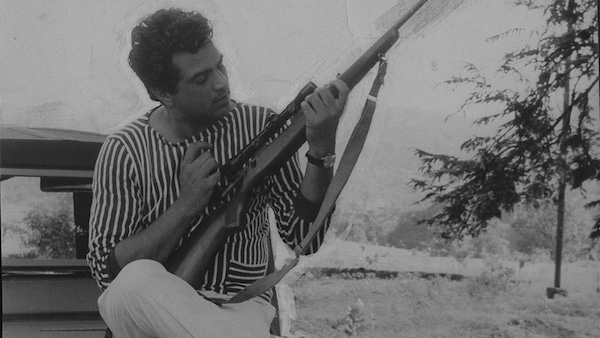
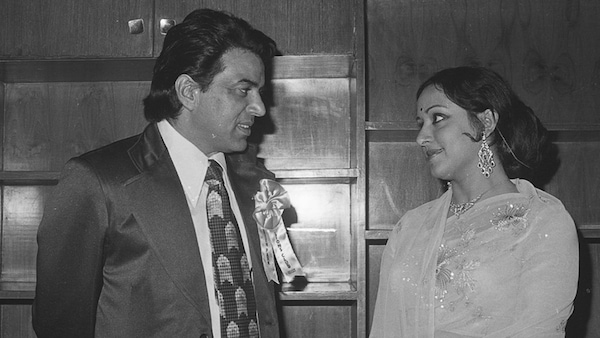
But the desire to make it big remained within him — insatiable, inexorable. The rejection had piqued him, killed his enthusiasm for the moment, but had luckily not destroyed his dream.
It would be almost five more years before Dharmendra would venture Mumbai-wards again, armed this time with his father’s reluctant blessings and a son, Ajay (born in 1957), who seemed to have brought his father luck. He was now participating in the Filmfare-United Producers’ contest for new entrants. He had filled in the form after reading an advertisement back home, been chosen as one of the finalists, and invited to Mumbai for the actual round.
As he put it, ‘I had taken my mother to watch a film. My mother told me that it would be better if I could apply for a job even in the Mumbai film industry—then my father would not be so upset. I wondered how one could get a role that way! But it was probably her blessings that the first Filmfare Talent contest was held that very year and I happened to see the advertisement. And so, I applied for a job as an actor!’
And so too, the ‘sunny’ phase in his fortune first began.
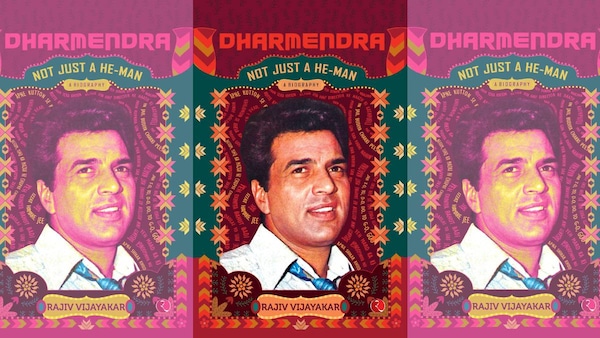
As Dharmendra stated once, ‘I loved the camera — and God heard me. Even today, I sometimes feel that I have not done anything. If you stop dreaming, you are over. The camera and I may be away from each other for a short while now and then. But it does not leave me even after almost six decades!’
Dharmendra still loves the camera — more than ever. And the camera, too, is still in love with him.