


OTTplay At Berlinale 2026: Notes On Sarmad Sultan Khoosat's Lali
Meenakshi Shedde reviews Sarmad Sultan Khoosat's Lali, from the 2026 Berlin International Film Festival. She writes: "You’ve simply never seen a film like this from Pakistan — or even India."
Last Updated: 10.43 PM, Feb 22, 2026
This review is part of award-winning film critic, journalist and curator Meenakshi Shedde's dispatches from the 2026 Berlin Film Festival for OTTplay.
***
SARMAD SULTAN KHOOSAT’s Lali is a visually stunning feature that got a long ovation from a full house at its world premiere in the Berlin Film Festival’s Panorama section. You’ve simply never seen a film like this from Pakistan — or even India: it careens cheerfully at high speed between genres like highway trucks at night — part riotous comedy, part-horror, part musical, but mainly, it explores the very dark spaces that marriage, and sex, can quickly descend into — imbued with scorching desire, and burdened by social expectations, jealousy, abuse, violence, past traumas — and superstition. Marriage in South Asia is a basic inevitable ABC of life — you do studies, get a job, get married, but no one warns you it can be a poison pit — not even those wallowing in poison.
Lali premiering at the Berlinale is a significant international break for Sarmad Sultan Khoosat — director, producer, actor and writer — with a very unique, original and courageous voice, and an obsession for dark, twisted stories of thwarted love. Following his Manto, his Zindagi Tamasha (Circus of Life) won the Kim JiSeok Award at Busan Film Festival, 2019; Joyland, which he produced, won the Jury Prize at Cannes’ Un Certain Regard and was on the Oscar shortlist 2023. Both Zindagi Tamasha and Joyland were Pakistan’s Oscar entries; his Kamli was at IFF Rotterdam 2023.
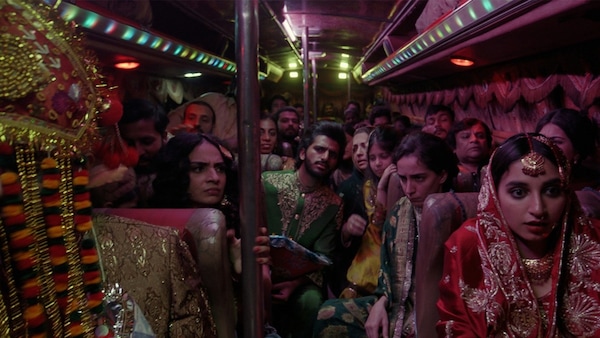
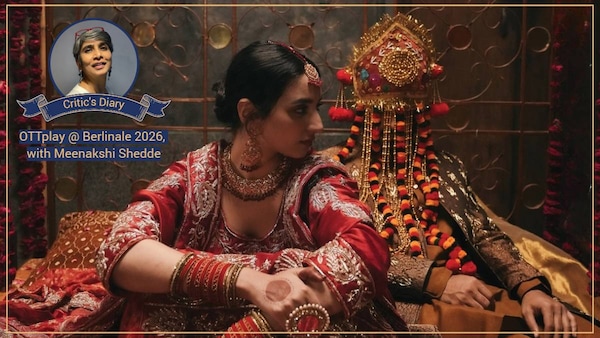
The film opens with the wedding of Sajawal (Channan Hanif) and Zeba (Mamya Shajaffar) in a small town in Punjab, Pakistan — with the bride in intense red and gold — and the groom’s feisty mother Sohni Ammi (Farazeh Syed) who orders the baraat to shoot pistols in the air in celebration — SOP for Punjabi weddings — a bullet from which accidentally hits her, but she cheerfully survives it. The bride is said to be cursed: three of her suitors died before the wedding, and Sajawal jokes he will survive her curse. Although Zeba is a stunningly beautiful bride, pliant and bold by turns, Sajawal blames her for agreeing to the arranged marriage.
MORE FROM BERLINALE 2026: Meenakshi Shedde On Watching R Gowtham's Members Of The Problematic Family
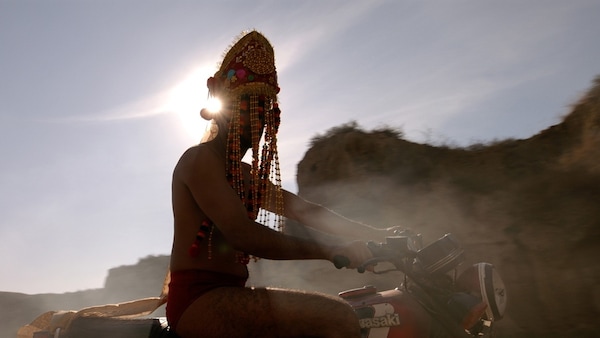
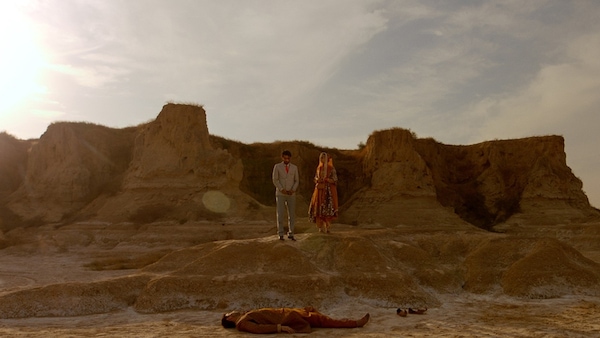
There is an explosive combustion of desire — in spectacular desert landscapes — but their feet seem to be in quicksand. Soon a deep loathing of himself and her takes over — he’s insecure and haunted by a large red birthmark on his face, painted over in black — and jealousy. Two scenes are hard to forget or forgive: when she brings him a glass of milk, he spits the milk on her face; later, he hangs from an overhead bar, and twists her head between his thighs in an act of graphic sadism: worse follows as his past traumas surface. Indian and South Asian wives are essentially Bagheeras, whose lives are devoted to raising the man cubs they have married. When Sohni Ammi passes away, she is buried in their yard, but Sajawal isn’t by her body, but pouncing on his wife for sex upstairs.
Meanwhile, his married sister Noor Jahan (Mehar Bano) arrives and is determined to get her share of the property, that traditionally goes only to the sons. It’s a modest element of modernity and in a story that otherwise lives largely in the past, buried in tradition. The unexpected horror climax makes reference to intelligent, powerful women down the ages whom the patriarchy gets rid of by branding them a witch or possessed by spirits. Khoosat offers some feminist agency, and also his women characters are mostly feisty — Sohni Ammi, Zeba and Noor Jehan; even Bholi, the mentally challenged neighbour (Rasti Farooq) is instinctively smart. Shajaffar and Hanif give their dark roles their all; the rest of the cast is good too.
The screenplay, adapted from the short story Kala Kambal (black blanket) by Khoosat and Sundus Hashmi, unloads a truck of TNT on the institution of marriage. Their screenplay tackles a whole slew of issues, and while essentially bathed in Punjabi melodrama, also seems to borrow from classical Western romantic tragedies, and even has a Greek chorus — neighbouring louts whose songs periodically comment on turning points in the film. Khizer Idrees’ cinematography is stunning, whether it is vast landscapes or close ups of beauty and wretchedness, all at once.
Saim Sadiq’s risk-taking editing embraces multiple genres, a kind of tutti frutti of domestic horrors — while keeping the film unpredictable, and us engrossed. Abdullah Siddiqui’s music and Lala Ahsan’s sound design is expressive. Kanwal Khoosat’s production design is finely observed; Ayesha Imran and Zoya Hassan’s costumes are excellent. Kanwal Khoosat is the producer — so rare to see a Pakistani woman producer — and co-producer Asil Baqa; key backers include Enso Films and All Caps Films (Apoorva Charan and Saim Sadiq’s); the latter also produced Liz Sargeant’s Take Me Home (US), which won the Best Screenwriting Award at Sundance, and played in the Berlinale’s Perspectives for debut features.
Altogether so fascinating what Punjabi culture looks like on the other side.
***
Meenakshi Shedde (Facebook | Instagram) is a National Award-winning film critic, journalist, curator and global influencer, shaping opinions on South Asian cinema worldwide since 40 years, based in Mumbai. She has been curator/programmer to TIFF Toronto, Berlin and film festivals worldwide. She has been jury member of 25 film festivals, such as Cannes, Berlin and Venice, including the jury of Cannes’ Semaine de la Critique (Critics’ Week) 2023, and was also Golden Globes international voter.