


Train Dreams & The Ruins Of Remaining
Train Dreams reclaims the importance of feeling like someone, not just anyone. Of knowing that no emotion is futile, no sadness is small, no memory is hollow, and no life is pointless.
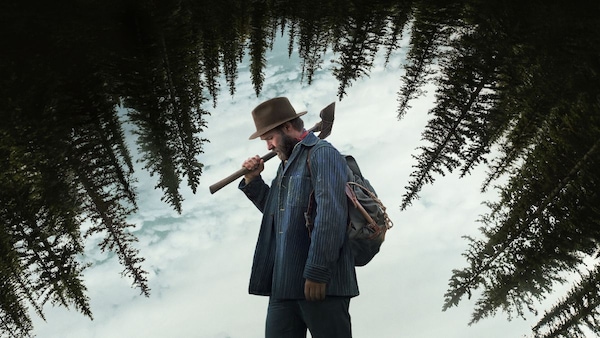
Promo poster for Train Dreams.
Last Updated: 06.33 PM, Dec 04, 2025
IN TRAIN DREAMS, life is but an accruement of endings. Based on Denis Johnson’s 2011 novella, Clint Bentley’s tender fever-dream of a film is rooted in the anonymity of time: an anti-Forrest Gump of sorts. It’s about the kind of man that history is wired to forget: a humble woodlogger and railroad construction worker, a normal husband and father, a survivor and soliloquy, a grafter and griever. A voice-over introduces Robert Grainier (Joel Edgerton) as an orphan in his childhood; it closes with him at 80, having lived and loved and lost and lived in the shadow of loss. He is a reluctant protagonist masquerading as just another person. It’s almost as if the story keeps leaving him behind in the hope that he will catch up.
Robert starts out as a drifter in 1920s America, where a vast country is revealing itself through the hands that build it. For a while, he’s too busy constructing a time to construct — or even see — his future. He soon finds purpose in love, meeting and marrying a woman named Gladys (Felicity Jones), having a daughter and a log-cabin by the river, but leaving home for months at a time to earn a living with strangers who do the same. He often leaves only so that he can return. He forms transient connections along the way with busy co-workers and quiet immigrants, but the permanence of his family is punctured by a wildfire. Everything then unfolds like a passing memory, as if the air is haunted by the ghosts of those who stop breathing.
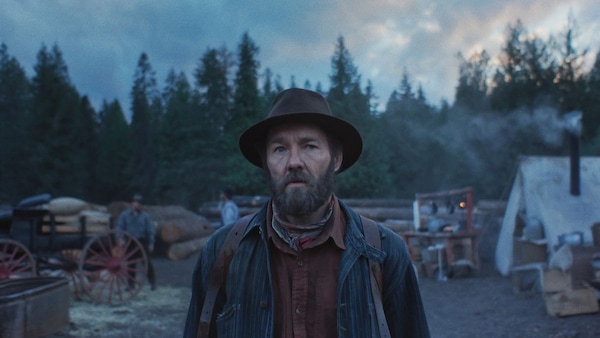
So much of the film is Robert recovering; he struggles to live somewhere between the nonlinearity of longing and the linearity of feeling. Colleagues die, jobs change, the landscape evolves, he waits for his wife and daughter to return, he waits for the pain to subside, he waits to live and lives to wait. Eventually, the film reveals him through the world that rebuilds him. The filmmaking — part Terrence Malick, part Chloe Zhao, part Life of Chuck — grants him the dignity of identity. It reclaims him, a somebody and a nobody, from the facelessness of existing. People like him quietly come and go, prosper and suffer, but Train Dreams legitimises their silence. It chases the invisible brick with the grammar of the wall. Robert spends a lifetime flitting between delusion and hope because the camera normalises his pain.
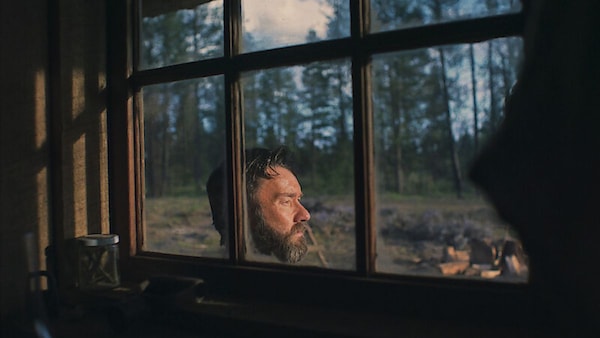
When co-workers die over the years, none of the others can afford to stop and pause; there’s a mundanity about their mourning that seems to desensitise someone like Robert. People come, people go — there’s not a lot of difference between moving on from a project and moving on from a human. He sees them disappear just as he sees the giant trees they cut fall to the ground; just as he reaches home after the season to reacquaint himself with the civilised patterns of love and parenthood. But when his family disappears, the enormity of loss finally hits: grief becomes a coping mechanism to deal with grief. It is no longer one of many feelings; it’s the only feeling. There’s something poignant about how the film confesses that much of life is spent missing people, phases and places. So much of living is the inability to accept that nothing comes back. The more Robert ages, the more he feels like an isolated moment stranded in the plurality of time.
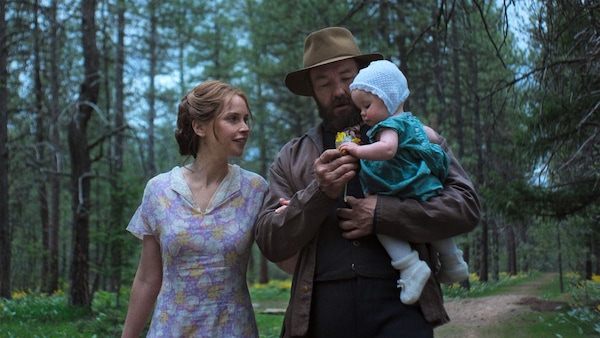
One of the many realities that Train Dreams derails is just this — the innate continuity of grieving. Most of us reach a stage at some point where we accumulate enough life to stop looking forward and start looking back: it’s the melancholic descent after the ascent of discovery. Robert finds peace in visions of his family; he mentions that he sometimes hears them play in the forest but doesn’t move for the fear of scaring them away. It’s a bit like the hero of Inception, where the grief-stricken man knows he’s dreaming only when he can’t see his children’s faces. His hallucinations become his truth, and who’s to prove otherwise? There are millions like Robert, going through the motions of loss and stillness every day, but that doesn’t make their scars less significant. The narrative rarely behaves like one, even when he comes across strangers who threaten a resolution or any kind of healing. Before we know it, he’s old, a stranger to himself, gaping at an America that surfaced while he was waiting for a lost future. It’s only in the sky, during a plane ride, does he realise that perhaps the point of bleeding all along was to feel alive: he gets flashbacks of all those moments and people and tragedies and snippets. It then emerges that the film might have been a version of a proverbial life flashing before one’s eyes — the kind that happens during a near-death experience, implying that Robert had been inching closer to dying from the second he was born.
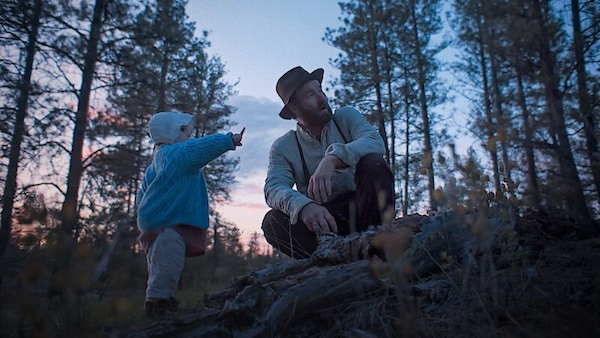
As someone who has been grappling with the ‘commonness’ of losing a loved one, watching Robert humanises the autonomy of staying broken. He does not move on; it’s the world around him that does; there is nothing smaller about his unravelling, or his courage to absorb the full force of the vacuum he’s left with. He goes on, as one must, but his soul is still stranded back in the night he and his wife had decided to start their own business to keep him closer. The film doesn’t feel like a cautionary tale about grief, though; it’s more of a fairytale about how loss is the vocabulary of life. He’s remarkable because he isn’t, and the film chooses to cut deeper than its sociopolitical metaphors and historical parables. It also gives the phrase “feeling seen” a makeover.

When I was a child, I used to imagine that a camera was recording me continuously; I’d imagine I was the protagonist of a story that perhaps the rest of the world was secretly watching and getting entertained by. So I used to move and act a little theatrically and deliberately, like a movie character aiming to please the audience. Like an underdog winning a last-gasp game or shedding a final tear. When I saw The Truman Show as a teenager, I was a bit unnerved by the concept of a human unaware that his entire life was actually a reality show; the idea of hidden cameras made me drop my fantasy of being watched and mined. I also didn’t think I was special enough to be the star of a story, or maybe my story wasn’t special enough to be consumed and broadcast. It’s a bit of a paradox, given that most of us can’t fathom ourselves as supporting characters in someone else’s journey; there’s the constant insecurity that we are not worthy of the focus or lens that public figures, leaders and celebrities get. In the process, we tend to invisibilise ourselves and trivialise the way we live and aspire and rise and fall. But a film like Train Dreams alters that — it reclaims the importance of feeling like someone, not just anyone. Of knowing that no emotion is futile, no sadness is small, no memory is hollow and no life is pointless just because nobody’s looking. Sometimes there’s a camera, sometimes there’s a beautiful film, sometimes there’s an imprint, and sometimes grief is but the training of dreams.
Train Dreams is currently streaming on Netflix.