


With Love Can't Quite Balance The Rom & The Com
Madhan's debut is an earnest, adult take on arranged-marriage romance, undone by frenetic editing, an incessant score, and a screenplay that treats love like set-piece action.
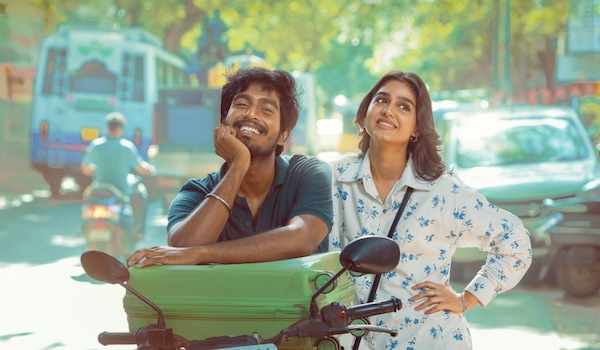
Promo poster for With Love.
Last Updated: 09.54 PM, Feb 07, 2026
IN Madhan's directorial debut, With Love, Monisha (Anaswara Rajan) and Sathya (Abishan Jeevinth) meet on the arranged marriage circuit. Sathya is a designer, and Monisha is an influencer with over a million Instagram followers. If there is anything particularly modern about this film, it is that Monisha asks about his “boring” design job. While her job is indeed one with the times — monetising social media — design apparently is already boring. It is a harmless word, but, wonder what choicest descriptors she would have used for the more common arranged marriage qualifications in the Tamil family circuit: engineering. Not pretty, one imagines. Having said that, we don’t get films that skirt the arranged marriage route often in Tamil cinema, at least in recent times. While the practice would have been a more common fixture on screen four decades ago or so (think 1986’s Mouna Ragam), the more famous contemporary (using the word loosely) examples include Dum Dum Dum (2001), Parthiban Kanavu (2003) and a few more. All those films begin with conflict, either the couple actively hating each other or the idea itself abhorrent to one of them (usually the hero, the man).
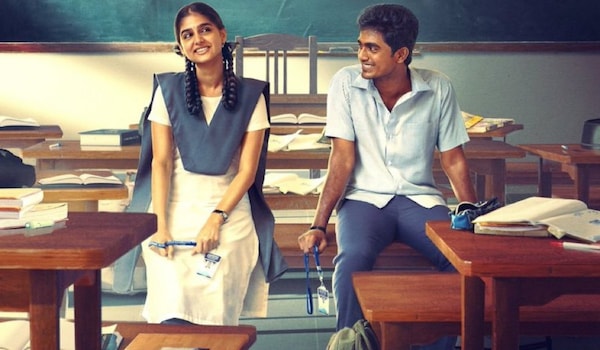
In With Love, things are more amicable. Sathya’s elder sister arranges this meeting with Monisha, and although he is first stumped by the number of tables in the restaurant holding exactly such meetings, Monisha eventually finds him. With Love is also a multipronged love story. Monisha and Sathya aren’t the only couple in love. As they recount their past connection (they went to the same school, he was in twelfth when she was in tenth) in Trichy, we learn about their very different school crushes and romantic non-escapades. They are non-escapades because both fail spectacularly in their endeavours. Madhan’s screenplay gives Sathya’s story first: his crush on Muslim classmate Anisha, his untiring shyness and almost a stubborn will for inaction. Madhan daydreams and loses Anisha to a friend, and Monisha’s incessant search for trouble and drama pulls her away from Balaji.
The film plays these two love stories back-to-back as their adult versions recall the stories through rose-tinted glasses. What makes this routine storytelling interesting is how their paths cross as we visit traces of Sathya’s love failure in Monisha’s. They, inadvertently and almost reluctantly, played a part in each other’s fruitless exercises. We see Sathya waiting impatiently for Anisha in the background as Monisha describes her first walk home with Balaji. A main character becomes a background artist who, unbeknownst to himself or herself, becomes a main character again in someone else’s story. While the romantic events — meet cute, songs, comedy — are only functional, the design keeps things going. The film cuts between blushing looks and stinging wisecracks relentlessly, sacrificing its rhythm in the process. Sean Roldan’s incessant background score doesn’t help; it plays on like this is a modern mass masala film (a problem there too). Madhan doesn’t seem to regard silence or yearning or even longing, ingredients for felt romance. He treats love like set-piece action.

As we return to the present with Monisha and Sathya, things take a different but familiar turn. Almost without warning, Monisha takes it upon herself to reform Sathya. He doesn’t listen to other people’s side of the story. He doesn’t apologise, and chooses only to justify his less-than-ideal actions. He jumps to conclusions far too easily. He is not harmful or creepy, but possesses one too many beige flags for Monisha to ignore. While the film surely becomes funnier and more intriguing in this dynamic, it reduces Monisha to a manic pixie, which should be a red flag in a 2026 romcom. It’s a neat touch that a schoolgirl like Monisha, with her rambunctious appetite for chaos and a proclivity for theatrical antics, becomes a social media influencer. Anaswara is usually great at chewing up the scene and does so here. Sathya, on the other hand, is too broadly sketched, and it doesn’t help that Abishan — the actor — is still raw. His comic timing is all over the place, and most of the time, the music, the frenetic editing or Anaswara take turns to rescue him.
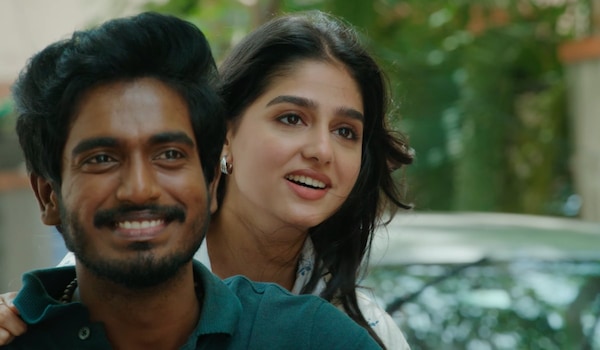
A film like With Love should be welcomed with love in Tamil cinema, a place saturated with mass masala and misplaced pan-Indian ambitions. But the result is a strict what could have been. The multiple love stories approach gets earnest, and more importantly, adult treatment. But the writing and tone are all over the place. At his biggest heartbreak, Sathya bawls his eyes out, but after a few seconds, the shotmaking and score make it look like a parody. With Love, unfortunately, struggles to find the balance between the rom and com.