


'Su From So's Success Proves That Content Matters, Content Alone Matters': Raj B Shetty
As Su From So becomes a Kannada box-office phenomenon, actor-filmmaker Raj B Shetty reflects on past failures, creative risks, and the community that shaped the film—in conversation with Subha J Rao.
Last Updated: 03.27 PM, Jul 31, 2025
IT TOOK RAJ B SHETTY exactly a week after the first paid premiere of his production Su From So at Bharath Cinemas in Mangaluru to catch up on much-needed sleep. The comedy drama with a hint of horror, directed by writer and theatre director JP Thuminad, is on a rampage at the Kannada box office. And it began in a theatre complex that Raj considers his “mother’s home.” He’s written scripts there in the food court, undisturbed for days, because, “in Mangalore, there’s glorious anonymity. Nobody bothers you”.
Raj, his voice all raspy from the talking, says the team received the greatest gift in the form of unadulterated laughter from the audience. “Can you imagine Mangaluru having 6.45 am shows? I am delighted with this response, this support. People have made the film their own,” says Raj, who has backed the film from the script stage. “We began with 180 shows, but are now at 900 shows. The brain is working on what we need to do right to sustain this momentum. But, you know what, this result, as joyous as it is, was not the goal. As a creator, the process is what matters. Now, I’m sitting in a room in some city, enjoying the breeze and just prepping for tomorrow’s theatre visits. I can do this because I have already had my share of fun while making the film. I am content. All this sound of laughter, the clapping, is additional validation.”
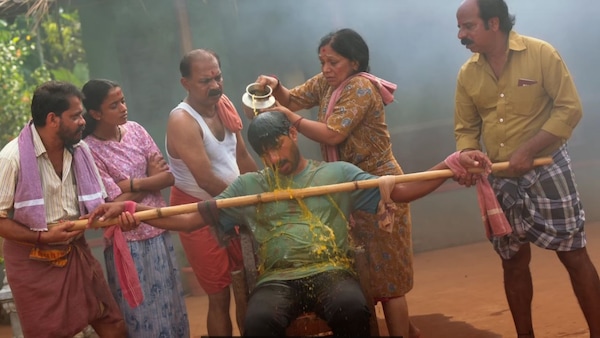
What makes the Su From So team happy is that the intent while making the movie transferred well onto the screen, and to the audience. “For example, when Bhanu speaks, I expected the audience to turn serious. They did, though it was a laugh riot before that. This is the joy I live for, because you cannot predict this outcome,” says Raj.
Many who watched the film have implored others to go to the theatre to watch it and not wait for an OTT release, because the impact is multifold. Raj agrees. “In that dark hall, you listen to the laughs, and you know a joke has landed well. It is a great way to see how human beings are social animals. We made something nice and wanted to share it with you. You felt it was beautiful and wanted to share it with the world. That different people have felt the same way watching it, that’s a great feeling.”
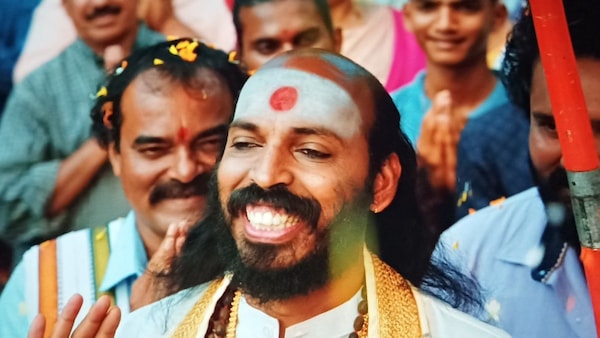
Also, at a time when everyone wants to be the first with the news and the first to reveal ‘spoilers’, the audience who watched the premieres voluntarily refrained from mentioning that Raj also plays an interesting part in the film as Karunakara Guruji, who is brought in to speak to the spirit.
“That was amazing. To appreciate this, you need to imagine what state we were in. Many were cursing the audience, saying they were not coming to theatres, but with this reception, they are telling us that if we give them the content they want, they will back us. They won’t reveal spoilers, they will cherish the film. The moment this happens, everyone automatically feels they own the film, and must nurture it. In fact, someone from the industry told me that Su From So’s reception has possibly enabled the launch of at least 20 new Kannada films. That makes me very happy.”
Raj has openly said that his previous outing, Toby’s failure at the box office and in people’s hearts, was a great teacher. “Su From So is my child, it has taught me responsibility. It has instilled in me the awareness that I need to be better as a producer, an actor and a technician. I have to give something that engages people who pay for the ticket.”
Su From So also shines the spotlight on many talented actors from coastal Karnataka or Dakshina Kannada such as director JP Thuminad himself, besides actors Shaneel Gautham, Prakash Thuminadu, Deepak Rai Panaje, Mime Ramdas and Pushparaj Bollar. “We all go back a very long way, say 2014. I realised they were all very talented but did not get the platform that would take them further. Some of them have played interesting parts in my Ondhu Motteya Kathe (2017). JP was constantly writing scripts, and we kept speaking. More than the fact that we made a movie together, I’d say we all grew up together as people.”
This time around, Raj took special care of the music. “I wanted someone fresh, who could give me the time I wanted. I wanted someone who would give the best, irrespective of the budget. One day, while scrolling at night, I chanced upon this song called ‘Daaha' by a 19-year-old boy called Sumedh. It was an indie production, and it created visuals inside me. I got him on board, and also a music producer who could help him find the right sound. That person was Sandeep Thulasidas, who has worked in Malayalam before. I explained the idea of the film to them and told them that their music should sound like an album. I also corrected mistakes from the past and acted like a producer, not a friend. So, things were very professional.”
Raj also brings with him the experience of working in Malayalam films. He was part of the Mammootty-starrer Turbo. “That set had the pace of an indie film even while it was a commercial setup. They were not wasting time and were very efficient. I am in love with how they achieved it. It was a fantastic exposure to learn and see how other industries operate, because I could then implement it in my productions.”
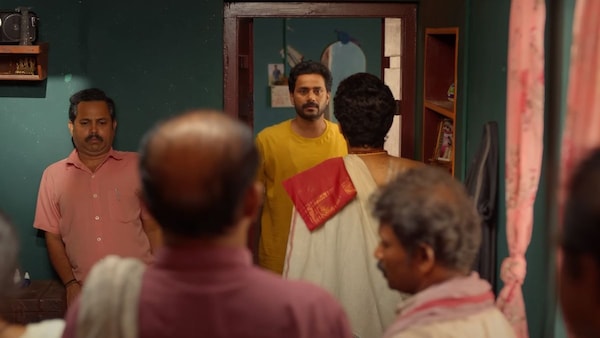
As an actor too, Raj occupies a different space in Su From So — his character is powerful, with hints of humour and vulnerability. “I let go in front of the camera, because Guruji is nothing like what I am. He’s acting on two fronts — in front of the villagers, and before the camera. You see him open up only before Bhanu, whom he sees as an ally, because she won’t speak. As an actor, this was a new space, because once you are recognised as a subtle actor, you want to hold on to that space. You are a little afraid to experiment, but actors should be many things. A name should not restrict you. I was aiming for something caricaturish with a hint of emotion. My only intent was that if my acting can help this film, then great.”
But Raj specifically kept the actor in him out when the film was being promoted. “Everyone said we need known faces to sell a film. I thought that, of all people, I should not do that, because when I did Ondhu Motteya Kathe, people in my own area did not know me. And so, we wanted the content to speak. That’s the reason we hid every part that would make for a talking point.”
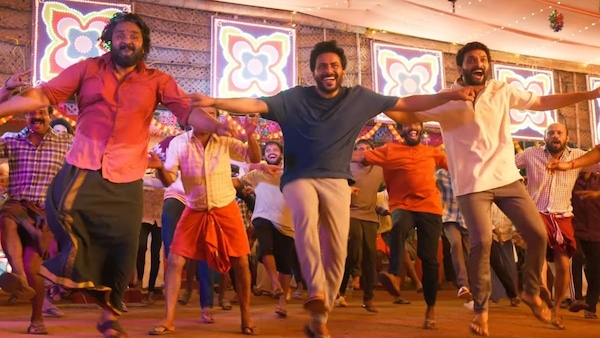
The team has been visiting theatres across the state and has been greeted with housefull boards. At a time when most are familiar with orange-lined boxes in online booking sites, a housefull board, says Raj, is a tangible thing one can touch and feel and rejoice in. “A red or orange box online is so much fun, but it is not tactile. In one theatre, a person held up the housefull board high in the air. This is the board we have seen growing up, this is the board we miss seeing now.”

For now, the team is rejoicing in calls from both multiplexes and single screen theatres. Some vintage theatres have had to put additional chairs in a 1,200-capacity hall, and others who say their theatres are finally seeing the family crowd return. There are clamours for more screens, with halls going full on weekdays. “This,” says Raj, “is proof that content matters, content alone matters.”
Subscribe to our newsletter for top content, delivered fast.
