


120 Bahadur ending explained: Did Farhan Akhtar’s Major Shaitan Singh stay behind after final order?
120 Bahadur depicts the 1962 Battle of Rezang La. Led by Major Shaitan Singh, 120 soldiers make a heroic stand against 3,000 Chinese troops, earning India's highest military honours for bravery.
Last Updated: 01.00 PM, Jan 17, 2026
The war drama 120 Bahadur, starring Farhan Akhtar, made its debut on Prime Video on January 16, 2026, following its theatrical release in late 2025. The film, which is directed by Razneesh 'Razy' Ghai, recreates the 1962 Sino-Indian War's pivotal Battle of Rezang La, a legendary event in Indian military history. The film's grim depiction of the "last man, last bullet" stand has rekindled attention since it became available on streaming, despite its dismal box office result during its theatrical run.
Who leads the defense of the mountain route in 120 Bahadur?
A pivotal mountain route is defended by 120 soldiers of the Charlie Company, 13 Kumaon Regiment, led by Akhtar's Major Shaitan Singh Bhati, as they face a tremendous Chinese onslaught. As viewers process the heavy emotional weight of the final act, here is a detailed breakdown of the "120 Bahadur" climax and the historical context that defines its closing moments.

The events of the morning of November 18, 1962, take centre stage in the film's third act. The 120 men of Charlie Company are besieged without artillery support at an elevation of more than 16,000 feet. The People's Liberation Army (PLA) of China initiates a coordinated assault with approximately three thousand soldiers.
ALSO READ: 120 Bahadur out on OTT: Where to watch, plot details, and more about Farhan Akhtar's war drama
How does 120 Bahadur portray the brutal reality of high-altitude combat?
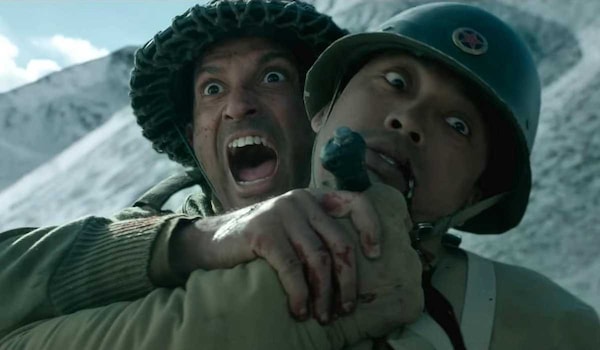
The film depicts the graphic nature of combat at high altitudes. As Indian forces run out of ammunition, the combat shifts from long-range rifle fire to desperate hand-to-hand fighting with bayonets and even bare hands. Major Shaitan Singh is unyielding in the face of overwhelming numerical advantage. Despite the intense enemy fire, he moves from platoon post to platoon to rally his men. At the end of the film, this leadership is still the most important thing.
In the closing stages of the battle, machine gun fire critically wounds Major Shaitan Singh in his arm and abdomen. His troops try to get him to safety in a crucial sequence. But Singh tells his troops to abandon him because he is impeding their progress and the position is about to be captured.
What final orders did Major Shaitan Singh give to his radio operator?
Sparsh Walia plays Ramchander Yadav, his radio operator, whom he orders to stay alive and report back to battalion headquarters. The film depicts Singh's dying moments as he lies injured and helpless in the snow, pinned to a boulder, as he gives in to the cold and his injuries.
An important part of the 120 Bahadur climax is when the two sides acknowledge each other's expertise. Historical accounts and the film both show that the Chinese commander praised the Indian officer Shaitan Singh for his exceptional bravery upon discovering his body. That even their enemies acknowledged the bravery of the 120 "Bahadurs" is a point driven home throughout the film.
Why was the survivors' account met with skepticism by headquarters?
Among the most moving aspects of the conclusion is what happens right after the fight. Ramchander Yadav and Nihal Singh are among the few survivors who return to the base to an expression of amazement. The higher-ups think it's implausible that 120 men could have killed more than 1,300 enemy soldiers during the 1962 war, when the Indian side mostly lost and retreated.
Officials believe the survivors may have retreated from their stations and concocted a heroic narrative to conceal their tracks, as shown in the film, which leads to interrogation and the danger of a court-martial. In the penultimate moments, this emphasises how the "fog of war" can first conceal the truth, creating a sombre and exasperating tone.
How was the truth of the battlefield finally uncovered?
The resolution comes three months later, in February 1963, when the winter snow begins to melt. After a shepherd from the area finds the battlefield, the Indian Army dispatches a search party to confirm the location.
The final visual segment of the film vividly recreates their discovery. Clutching their guns, soldiers were discovered immobilised in their trenches. While ministering to a fellow soldier, the nursing assistant was discovered with a bandage and syringe in his hand. The mortar man was discovered with a bomb in his hand, prepared to detonate. The location where Major Shaitan Singh was found frozen solid was precisely the one that the survivors had predicted. This finding lends credence to the survivors' stories and turns what seemed like a loss into an inspiring tale of triumph.
How does 120 Bahadur honour the heritage of the Kumaon Regiment?
A montage honouring the real-life martyrs of the 13th Kumaon Regiment, many of whom were members of the Ahir (Yadav) community in Haryana, serves as the film's finale. The real-life issue over the film's title is discussed here; several community leaders suggested that it be changed to "120 Veer Ahir" to honour the distinct heritage of the warriors.
The unit receives accolades as the credits roll. Posthumously bestowed upon Major Shaitan Singh was the Param Vir Chakra, the top military honour bestowed by India. In addition to the Sena Medal, eight more warriors were presented with the Vir Chakra. Until this conflict, there had never been a single encounter in contemporary military history when a company-sized force garnered so many heroism awards.




Where is the legacy of these 120 men preserved today?
Though the land was ceded in a 1962 deal, the 120 men's honours were preserved, as seen in the 120 Bahadur closing shot of the Rezang La War Memorial in Rewari.
120 Bahadur FAQs:
Q: Is 120 Bahadur based on a true story?
A: Yes, 120 Bahadur is a biographical war drama based on the Battle of Rezang La, which took place on November 18, 1962.
Q: How many soldiers survived the Battle of Rezang La in 120 Bahadur?
A: Out of the 120 soldiers stationed at Rezang La, only six survived.
Q: Where can I watch 120 Bahadur on OTT?
A: Following its theatrical run in late 2025, 120 Bahadur began streaming on Amazon Prime Video on January 16, 2026.