


Prathichaya director: Filmmakers once felt guilty about propaganda, now they are unabashed | Exclusive
Director B Unnikrishnan, who is set for the release of Nivin Pauly's Prathichaya, talks to us about his latest movie, how he tries to address ‘the image vs individual’ aspect of politicians and more
Last Updated: 04.27 PM, Mar 23, 2026
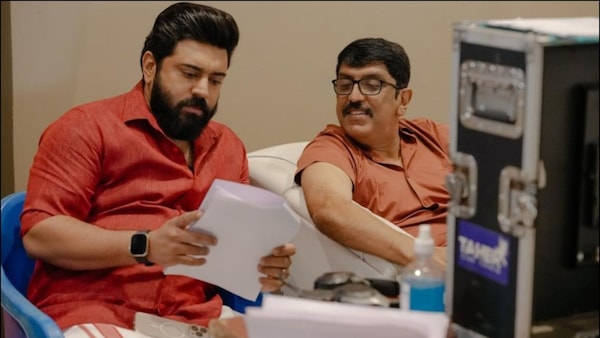
Be it Mohanlal’s Madampi and Villain or Mammootty’s Pramani and Christopher, one thing that has held B Unnikrishnan’s movies together has been the interpersonal dynamics of its central characters. In his latest movie Prathichaya, starring Nivin Pauly and Sharafudheen and releasing on March 26, the filmmaker uses the world of Kerala politics as its backdrop to discuss ideas that he says he believes needs to be told.
In an exclusive interview with OTTplay, Unnikrishnan talks about why the image of a politician is now more powerful than the individual itself, his experience working with a new set of cast members and his view on propaganda movies.
You have directed a political thriller for the first time with Prathichaya, which coincidentally will also release just a few weeks before the Kerala elections. What made you pick the theme?
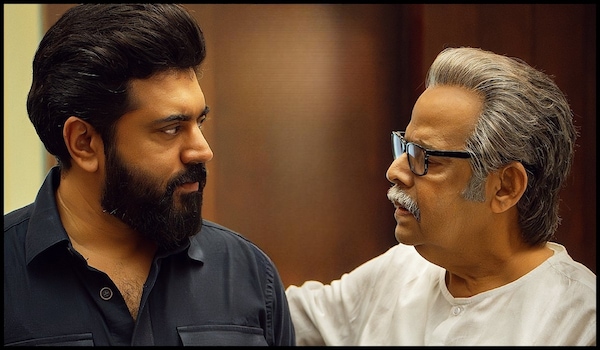
I wouldn’t say it’s a political thriller per se. Politics serve as a backdrop, but Prathichaya is ultimately a father-son drama in the template of a Thevar Magan or The Godfather. The movie does discuss powerful politics, but it has elements of family and emotional dramas, and revolves around the dynamics between a father and a son and partners. I also believe there’s a powerful equation between the hero and the anti-hero.
About it releasing ahead of the elections, that’s just coincidence. I started writing the movie in 2019 when (Kerala CM) Pinarayi Vijayan had just come to power. That’s when writer Sharis Mohammed had narrated a screenplay to me. I liked a particular moment in it and I asked him if I could write it; I did that and he told me to go ahead. The script has also travelled through many actors before it was finally made with Nivin in the lead. But yes, it’s the best time for releasing the film, barring the tensions in the Gulf.
Was it the political element or the interpersonal equation that appealed to you the most?
Powerful political figures, be it Vijayan, K Karunakaran, Oommen Chandy or AK Antony, also have a personal space. Whenever they face a challenge in the public realm, they inevitably have to address that in their personal space as well, with their partners, children and others in the family. Our films have rarely discussed that aspect and that’s what hooked me.
Prathichaya is also mounted on a bigger scale than your previous two movies, Aarattu and Christopher. As a filmmaker, how did your approach change?
Even if you analyse some of the post-pandemic hits, take Dhurandhar with all its political evil, it’s still a template film. The same was the case with the KGF movies. If you look at the movies that have been big box-office hits including RDX in Malayalam, the template is evident.
I don’t have a particular format like a Renji Panicker-Shaji Kailas combo. My style is more emotional. Prathichaya is my first film that doesn’t have any fight sequences; there’s only a gunfire scene. But I have tried to say things that I think had to be told through this movie.
Since you brought up Dhurandhar, and given that political films today are often scrutinised for possible propaganda, how do you see Prathichaya being perceived in that context?
I haven’t intended any propaganda angle with this film. Secondly, I believe that every film, even a family drama, has its own politics – it could be hidden or layered. With Prathichaya, I am trying to address that in today’s politics, there aren’t individuals but only images. It’s the carefully-constructed image of a politician that floods our consciousness. And from that, you have to filter out the reality and take democracy forward. So, you don’t know what’s real.
Based on the studies of political scientists, billions of rupees have been spent in cyberspace over the past three general elections in India. So, the real battle is fought there. Direct, one-to-one interaction between politicians and voters no longer exists.
So, every reality is mediated and in a small state like Kerala that has seven or eight news channels and multiple newspaper publications, it’s a double-edged sword. The Fourth Estate has its power and relevance, but at the same time, there’s also another side to it. I have tried to shed light on those aspects, but in a commercial movie’s format.
How do you view the risks of filmmakers embedding propaganda within popular, entertaining cinema? How significant a threat does this pose?
In the past, filmmakers might have felt guilty about making propaganda films, but now they are unabashed. There is a large section of the audience who readily consumes such films.
The other side is that art has the ability to make even the most unpalatable things pleasurable. That’s where it becomes tricky. If something uncomfortable is presented well, you will enjoy it. I’m not saying this applies only to propaganda films.
But as a student of art and cinema, I believe you cannot escape being political. Whether you like it or not, or do it consciously or not, it’s inevitable; everything is ultimately political.
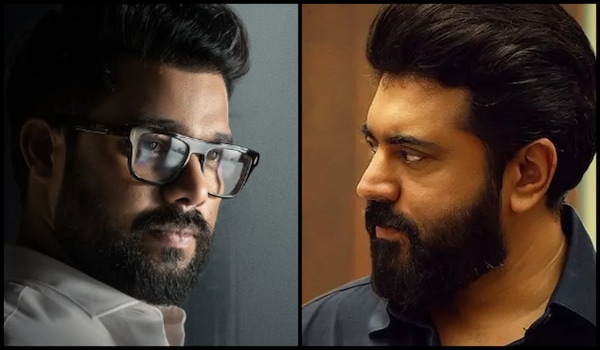
Nivin, in an earlier interview with us, described working with you in this film as a “different school of filmmaking”.
Funnily enough, apart from Saikumar and Vaisakh Shankar, I hadn’t worked with any other cast member of Prathichaya earlier. So, everyone from Nivin, Sharafudheen, Vishnu Agasthya, Ann Augustine to Maniyanpilla Raji and Harishree Ashokan, had worked with me for the first time in this film.
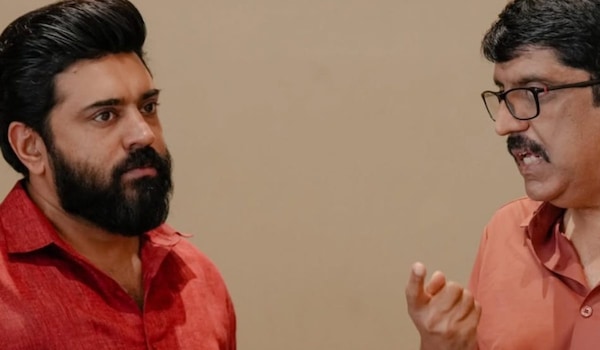
What Nivin and Sharaf had told me was that they had usually collaborated with people their own age. So, my type of filmmaking might have been different to them because I come with a fully-edited version of the film in my head before I start the shoot. It demands specific shots. It would have been new to them as well because they don’t know how the output would turn out.

Does that limit their contribution in terms of improvisations because they are basically sticking to the script?
I don’t impose restrictions in terms of their performance. I read out the script to them with specific modulations that also reflect what I want from the scene. And then I place them within my frame and they are free to perform. If they do something that I feel is not required, I make sure to let them know. It lends to a more disciplined approach where the director is in control; but they are more used to a more flexible style with discussions and changes being made on the edit table.
It was also a learning experience for me, because all of them were very professional. I enjoyed the same comfort that I did while I worked with veterans like Mohanlal and Mammootty.
Subscribe to our newsletter for top content, delivered fast.
