


Dhurandhar: The Revenge review - Effortless Ranveer Singh meets an effortless-to-ignore, Aditya Dhar's 'peak detailing' slog
Dhurandhar: The Revenge is a muddled, four-hour propaganda slog. Despite Ranveer Singh's effort, patchy editing and "peak detailing" turn this sequel into an exhausting endurance test.

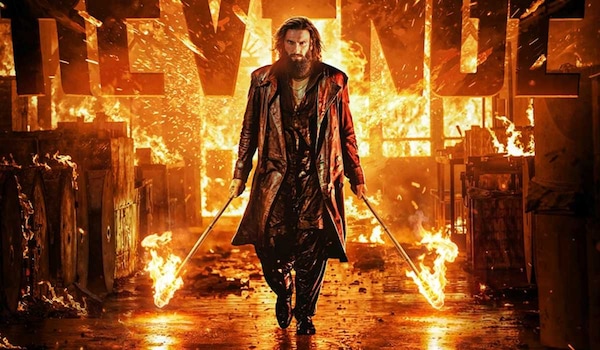
Last Updated: 12.57 AM, Mar 19, 2026
Dhurandhar: The Revenge story:
Undercover Indian intelligence agent Jaskirat Singh Rangi (Ranveer Singh) is brought to life in Dhurandhar: The Revenge by Aditya Dhar. Rangi has immersed himself in the dangerous criminal underworld of Karachi, Pakistan, using the pseudonym Hamza Ali Mazari. The film plots out Hamza's rise to power as the "Sher-e-Baloch" and his intricate operation to destroy global terror networks and seek retribution for the 26/11 Mumbai attacks; it is the direct sequel to the 2025 smash hit. Alongside allies like Ajay Sanyal (R. Madhavan) and SP Chaudhary Aslam (Sanjay Dutt), Hamza faces vicious ISI officer Major Iqbal (Arjun Rampal) and a shadow antagonist called "Bade Sahab" in a perilous world of betrayal and political corruption. As he relentlessly pursues national security, this massive espionage epic challenges the line between Jaskirat, a dedicated patriot, and a vindictive operator, blending intense action with an intimate examination of his metamorphosis.
Dhurandhar: The Revenge review:
There are movies which you watch, write about, and move on to the next. You might revisit it after a very long time if there are moments that have stayed with you and you wish to reminisce about them. When I watched Dhurandhar back in December at an early 7:30 am show, the more than three-hour runtime felt equally engaging. However, once I was done with writing about it, nothing urged me to revisit it apart from the songs, which are still a part of my playlist. But can anyone even make you move on from Dhurandhar in the past three months? Of course not. The discussions, threats, impacts, and influences all lingered in the air, creating anticipation for the sequel, which quickly made its way to the big screen. As the days neared, I was thinking, 'What could the outcome be? Will the next installment go in the direction I thought of and make it equally engaging, or will it be just a stale move to divide the plot into two parts?'

Today, I faced the film while sitting in a packed theatre, absorbing each moment one at a time. First things first, nearly four hours of runtime got to me, like many others who were questioning its necessity per se. This time, the film makes you acutely aware of those four hours, as every passing minute feels like a reminder of how much longer you have to endure.
The first chapter, which is titled "A Burnt Memory", takes us back to 2000 when Jaskirat Singh Rangi (Ranveer Singh) is a young man smiling happily with his family. He sports a military cut, hinting at the fact that he is going to join the army just like his forefathers. In no time, we see him wielding a gun and blazing it at a family. Then we eventually see Ajay Sanyal (R. Madhavan), which takes us back to their first meeting, marking the beginning of Jaskirat's transformation into Hamza Ali Mazari. To be honest, the beginning elevates the film to a certain level, and it was refreshing to see a location that is not Pakistan.
But then we are back in Lyari, and once again we see a world where there are no good people at all. Everyone likes to chop and slash people with no remorse. There's fire and smoke everywhere. Sun rays don't fall entirely on them, and it's always the fire within and around that emits the harsh light. Even if people shed tears when someone close to them is slaughtered, there is no humanity left in this world. However, they quickly wipe away the tears and proceed to execute the next person.
In the first part, even though those instances were glaring, there was some kind of story also taking shape. Here, you see Hamza becoming the King of Lyari, then what? He is determined to clean up the mess and enhance his intelligence to prevent mistakes like those made during the 26/11 attacks in Mumbai.
Dhurandhar: The Revenge focuses intensely on the vendetta, fully justifying its title. The whole franchise is all about revenge against Pakistan, which has been infiltrating India since independence through terrorism. As this agenda evolves into propaganda, the film increasingly portrays a futuristic perspective on various issues. Indeed, we are currently observing the culmination of the ruling government's decisions and their outcomes. From demonetisation to the Babri Masjid verdict, it seems that recent incidents have provided a foundation for creating a backstory that presents a foolproof plan.
There's a moment where Arjun Rampal's character, Major Iqbal, says that he will make people in India read Kalma and castrate them. His face is not clearly shown when he delivers those lines, suggesting that the scene was intended to foreshadow the Pahalgam attacks that occurred in 2025.
To be honest, it felt like Aditya Dhar also created an India where Muslims don't exist at all. If the religion in question is Islam, then it is associated with Pakistan, as only Hindus are considered patriotic in India. Additionally, we observe Punjabis entering Pakistan to negotiate a trade deal that aims to turn India into a drug-addicted country. The first part reminded us of the dialogue suggesting that Indians are enemies of each other, while the second part harshly illustrated the argument with examples, prominently highlighting the communal angle.
With the loud background score and rap music elevating the moments, this time it felt more like a cover-up. Yes, there are peppy nostalgic trips as well with renditions of Tamma Tamma and Tirchi Topiwale; who wouldn't groove to them? But as much as your foot might start tapping, you will not be able to take away the moments your eyes witness throughout the film. Even the original songs lack the repeat value that they had in the first instalment. The rap tracks meddle with the sequences, especially the lyrics, which is quite distracting when the characters keep on talking on screen.
The four-hour duration is so deliberate that every other chapter feels like a filler, which hardly makes any impact and seems created solely to give the illusion of an engaging narrative. The online discussion, which has been ongoing, makes it seem like the film is focused on "peak detailing by Aditya Dhar," but this approach feels more like capturing moments than contributing to the story's purpose. If it's a fictional story based on true events, the faction will make you believe it, only to realise that it walks the most dangerous thread ever.
If you are waiting for a cameo, there is one featuring Prime Minister Narendra Modi, who appears via television screens. However, our beloved PM did get more screentime than Sara Arjun, probably. The young actor, who was some sort of catalyst in the first instalment, was here to eventually be a mother and live in the shadows like a homemaker.
On the other hand, Sanjay Dutt as Baloch-hater SP Chaudhary Aslam gets the most slow-motion shots, and it felt like the film was buying more time for no reason at all. The cinematic liberty keeps on topping and doesn't stop, because in this world, limits do not exist. Every word spoken by the male characters in this film is crass, and this crudeness extends to the lewd physical actions as well. There are a lot of "jihads" and "kaafirs" mentioned throughout the film, and it just gets to you after a point in time.
Ranveer Singh shoulders the film truly well, but I found his Jaskirat era had more heft than the Hamza transformation. Although his younger days were showcased in a limited way in the film, it created far more impact, particularly in illustrating the formative experiences that shaped his character and motivations. But I cannot take away the fact that the actor's performance seems effortless as the story progresses.
The same with Rampal, who also gets a backstory this time; no, not to make anything emphatic, but also to not show why he is like this. Even for R Madhavan, the actor maintains that stability which he had in the first film, and it works well for the character to a larger extent. It's Rakesh Bedi who is quite a revelation this time, and the first part was just a glimpse of the blast he creates on screen with his mere presence in this one.
The whole build-up around "Bade Sahab" makes a similar impact to the result of "Why did Katappa kill Baahubali?" However, more than this suspense reveal, it's about a character revelation that will leave you delightfully surprised. For me, the ending was the only time I felt the culmination came at the right moment, but the path is so long that the shortcuts, even if necessary, are neglected.
If I wanted to talk about the technical aspects of the film, the editing is so patchy, and it makes you feel exhausted. No, I don't have issues with too much information, but it felt like a Pandora's box that keeps on sucking you in, and all you are left with are questions.
Even if I set aside the propaganda, which I know I shouldn't, the overall vibe this time felt very muddled and different from that of the first instalment. It felt so rushed and then slowed down drastically that the tempo was inconsistent throughout. To be honest, it seemed that prioritising a longer runtime than the first part was more important than making the film engaging.
"Peak detailing" by Dhar is what Dhurandhar: The Revenge is all about, which turns out to be banging noises that the empty vessels make. Yes, the film will be impactful for its target audience, like a WhatsApp forward, which is more trusted than touching grass.



Dhurandhar: The Revenge verdict
Aditya Dhar's Dhurandhar: The Revenge is a bloated, four-hour espionage slog that trades the first film’s grit for heavy-handed propaganda and tedious "peak detailing." While Ranveer Singh’s effortless performance and a surprising finale offer some redemption, the inconsistent pacing and patchy editing make the massive runtime feel like an endurance test.
Subscribe to our newsletter for top content, delivered fast.
