


The Taj Story ending explained: Does Paresh Rawal's Vishnu Das win the legal battle for the Taj Mahal?
Paresh Rawal stars in The Taj Story, a drama challenging the Taj Mahal’s origins. It explores the Tejo Mahalaya theory through a courtroom battle, favouring inquiry over a definitive legal verdict.
Last Updated: 02.27 PM, Mar 15, 2026
Tushar Amrish Goel's courtroom drama The Taj Story premiered on OTT via Lionsgate Play (OTTplay Premium) on March 13, 2026, following its prominent theatre run in late 2025. Online discussion surrounding the film's principal thesis—a historical and legal challenge to the established origins of the Taj Mahal—has flared up again since it was made available for streaming.
What is the central journey of the protagonist, Vishnu Das?
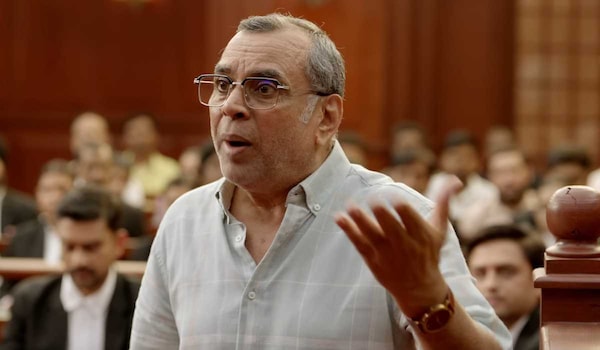
The film follows Vishnu Das, played by Paresh Rawal, as he goes from being a tour guide in Agra who tells stories about the Mughals to being a lawyer who wants to "uncover the truth" about the monument. As of March 15, 2026, viewers are still trying to understand the film's ultimate message and the court's decision, which is made unclear by the film's confusing ending.

Rawal plays Das, a seasoned tour guide with 30 years of expertise, at the centre of the story. The catalyst is a private video of an inebriated Das that becomes popular online. He tells a journalist in the video that a lot of the history he tells tourists about is "fabricated" to fit a more idealised story. As a result, Das socially isolates his son Avinash (Namit Das) and immediately suspends him from his position.
What are the core legal and historical claims made in the PIL?
Das, embarrassed but now more determined than ever, chooses to dispute the official records. In a public interest lawsuit (PIL), he alludes to the "Tejo Mahalaya" theories popularised by P.N. Oak and asserts that the Taj Mahal was formerly a Hindu temple or palace. In the second half of the film, the action takes place entirely in a courtroom, as Das defends himself against the experienced advocate Anwar Rashid, played by Zakir Hussain.
The film culminates in a drawn-out courtroom struggle that makes use of expert testimony, architectural research, and historical documents. Vishnu claims the basement chambers of 22 sealed rooms provide proof of the monument's pre-Mughal origins and demands their opening. He bases his arguments primarily on these three grounds. The text highlights a 1959 carbon-14 test on a fragment of the monument's wood, which Vishnu claims is older than Shah Jahan's reign. According to historical records, he wonders why Shah Jahan's official reign history, the Badshahnama, describes the purchase of a "lofty mansion" from Raja Jai Singh instead of a brand new building.
How does the defense respond to the claims of pre-Mughal history?
In response, Anwar Rashid refers to the Archaeological Survey of India (ASI) and earlier rejections of such petitions by the Supreme Court. He claims that bringing these arguments back up will do nothing but sow discord across communities and endanger India's international tourist income, which relies heavily on the cultural significance of monuments like the Taj Mahal.
Das does not emerge from The Taj Story with a resounding triumph in court. Rather than ending on a note of court decision, it speaks of "intellectual inquiry" instead, highlighting the importance of understanding historical narratives over legal outcomes.
What themes are explored in the protagonist's final rhetorical speech?
He speaks to both the bench and the gallery in his final remarks. Das makes it clear that he is fighting for "historical accuracy" and not religious ownership. His main point is that citizens who question long-held narratives characterise strong democracy, and history shouldn't remain stagnant. "Will the monument's beauty diminish if we discover its true foundation?" he asks rhetorically. From a religious discussion to a nationalist attack on India's school system and the "leftist" view of history, this monologue is meant to change the film's tone.
The judges in the film do not order the excavation or the opening of the sealed rooms. While they recognise the "sincerity" of the petitioner's enquiries, they stress that the court has no business changing the past due to "gaps" or incomplete information. Instead of viewing Das' acts as a triumph for communal integrity, they let him regain his licence and dismiss the PIL.
How do the post-credit slides reconcile the film with real-world history?
As the credits roll, text slides are used to keep the story grounded in reality. According to these slides, Indian courts have recently dismissed multiple PILs challenging the Taj Mahal's provenance in 2022 and 2024. According to the ASI, there is no physical proof of a temple under the tomb. After dedicating the story to the "seekers of truth" at the end, the film leaves the "Tejo Mahalaya" notion up for debate rather than presenting it as a proven fact.
A late-film subplot involving the temporary kidnapping of Vishnu by "hardliners" who want him to abandon the investigation is a source of bewilderment for many viewers. The sequence heightens the tension by depicting Vishnu as a martyr for his cause. The point of his unwavering stand, even in the face of imminent danger, is to support his character's beliefs. A visual representation of the "cost of seeking truth" will be his bodily injuries when he comes to court.
What was the director’s intent behind the ambiguous ending?
The "inconclusive" ending is a conscious decision by Goel, according to critics. The filmmakers validate the protagonist's sentiment without directly contradicting contemporary Indian law or historical consensus by denying Vishnu a legal victory.
The film employs "post-truth" reasoning, prioritising questioning over the accuracy of the response. A "mystery" to those who follow Vishnu's line of reasoning, the Taj Mahal remains a tomb in the eyes of the law, according to the climax.
Who are the key supporting actors and technical contributors?
In The Taj Story, Sneha Wagh, Brijendra Kala (who plays a reluctant lawyer), and documentary filmmaker Amruta Khanvilkar are among the supporting actors. Satyajit Hajarnis captures the Taj Mahal with stunning visual fidelity, a stark contrast to the clinical, frequently green-screened courtroom settings in the film.



The movie is now streaming on Lionsgate Play (OTTplay Premium) in three languages: Tamil, Telugu, and Hindi. Rawal's performance and the film's sensitive subject matter have kept it at the box office despite mixed reviews and complaints about its length (166 minutes) and "preachy" tone.