


Subedaar review: A powerhouse Anil Kapoor is trapped in a dated, trope-heavy script that fails to match his ageless charisma
Anil Kapoor’s soulful performance can't save Subedaar, a gritty yet formulaic drama about a veteran fighting a sand mafia. It relies on dated tropes and a predictable screenplay.

Last Updated: 12.49 AM, Mar 05, 2026
Subedaar story:
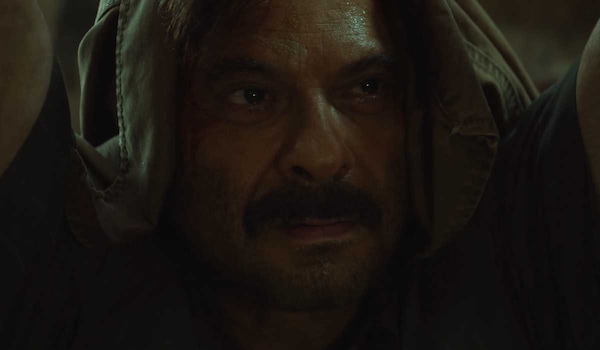
Set against the rugged backdrop of the Indian heartland, Subedaar follows Arjun Maurya (Anil Kapoor), a decorated and battle-scarred retired soldier who finds that the transition to civilian life is a war of its own. As he attempts to navigate a deeply fractured relationship with his daughter, Shyama (Radhikka Madan), he discovers his town has fallen under the oppressive shadow of a ruthless illegal sand mining mafia led by the chilling Prince (Aditya Rawal) and the whimsical yet menacing Babli Didi (Mona Singh). Forced to trade his hopes for a peaceful retirement with his old instincts of discipline and duty, Arjun must confront both his inner demons and a corrupt societal system to protect his family and restore his sense of honour.
Subedaar review:
A man relocates to a new city where corruption permeates everything. He waits to retrieve money from the bank, only to be met with a constant "Kal aana." A local goon harasses him relentlessly, and there is no legal system to assist him. Furthermore, he remembers his late wife through a tired trope: she laughs while walking around the house and calls his name, her voice echoing in his mind. Have we seen this movie before? This phenomenon has played out a hundred times across various languages, and Subedaar is yet another subpar addition to that list.

I thoroughly enjoy Anil Kapoor as a performer, regardless of the film he stars in. Over the years, the actor has made a significant impact on the industry, avoiding being typecast and remaining true to himself for almost four decades. In Subedaar, he is back to kicking ass and fighting the system—much like when he became Chief Minister for a day in Nayak: The Real Hero twenty-five years ago. However, this time he is a retired, wounded man who lacks that youthful energy. Despite his desire for peace, his surroundings—and his mind—urge him toward a "clean-up drive" every now and then.
ALSO READ: Anil Kapoor's Subedaar is the 'toughest and the most monumental film': Director Suresh Triveni
The film, directed by Suresh Triveni, relies solely on Anil Kapoor as its main asset. He uses his screen presence effectively, even though the story desperately needs updating. Just last year, I watched Jaat, which had a similar premise: a North Indian man (Sunny Deol) reaches the South, and just as he is about to relish an idli, his life changes. However, he ensures he seeks revenge righteously, as he is ultimately an army official.
In Subedaar, it is well-established that Arjun Maurya is a war veteran and recent widower living with his daughter, Shyama (Radhikka Madan), where peace and guilt go hand in hand. After settling into retirement, Arjun—at the insistence of his fellow retired official Prabhakar (Saurabh Shukla)—decides to pursue a job. They reach the residence of Prince (Aditya Rawal), an ill-mannered, notorious young man who shoots people knowing there will be no repercussions. He frequently pisses (literally) in public and makes threats about it on a regular basis.
Yes, it is yet another typical villain: a youngster backed by an influential family. This time, it’s his half-sister Babli Didi (Mona Singh), who is in jail, living "life queen-size" while controlling everything outside. They are supported by a manager, Softy (Faisal Malik), who handles everyone's tantrums while maintaining a mind of his own.
The typical start and execution show Maurya taking his sweet time to finally snap and tell his adversaries they can't mess with him. It mainly takes a turn when the red Gypsy gifted by his late wife, Sudha (Khushbu Sundar), is destroyed. This leads him to unleash the inner demon he had hidden away after retirement. The story then takes a predictable turn as the hero and villain engage in ego clashes. Prince's sister cautions him against acting out of anger, even though he doesn't mind killing. On the other hand, the man with a "licence to kill" (Arjun) doesn't want to because of the discipline he was once taught. The cat-and-mouse chase, filled with excessive "pissing", prolongs the runtime in a tedious manner.
Then there is Shyama, who fights a battle of her own. She is harassed by college mates, but nothing bogs her down. We see Shyama possessing a fighting spirit just like her father; indeed, all she does is fight throughout the film. Her appearance is also stereotypical; Madan is cast as a Kabaddi player whom we never actually see playing. Instead, she consistently has mud on her face and clothes, leading us to assume she is always on the playground.
Triveni, who wrote the screenplay with Prajwal Chandrashekar, relies on every usual trope, right down to the fictional world the film inhabits. The villains are generic; they express frustration through repetitive language and behaviour. Rawal is reduced to a menacing caricature who laughs when frustrated and fails to react naturally after shooting someone. He dances in anger, stays shirtless after being stripped down, and chugs beer like it's a personality trait.
I am unsure if the primary intention was to portray Kapoor as a towering personality, which would certainly be a win for the film. The actor holds the movie together, and it’s a treat to watch him get riled up. Meanwhile, Madan tries to make an impact, but her opportunity is minimal and serves only a superficial purpose. Although her storyline runs parallel to the main plot, it ultimately reveals she is merely a catalyst to show that Arjun Maurya is now a family man with weaknesses.
Regarding the antagonists, the film belongs as much to Rawal as it does to Kapoor. However, the young actor is heavily stereotyped; he is not a villain we haven't seen before. He is given twists you see coming and a fate that is predictable from the opening scenes. On the other hand, Mona Singh is a major disappointment, especially after her wonderful recent run. The disappointment isn't with her performance—which is always reliable—but with her character development. She is portrayed as cold, with traits reminiscent of a godmother, but these are merely traits rather than a cohesive character arc.
Subedaar is a constant reminder of the fact that once a soldier, always a soldier. There's an eventual scream by Kapoor saying, "Ab jeene do," which felt like it was needed for almost every film that's done and dusted in this genre.




Subedaar verdict:
Subedaar is a gritty yet formulaic action drama that leans heavily on Anil Kapoor’s enduring screen presence to stay afloat. While the actor delivers a disciplined, soulful performance as a battle-scarred veteran, the film is weighed down by a predictable screenplay and dated tropes. It is a functional entertainer for fans of old-school justice, but it ultimately lacks the narrative fresh air needed to truly stand out.
Subscribe to our newsletter for top content, delivered fast.
