


Vilaayath Budha Review: Prithviraj-Shammi's Tale Of Male Ego Fails To Take Root
Vilayath Buddha is meant to explore pride, shame, and ego, but outdated storytelling and exaggerated archetypes dilute its impact. Neelima Menon reviews.

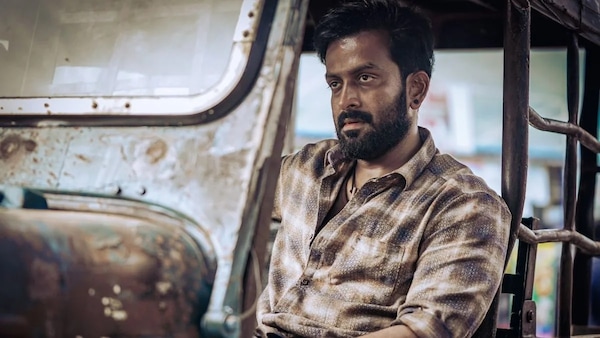
Vilaayath Budha. Film still
Last Updated: 04.42 PM, Nov 21, 2025
Vilaayath Budha unfolds in the picturesque valley of Marayoor, where we meet Bhaskaran (Shammi Thilakan), a schoolteacher-turned-Panchayat President hoping for another term in office. But his political fortunes take a spectacular hit when, on a fateful night, he slips and falls into a pit of excreta — an accident made infinitely worse because it happens in the premises of the local prostitute. The stench clings to him, and so does the scandal, as his rivals seize the opportunity to weaponise it and tarnish his reputation. The humiliation burrows so deeply into his psyche that Bhaskaran becomes convinced that only death can truly wash him clean. In a moment of warped clarity, he decides that the sandalwood tree in his own compound should one day be used for his cremation — a final act, he believes, that will release him from the “stench” that has come to define him.
Running parallel to Bhaskaran’s story is that of Double Mohanan (Prithviraj Sukumaran), a local sandalwood smuggler who, as these narratives often go, enjoys a quiet, almost folkloric hero status in the region. We know little about his past beyond the fact that he’s a school dropout, but his presence carries the weight of someone shaped by the land’s moral grey zones. There’s also a love interest, Chaithanya (Priyamvada Krishnan), the daughter of the prostitute, whose social stigma quietly shadows their relationship.
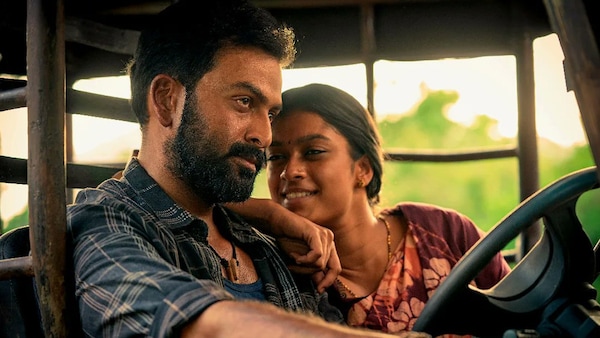
When Mohanan discovers the priceless Vilaayath Budha tree in Bhaskaran’s compound, he approaches him with an offer to buy it at any cost. But Bhaskaran, now consumed by the symbolic purity he attaches to the tree, insists on preserving it for his own cremation. It’s here that the inevitable ego clash kicks in: Mohanan sees the tree as a way to fund a road up the hill and name it after Chaithanya, his attempt to rewrite her narrative and erase the stain society has imposed on her. In contrast, Bhaskaran views the tree as his final redemption. Their opposing desires — one rooted in love, the other in shame — set the conflict on its simmering course.
The film, helmed by debutant Jayan Vannery, adapts Indu Gopan’s novel of the same name. True to Gopan’s signature style, the story delves into male interiority — a restless, combustible terrain of pride, rivalry, and fragile egos. Unsurprisingly, the film mirrors this focus, centring on the same ego-driven conflicts.
The larger problem with Vilaayath Budha lies in its archaic execution, which feels more suited to a '90s action/family drama than a contemporary narrative. Mohanan’s character sketch, for instance, is painfully generic, an assemblage of familiar “mass hero” beats, with perfunctory dramatic stretches inserted to inflate his heroism, none of which truly land. There’s a chase sequence where cops pursue him through the jungle as he barrels ahead in a rickety jeep with a dog by his side; it should have been thrilling, but the staging is so bland that it barely registers.
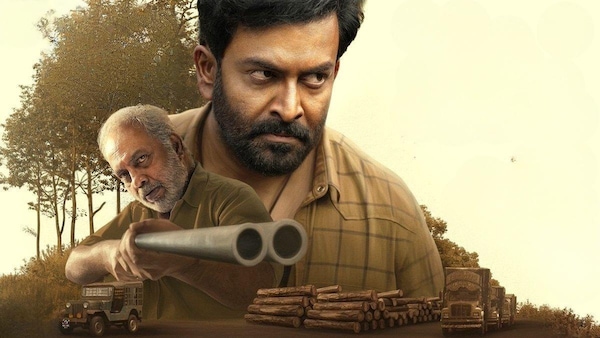
Prithviraj, burdened with a conspicuous tan to “look” the part, struggles to inject any real heft into Mohanan’s myth-making. His performance falters especially in the emotional interludes, considering he could rarely sell those abrupt flashes of vulnerability, and here, too, the disconnect is impossible to ignore. The film wants Mohanan to be a figure of local folklore, but neither the writing nor the actor’s interpretation gives him the depth or charisma needed to sustain that aura.
While Shammi Thilakan is undoubtedly in fine form, the film stretches his scenes to such disproportionate lengths that even his solid “performance” begins to wear you down — much like the character himself. Bhaskaran is written as someone in constant conflict, oscillating between self-pity and self-loathing, between moments that invite empathy and ones that provoke sheer disdain. But the overindulgence in his arc dilutes the impact, leaving you more exhausted than moved.
It’s almost uncanny how the heroine is lifted straight from Sachi’s familiar template of token feminism. Chaithanya is written as angry, horny and feisty at all times, with a forced bravura that feels more performative than organic. She treats her mother with open disdain, exhibits an obsessive attachment to Mohanan that verges on toxicity, and by the film’s end, her arc becomes grating rather than engaging. Priyamvada Krishnan struggles to make the character feel real or relatable, often appearing trapped by the script’s rigid expectations rather than inhabiting the role naturally.
Filmmakers often use the village prostitute as a shorthand for “shame” or scandal, reducing her to a plot device that fuels male ego battles. She exists mostly to escalate conflict, reinforcing patriarchal and classist stereotypes rather than reflecting her lived reality. In here, it was no different.
The film’s old-school aesthetics are evident in its sluggish song montages and lacklustre action sequences, none of which deliver memorable moments. Predictable plotting and dramatically flat dialogues only compound the sense of staleness. Supporting characters are largely wasted, with little to contribute to the narrative.
At its heart, Vilaayath Budha is meant to explore pride, shame, and ego, but outdated storytelling and exaggerated archetypes dilute its impact. The lush Marayoor landscapes and dramatic setups feel like window dressing for a conflict that ultimately goes nowhere. Ironically, the film mirrors its own subject: an indulgence in ego that leaves both characters and audience circling unresolved emptiness rather than insight.
Subscribe to our newsletter for top content, delivered fast.
