


10 Unknown cricket rules that will shock you as a fan
This article delves into the complexities of cricket, revealing ten lesser-known cricket rules that may surprise even avid fans.
Last Updated: 04.00 PM, Aug 08, 2025
Cricket, from the outset, looks like a very simple game of sport. However, as you dig deep into the game and rules, you will get to know how complicated it actually is. Today, in this article, we will present you with 10 unknown cricket rules that can shock you even if you are a knowledgeable cricket fan.
#1 Fake fielding rule
Many do not know that, as per MCC rule 41.5, if any fielder tries to distract, deceive, or obstruct a batsman during the game with a fake fielding or throwing, the umpire can call it a dead ball and award the batting team five runs as a penalty.
Obviously, there needs to be an intention from the fielder to misguide the batter in any way.
#2 The shadow rule
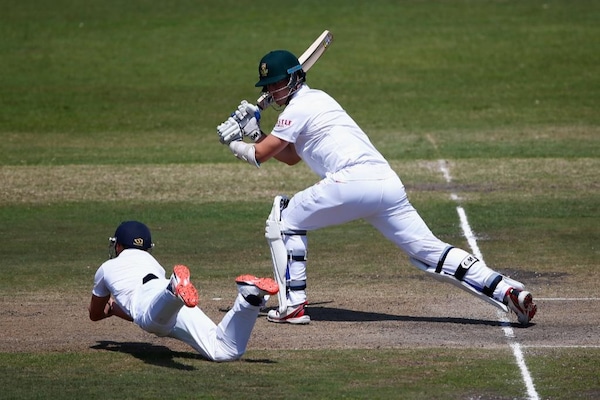
Mainly in test cricket, you might have seen fielders with helmets fielding at silly point or short cover. But if the shadow of the fielders falls onto the pitch, the fielder is not allowed to move before the batter has completely played the ball or played his shot.
Since the shadow can cause a distraction to the batter, the rule has been implied.
#3 What if someone catches a deflection from the fielder's helmet?
Let's continue with the closing fielders scenario. Imagine a batter has smashed the ball and it has hit the silly point fielder on the helmet. That ball then popped up in the air, and someone caught it.
Is that out or not out?
Well, as per the rule, it will not be out. The rule suggests that once the ball hits the clothing and helmet of a fielder, it will be considered a dead ball.
#4 No impact when no shot offered
Although this cricket rule has been there for a long time, with the implications of DRS, it has become more popular.
If a batter leaves the ball or makes no effort to play the ball, and the ball hits the pads (the ball has to pitch on within the stumps or anywhere in off-stump) and the ball trajectory says that it would have hit the stumps, the umpire will give the batter out.
Even if the 'impact' was outside off-stump, the batter will be adjudged out.
Read Also: Highest test scores in each batting position
#5. Timed Out
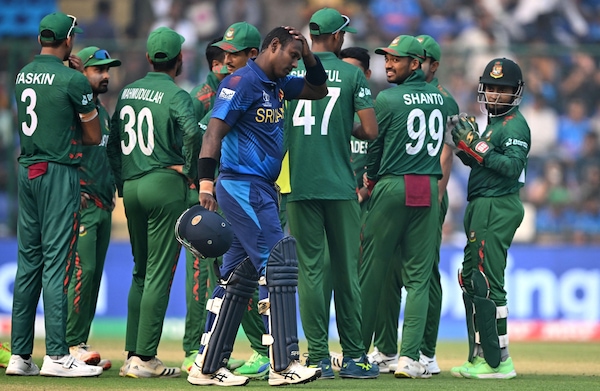
Now, this cricket rule might be one of the most famous ones due to Angelo Mathews's dismissal against Bangladesh in 2023.
As per the rule, a batter can be given out if he/she is not ready to face the ball within a given time after the previous dismissal. In test cricket, the time is usually three minutes. However, to cut the wastage of time, in some ICC tournaments, it has been reduced to 2 minutes.
#6 Only two fielders are allowed behind square leg
The square leg is the fielding position that is on the line of the batting crease in the leg side of any batter. To protect batters from dangerous bowling tactics, such as bodyline bowling that targeted the upper body, cricket rules prohibit the number of fielders behind square leg to a maximum of two.
So, even if you bowl from around the stumps and target the body, you can only have two fielders behind square on the leg side.
#7 Hitting the Ball Twice
This rule has confused many gully cricketers in the past. A batter is generally out if they purposefully hit the ball a second time.
However, there's a crucial exception.
A batter is allowed to hit the ball a second time to guard their wicket, but they cannot take a run after doing so. This means if a batter plays a defensive shot and the ball rolls back towards the stumps, they are permitted to use their bat or any part of their body to strike it away.
#8 Playing without bails
Although we know that a batter is not given out bowled unless the bails are completely dislodged from the stumps. Even in run-out scenarios, we see the same thing.
However, in windy conditions where the bails are getting dislodged automatically and creating delays and confusion, the umpires can decide to go without the bails on the stumps. In that case, hitting the stumps will be considered as out or runouts if the batter is outside the crease.
#9. Double bounce and underarm bowling
While bowling underarm is not illegal in cricketing rules, if the ball bounces more than twice on the pitch, it is considered a ball.
After the famous 1981 underarm bowling incident, Australia's Greg Chappell instructed his brother Trevor to bowl the final ball of a match underarm to prevent New Zealand. The rule was forced to make sure the balance between the ball and bat remains intact.
#10 Catch from the gloves? Out or not out?
Imagine a batter being struck on the glove by a bouncer, the ball looping up, and a fielder taking a simple catch. Out, right? Not necessarily.
According to the cricket rules, a batter is only given out if the ball makes contact with a glove that is holding the bat.
If the ball hits a glove that is not in contact with the bat handle at the moment of impact, the batsman is not out.