Home » Features » Accused: Netflix’s Post-MeToo Thriller Squanders Its Potential
Features

Accused: Netflix’s Post-MeToo Thriller Squanders Its Potential

This is #CriticalMargin where Ishita Sengupta gets contemplative over new Hindi films and shows.
Ishita+Sengupta
Feb 28, 2026
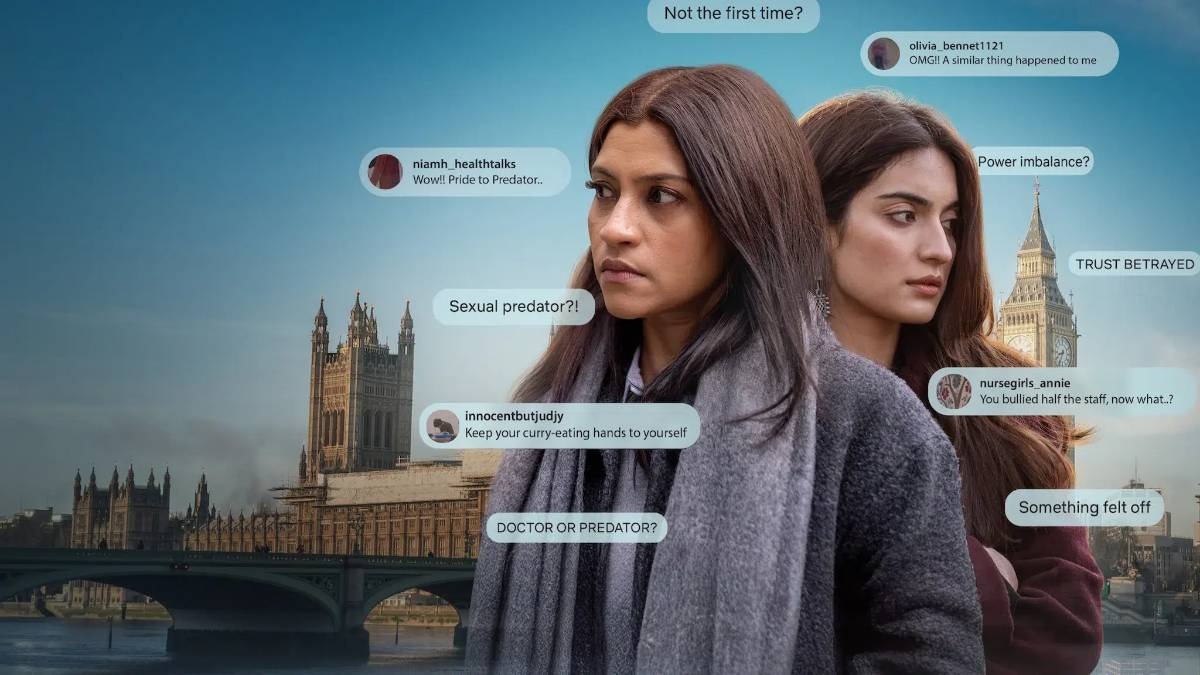
Accused. Poster detail. Netflix
This review was originally published as part of our newsletter Stream Or Skip on February 28, 2026. Subscribe here. (We're awesome about not spamming your inbox!) *** DAYS BEFORE Anubhuti Kashyap’s Accused dropped on Netflix, the director admitted that the film was made keeping in mind the audience and algorithm. Her words were a radical confession, one that freely used the “A” word and distilled an aesthetic that is increasingly becoming a norm in the streaming landscape. Algorithm filmmaking, bent on holding the audience’s attention hostage, has diverse symptoms, ranging from using stark colours, recurring expositions and, as Kashayap shared, the dire need to sustain tension (“I kept taking very specific notes and showing the film at different stages to different people — asking, were you feeling relaxed here? Were you getting out of the film at this point?” she told The Hollywood Reporter). Such interventions can result in assembly-line products, and Accused is the recent casualty.
This, of course, wasn’t supposed to be the case. Accused stars Konkona Sen Sharma and Pratibha Ranta and is helmed by Kashyap, whose directorial debut Doctor G (2022) had a distinct voice. More crucially, the premise turns assumptions on its head by anchoring the narrative around a female gynecologist Geethika Sen (Sen Sharma) accused of sexual misconduct. It is an intriguing jumping off point. The film, tragically, remains stationed there only to deflate by the end with all the accrued tension.

Get your pop culture fix on OTTplay for just Rs 149 per month. Grab this limited time offer now!

Written by Sima Agarwal and Yash Keswani, Accused centers around a queer couple. Geethika and Meera, both doctors in the UK, are on the brink of a big change. Geethika, considerably older, is about to be promoted and they are adopting a baby. Plans of relocation are underway but their plans are soon upended. An anonymous email accuses Geethika, one of the most successful doctors at the hospital and known for being severe with her methods, of sexual misconduct. Within days, more complaints seep in — all anonymous. And then a former staff member turns up.
Set in a post-MeToo world, Accused looks at the other end of the spectrum and what accusations can do to those accused. In that sense, it treads close to Anurag Kashyap’s Bandar (2025), where a washed up actor faces a similar ordeal. But the thorniness of the Bobby Deol-starrer is offset here not just by swapping the gender but also by solely focussing on the person going through public humiliation. There was a real scope here, not diminishing the claims as such, but of exploring the beats of social trials and the way this can percolate in relationships.Kashyap’s film, however, squanders the potential with an almost curious level of meticulousness. What could have been a nuanced dissection of power culminates as a tepid thriller. And the misshapen setting includes an assortment of people — Geethika’s former lover, a mercurial private detective (Sukant Goel trying to do a Saurabh Sachdeva); Meera’s male colleague, evidently smitten by her — only to reduce them to red herrings. Soon, Accused transmutes into a generic whodunnit where the complications of gender and abuse are reduced to a footnote.
This formulaic treatment leaks into the way Accused is shot. The physicality of the place lends nothing to the plot, least to the psychological exploration of the person at the centre. Ditto for all characters. Kashyap’s film breadcrumbs its way through, continually promising only to step back on it. Take for instance the complexity that the outing grants Geethika, a flawed woman with a propensity of abusing power, in the language of redemption. Her partners, Meera included, have been younger than her. It is a cogent detail that the film underlines only to look away from. Meera too is (under) written with the same ink. When news of the accusations arise, Accused affords no agency to the character to confront her partner about it. The blind reverence makes sense in context of the lopsided power dynamics between them; it is fronted as a given, and not a subject for discussion. The only bit that presumably troubles Meera is Geethika cheating on her.
Such infantilisation mirrors the overt turns in the film. It is bewildering to see Sen Sharma, one of the greats, lean into the mundanity of the surrounding. On paper, her playing such a role makes for a fascinating prospect but it hardly translates. Ranta too, in her second film after Laapataa Ladies (2024), has little to do. The more baffling bit about Accused, however is its understanding of power. There is a tiny moment in the end when Geethika reckons with the way she has designed her behaviour of a powerful woman in the mould of a powerful man. It is an interesting detail but the irony here is that although Kashyap’s film recognises power as a male construct and comes close to calling out a woman adhering to it, it treats its “powerful female character” the very way the society treats powerful men: with impunity. In that Accused becomes guilty of the very accusations it is levelling. Accused is now streaming on Netflix.
Share
return(
)