Home » Features » Bison Kaalamaadan: Mari Selvaraj Crafts A Rousing Tale Of A Boy Who Runs From Strife Into Sport
Features

Bison Kaalamaadan: Mari Selvaraj Crafts A Rousing Tale Of A Boy Who Runs From Strife Into Sport

Selvaraj stages Bison as a tale of rising above oppression, a peek into the human condition, the role of a family unit, and how everyone is made up of various shades from white to grey and black.

Subha+J+Rao
Oct 18, 2025

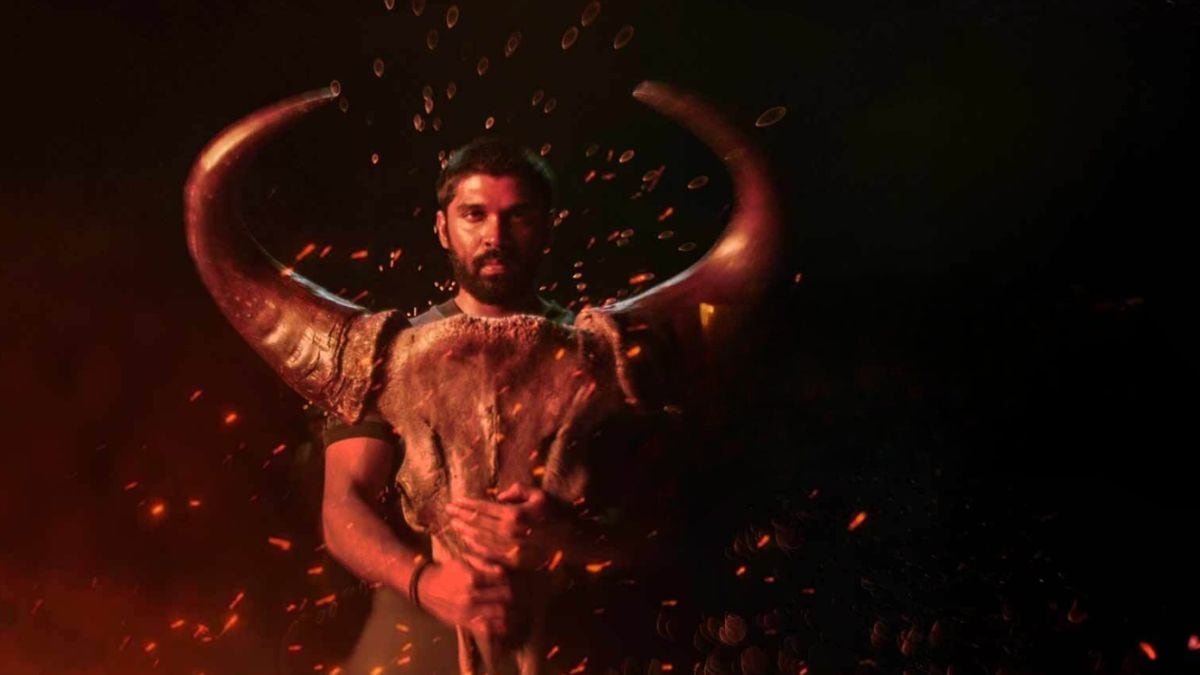
Promo poster for Bison Kaalamaadan.

I CAN'T REMEMBER the last time leaders of two opposing factions in a film spoke about the futility of their struggle and its relevance with more muddled honesty than in Mari Selvaraj’s Bison Kaalamadan. It helps that the leaders are played by Ameer (Pandiaraja) and Lal (Kandasamy), artists whose faces and voices convey honest anger and built-up fury, but also wander into areas filled with doubt. This makes them very non-leader-like and utterly human. This ability of Mari’s to question his own character is one of his defining traits.On the other end of the spectrum is Pasupathi, who plays Velusamy, a widower, who, in his words, has raised his children Kittan and Raji (a fabulous Dhruv Vikram and Rajisha Vijayan) hidden under his armpits to protect them from the strife and murders that abound around them. Pasupathi is Tamizh cinema’s gem who safeguards and nurtures his craft and emerges once in a while to gift us a performance we can remember for long. Velusamy knows anger, thinks he has learnt to control it, and struggles not to unleash it once the scourge of caste comes calling at his doorstep. There’s a familiarity with which he extracts hidden daggers and hides them on his person, but his face belies that past.

Stream the latest Tamil, Malayalam, Telugu and Kannada releases, with OTTplay Premium's Power Play monthly pack, for only Rs 149.

Teachers are an important part of Mari’s universe, and in Bison we get the wonderfully written Santhanaraj (Aruvi Madhan), who is from a privileged caste, but thinks sports erases boundaries, and that one should strive to reach a place where no one can build fences. He, too, begins from a place of doubt, but belongs to that category of people who constantly work on themselves, seeing the world around them, and becomes Kittan’s biggest strength. The role of village schoolteachers has rarely been explored much in cinema, and that’s a rich subject filled with possibilities.Bison loosely based on the life of Kabbadi player Manathi Ganesan, is not your regular sports drama that also speaks of caste. Instead, Mari writes and stages it as a rousing tale of rising above oppression, both inward and outward, a peek into the human condition, the role of a family unit, and how everyone is made up of various shades from white to grey and black. And Kittan’s character is us in so many places, wondering why someone his father said was a protector was taking lives, and later wondering why someone said to be the bad guy is placing all bets on him. Like in life, most of the characters in Bison are a little too real. And that ensures you never see it as a movie.
Not that the film is flawless — I could never buy into the love Rani (a very, very brown-faced Anupama Parameshwaran. I still don’t get why this is permitted, even celebrated) and Kittan share, primarily because he’s the one who brings up their age difference. Mari expects you to understand the longevity of that love, but does not leave you with enough history to imagine it. However, to Mari’s credit, Velusamy never even blinks an eye at this love, and there’s an endearing scene where he fondly embraces the two young women, Rani and Raji. In their village, young love is often nipped in the bud to disastrous after-effects, and Raji’s life is proof of this. Sometimes, you wonder at her place in the world of men — her own father and brother don’t know of her backstory, or why she’s at home, and don’t even make an attempt to know. It takes a Rani to tell them some home truths.But let’s get back to Kittan or Bison as he gets called later. He’s shown as constantly running — from trouble, from people, from disappointment, towards kabbadi, and behind a car carrying his mother bitten by a snake. When he’s sad or when he feels constricted, Kittan needs to run to feel better, feel the breeze against his face — for, in many ways, Kittan is a child of Nature, happiest amid water bodies, fields, animals and the wind against his face. ALSO READ | Bison OTT release: Where to stream Dhruv Vikram-Mari Selvaraj film online
And, cinematographer Ezhil Arasu K frames the film so effectively, tapping into the characters’ traits and the beauty of the Nature they are surrounded by. Those scenes of pollen flying off fields, Rani with a halo of insects in a field, boys jumping into the waters as two friends engage in a heartfelt conversation, ferocious looking dogs standing as silent sentinels as people rush to help Kittan, and Kittan pushing his body to its limits, are captured with a poetry-like gaze, in contrast to the blood and fury all around. There’s a lot of violence, implied and apparent, and, consequently, a lot of blood and hacked flesh too. Strangely, and I say this after consideration, the overriding emotion in those scenes is sadness, not vicarious joy. They only serve to drive home the point of how fragile and futile life can be.I had some issues with the run-up to the climax — can a name be included because a selector’s daughter bats for a player? Interestingly, Mari sets up a clash between India and Pakistan on the sports field, but to great relief, stays away from jingoism and treats it like yet another match. With each film of his, Mari is unconsciously creating a body of work that, at first, nudges people, especially those from traditional oppressor castes, to set foot into a world vastly different from the one they know, where nothing comes from privilege, and where everything is the result of a past burden. And, while that might not be the intention, his films educate and, in the long run, will hopefully help people engage better with each other, with words that aid debate and not fuel arguments.
Bison has a fabulous tech team, including editor Sakthi Thiru and music composer Nivas K Prasanna, and they lend so much value, allowing the film to breathe, even thrive. Some might complain of a lag, but this film needs that space. Nivas’ score is electrifying, and his choice of background score, especially for some matches, works so very beautifully. ALSO READ | Bison director Mari Selvaraj: 'If you are waging a war using an art form, you need patience' However, mention has to be made of the use of singer Vedan, accused of rape and released on bail, in a song. That he sings it with Therukural Arivu, a known voice of the oppressed, stumped me. Everyone must do better and take cognisance of the voice of survivors. All the more so when the team involved speaks of the oppressed. And when a film speaks of such an important issue. Makes me question myself: am I dissing the film by pointing out this apparent flaw, or am I simply being honest?
Coming back to the life breath of the movie, that would be Kittan. Dhruv is nowhere really to be seen, but you are reminded of who he is and whose son he is, only when he speaks and when the camera lovingly gazes at him. If allowed to nurture his talent, and if he seeks to become a performer first, the field looks set for Dhruv. If Kittan did not step into our hearts, Bison would not work as a movie. For you have to feel the angst of a young boy who just does not understand the real world around him, and who only understands his world — that of kabbadi, to buy into the film. Some films leave you feeling fulfilled, despite minor glitches, and make you want to get back to the darkened theatre and invest your time and money. Bison is that kind of film. Go watch! Psst...Mari Selvaraj's 2024 film Vaazhai is currently streaming on JioHotstar, now available with your OTTplay Premium subscription.
Share
return(
)