Home » Features » Dhurandhar: Aditya Dhar Marries Spectacular Craft With Deeply Skewed Politics
Features

Dhurandhar: Aditya Dhar Marries Spectacular Craft With Deeply Skewed Politics

This is #CriticalMargin, where Ishita Sengupta gets contemplative over new Hindi films and shows.
Ishita+Sengupta
Dec 05, 2025
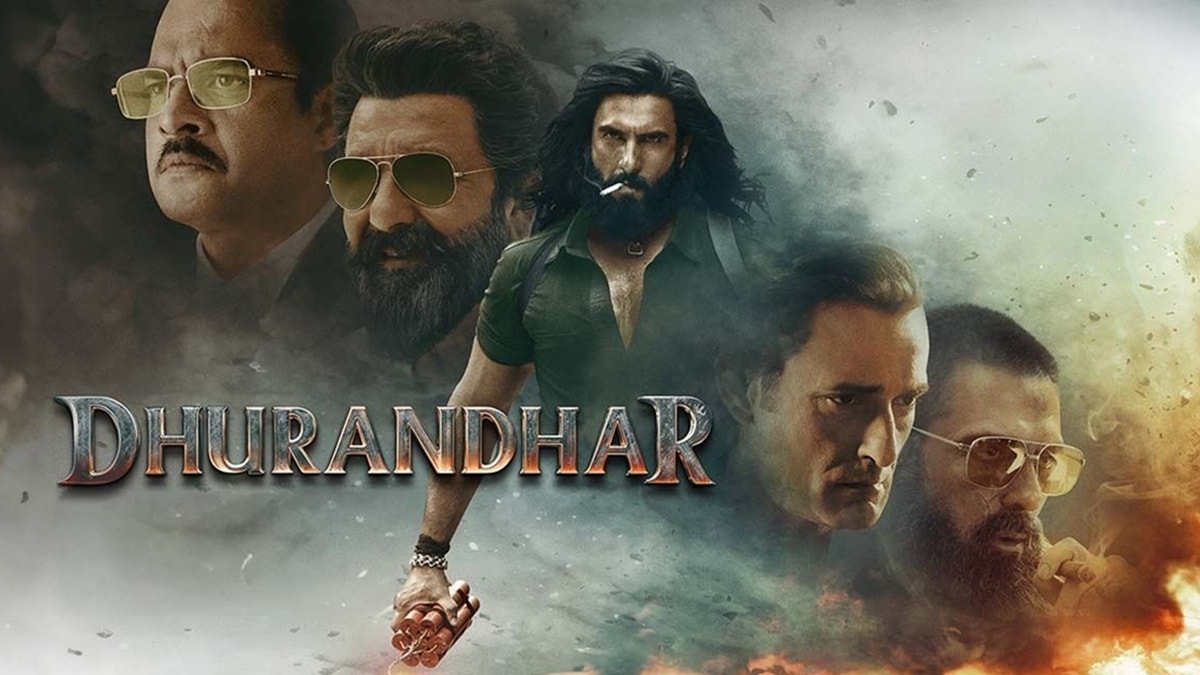
Dhurandhar. 2025. Poster detail
ADITYA DHAR who gentrified propaganda with Uri: The Surgical Strike (2019), has made an accomplished Pakistan-set Hindi film with Dhurandhar. As a producer and director, his career leans on perpetuating bigotry in the garb of persuasive filmmaking. And while this continues with his sophomore feature, he also displays more curiosity about the neighbouring country than most outings, peddling similar politics, did of late. This perverse obsession is so extreme that if Dhurandhar was a teenage boy, one would assume he has a crush on Pakistan.At one level, Dhurandhar is a bafflingly intricate gang-war film based around Karachi’s Lyari locality. Two rival groups, one headed by Rehman Dakait (Akshaye Khanna) and the other by Babu Dakait, are up against each other but things really come to head when Babu kills Rehman’s son. The murder unleashes a bloodbath and a triumphant revenge elevates Rehman from a politician’s right-hand man (Rakesh Bedi used for comic relief) to an aspirant minister. From here, Dhar, also the writer, goes all gory and brutal, tracking Rehman’s journey from a grieving father to a ruthless man willing to sell arms and his soul for power.A man called Rehman Dakait, a Pakistani drug dealer, did exist in Lyari and this figment of reality lends Dhurandhar a biopic-like quality. Through him, the film explores the mythical Karachi neighbourhood, the alleys where young boys played football, the sherbet shops and dingy gangster dens. Beyond the good and bad of this recreation is Khanna playing Rehman with main-character histrionics. The actor is always compelling but here he makes even his chin act. Khanna refuses to look straight, perpetually scrunching his face for effect and looking down upon the rest. His eyes keep brimming with tears and his shoulders slouch when needed as Dhurandhar gives him one entry shot after another (all earned) with a cigarette dangling from his mouth.In a move reminiscent of Gully Boy Ranveer Singh, the wilful protagonist of this feature, is often found standing behind him. Singh plays an Indian spy who worms his way into Rehman’s gang as Hamza Ali Mazari. Keeping him at the centre, Dhurandhar becomes the film it wants to be and this naked intentionality reveals Dhar’s new work as an extension of his filmography that six years into existence has only transfigured into something more grotesque and vile.
Divided into chapters (and a second part waiting in the wings) Dhurandhar opens in 1999 during the Kandahar attack where an Indian flight was hijacked by terrorists. Negotiations are underway when Ajay Sanyal (R Madhavan), chief of Intelligence Bureau (IB) is informed that the Prime Minister is under a lot of pressure and their demands — the release of certain militants — need to be fulfilled. In the larger picture, that soon gets bloodied with feuds and treachery, this entry point makes little sense. But it aligns with Dhurandhar’s purpose that takes every opportunity, standing or sitting, to throw shade on the then current government while hyping up the possibility of a more daring ministry to be at the Centre. The implications here are more apparent than those with an Indigo flight ticket at the moment but Dhar still chooses to spell things out.When Ajay Sanyal rallies the passengers in the flight to chant for the country and they don’t, fearing a gun still pointed at them, a terrorist mockingly says, “you Hindus are very scared”. Indignant with this, Sanyal offers a plan of action to his superior (Akash Khurana with very fake eyebrows) only to be told that they are too radical except “project Dhurandhar”. A stray remark about “aman ki asha” in Kashmir floats in the background. If Dhar is to be believed then every diplomatic policy of the then government was steeped in cowardice and, like a hero who can’t be seen but is only spoken about, the present political party hovers over the narrative as an impending saviour. Every time Sanyal is heartbroken by the Prime Minister (no names are taken, no faces shown), he looks at a distance (possibly at a news channel from the future) and says things like, “someone will come and change things around,” like a man smitten out of his senses.The filmmaker’s commitment to deride the previous party in power infiltrates most things. It decides on the timeline (1999-2009) and bleeds into the choice of events. Hamza quickly joins the ranks in Rehman’s gang and through his eyes in Pakistan (he stays like he never wants to leave), the filmmaker stitches together the attacks on India. The 2001 Parliament attack is included, so is 2008 Mumbai attack but the abject lack of empathy in the depictions is telling.
It is never not ironic the way Dhar uses disclaimers to his advantage. Dhurandhar opens with a caveat that it is not a documentary but in the same breath, uses footage as and when required for blatant provocation. The most gratuitous one is reserved for the 26/11 blasts when the screen is filled with transcription of factual exchanges between terrorists and hostages in Mumbai’s Taj Hotel bookended with fictional recreations of ISI leaders (Arjun Rampal makes an appearance) and Rehman Dakait celebrating and baying for Indian blood.The filmmaker's desperate obedience leaks even in the laughable way he weaves in a conspiracy theory that an Indian leader had sold ₹500 note design to Pakistan which, two decades later, should justify demonetisation. Such an undisguised agenda makes Dhurandhar a staidly ineffective film even as it tries to inject graphic visuals (hands and heads are routinely chopped, an Indian man’s body is pierced with thousand cuts) to make people in Pakistan look like savages. Perhaps this also explains the reason why Hamza gets married to a child-bride (Sara Arjun, the actor, is 20 years of age) and no one bats an eyelid. A sacrifice, if you will, from an Indian spy.Dhurandhar is Singh’s first film in three years and the actor is alarmingly unremarkable. He has bulked up, making Sara Arjun look even more frail in his presence, and offers a turn that is all noise with little to hold on to. He also plays a strangely dense character where the writing says little to nothing about him. Most films made in parts (like Anurag Kashyap’s Nishaanchi) tends to do this where the enthused prospect of a second installment keeps most ends untied. For a film as long as this (212 minutes), this proves to be a misfire. As do other things.Having said that, Dhar continues to be impressive in his craft. The chase sequences are well done, edited with buzzing kineticism and pressed to banging music (the soundtrack ranges from Punjabi folk to qawwali muttered with retro Hindi film music thrown in ). But it is also difficult to separate his filmmaking from the hostility it spews. Given his merit, one is tempted to imagine a world where Dhar makes films devoid of biased choices but Dhurandhar also brings to mind a more worrying question: what if propaganda is not the crutch but the fuel to his filmmaking? (Disclaimer: The views expressed in this column are those of the author and do not necessarily reflect the official policy or position of OTTplay. The author is solely responsible for any claims arising out of the content of this column.)
Share
return(
)