Home » Features » Maude Apatow’s Poetic License Is Effortlessly Charming
Features

Maude Apatow’s Poetic License Is Effortlessly Charming

OTTplay's critic Ishita Sengupta reports from the Toronto International Film Festival (TIFF) 2025. Here: A review of Poetic License.
Ishita+Sengupta
Sep 14, 2025
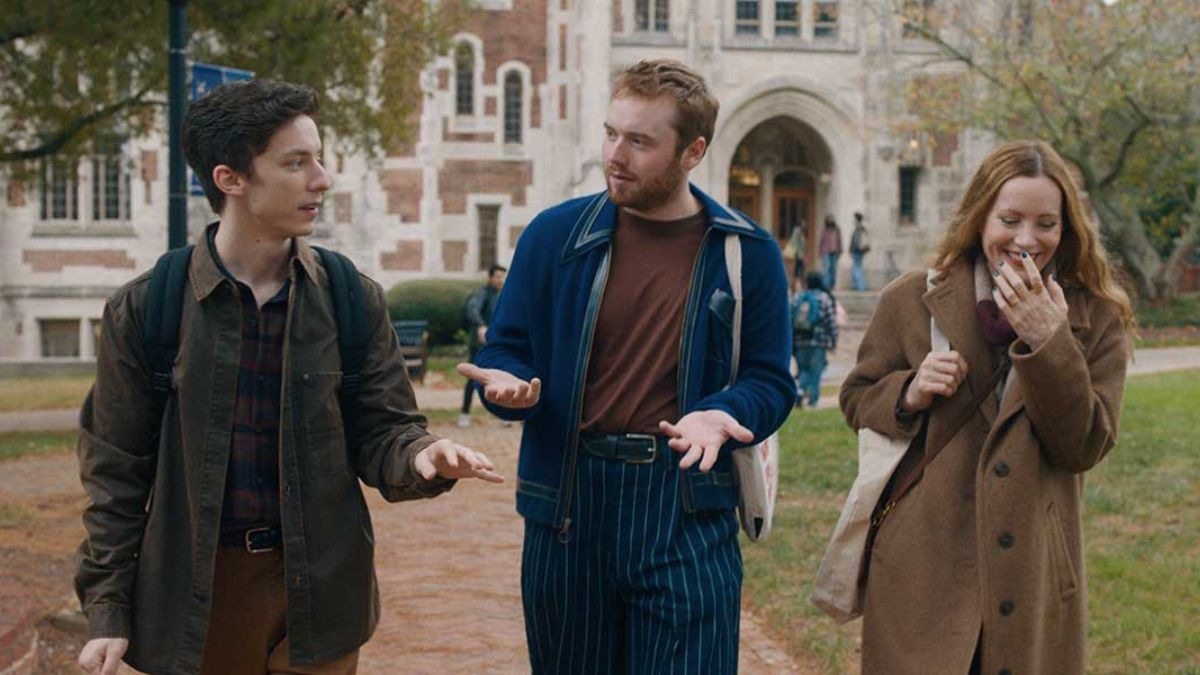
Still from Poetic License.
IN FILMS the presence of three is inherently fodder. The arrangement can be disruptive, but it is mainly used by makers to arrive at familiar resolutions. In her wonderfully assured directorial debut Poetic License, Maude Apatow flips the script. She takes three people, resists settling for sweeping endings and shakes things up for fun. It is a lovely detour that is consistently rewarding.Ari (Cooper Hoffman) and Sam (Andrew Barth Feldman) have been friends for a while. As students, their lives have been mostly spent on campus. Things, however, are about to change. The erudite Sam has his eyes set on a finance job, while Ari, the rich young boy prone to wearing LED face masks at leisure, is still trying to figure things out. A poetry class together becomes their latest way of hanging out. But when Liz (Leslie Mann) sits with them in class, their attention to each other wavers a little. There is only one problem: Liz is a married woman with a daughter. Her professor-husband’s new job at the university brings her to a quiet town from Chicago, as she sits with them in a poetry class to audit. Stream the latest films and shows with OTTplay Premium's Power Play monthly pack, for only Rs 149.If three is trouble, then an arrangement like this can be troubling. The setting of an older woman caught between two fawning young men can go in any direction for the many moving parts involved. There is the question of gender and unequal power dynamics, rife with potential for things to spiral out of hand. Apatow, who directs from Raffi Donatich’s story, introduces a playfulness to the set-up that drifts but never fails to charm.As enticing as youth can be, Apatow, in her retelling, focuses on the woman at the centre. It is an effective swerve that lends Poetic License most of its ingenuity. In the filmmaker’s hands, Liz is a far cry from the stereotypical middle-aged woman receiving renewed attention from young men. Instead, she comes across as someone fighting boredom. Beneath the perfect exterior of a loving family and inviting home, Liz’s life is scattered; she is no less aimless than her newfound friends in the class.Expertly portrayed by Leslie Mann (in many ways, the film is a daughter’s gift to her mother), Liz is a fascinating character. She is socially awkward and emotionally dependent on her daughter, Dora (Nico Parker). With Dora finding new friends, Liz plunges into a state of loneliness. Motherhood had been Liz’s full-time job for the longest time, but with that transitioning and her daughter going to college, she is afflicted with an identity crisis. Liz, however, holds the rails against being invisible. But to Ari and Sam, none of these registers. They see her as someone both are struggling to be: sorted. And therefore, the prospect of being with her promises to legitimise the big feelings they carry around. For Liz, on the other hand, the intimacy of a friendship is reminiscent of the carefree life she has left behind.
Watch these Maude Apatow performances!
To Apatow’s credit, the suggestive heaviness in the premise is offset by humour. She displays a genuine knack for not just mining humour in regular situations (Martha Kelly is hilarious as the poetry teacher undergoing a bitter divorce) but also recognising the potential of lightness in mundanity. Through her keen eyes, all three characters are humanised even when each runs the risk of being stocky. Feldman is excellent as this apparently put-together youth, but no less muddled than his best friend, Ari. It is Hoffman, however, as the Strand tote bag-carrying rich boy who is assuredly excellent. He is immensely watchable and, despite being talky, inhabits the lines like second nature.With Poetic License, Apatow manoeuvres a recognisable backdrop and infuses it with likeable goodness. It reminds one of the Cooper Raiff brand of filmmaking (Leslie Mann being in Cha Cha Real Smooth intensifies the comparison) as no character is given a shorthand. No one is unkind or evil. Not the absent husband nor the grown-up daughter (in fact, the filmmaker stages the quieter moments between Dora and Liz with great warmth). It is just that, contrary to popular perception, women’s struggles do not abate with age, even for those who used to be therapists. Apatow takes three people, uses rom-com aesthetics and then yields poetic license to offer a timely reminder about the grown-up in the group.
Share
return(
)