The Fantastic Four: First Steps | A Bad Rebirth, A Good Newborn
Matt Shakman’s star-studded reboot is a study of contrasts. As a modern superhero franchise, it’s too comicbook-ish to be an effective movie, writes Rahul Desai.
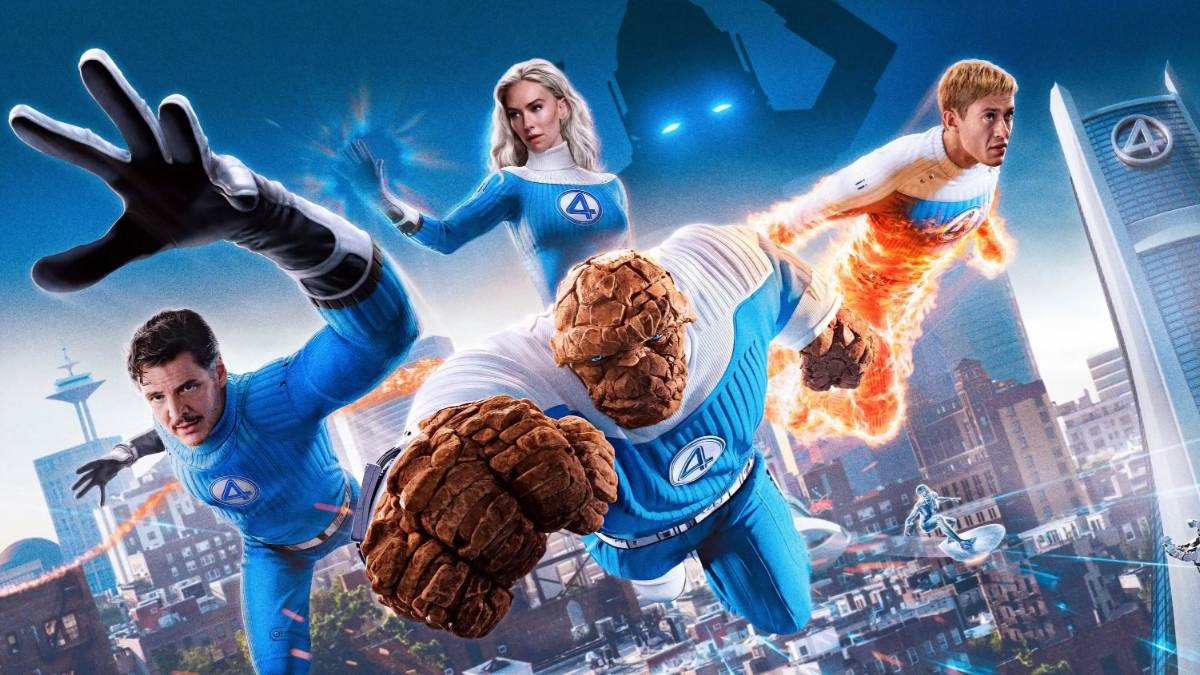
The Fantastic Four: First Steps. Poster detail
I REMEMBER BEING TRAUMATISED by the mediocrity of The Fantastic Four (2005) and its Silver Surfer sequel (2007), back when superhero movies were still in the ‘Sam Raimi’s Spider-Man’ era. One of my first thoughts, as a red-blooded male teenager, was: Is Jessica Alba really worth the fuss? The Fantastic Four: First Steps is a considerable step up from both the 2000s debacles and the 2015 disaster (I bet you didn’t remember that one — well, neither do Michael Jordan, Kate Mara, Jamie Bell and Miles Teller). Granted, that doesn’t take a lot of doing, but as an MCU movie that absolutely ‘needed’ to be made to thicken the chaos of the next Avengers movie, it’s not the worst thing. It’s not the best thing either, but when did Marvel ever pretend to be ambitious within its anti-cinema aesthetic? The Emmy-nominated Martin Scorsese will tell you more.With Pedro Pascal (as Reed “Mister Fantastic” Richards), Vanessa Kirby (as Sue “Invisible Woman” Storm), Ebon Moss-Bachrach (as Ben “The Thing” Grimm) and Joseph Quinn (as Johnny “The Human Torch” Storm), Matt Shakman’s star-studded reboot is a study of contrasts. As a modern superhero franchise, it’s too comicbook-ish to be an effective movie. Let me explain. Like several of its Marvel co-workers, The Fantastic Four is essentially unfilmable; it’s written and conceived to be imagined and customised as per the personality and creativity of the youngsters who read them. The plot revolves around the retro-futuristic heroes having to save 1960s Earth from being ‘devoured’ by a hungry and villainous space god named Galactus. The Silver Surfer (female this time) is Galactus’ enforcer.
Get your Marvel fix on OTTplay Premium for only Rs 149 per month. Grab this limited time offer now!So this adventure involves a lot of green-screen acting, psychedelic space travel, imploding planets, approximations of black holes, zippy portals and wonky-science-meets-fantasy ploys. At one point, faced with impending doom, the team come up with a plan to teleport their own planet so that “Galactus can’t find us”; then they plan to teleport Galactus himself by luring him to Times Square. These are clumsy and cute ideas that I’m not sure can, or even should, be ‘executed’; it dilutes the childlike innocence of being able to think so limitlessly to begin with. It doesn’t help that the giant baddie looks like some Aztec-era Sanjay Dutt who’s tall, tired and operates like a 2D concept. I’m convinced that envisioning him shapelessly in our heads is precisely why comic-books exist; we don’t always need a movie to convert our fancy into VFX-stunted visualisations and forced 3D imagery.All the set pieces just don’t work because of how far Fantastic Four — as fiction itself — stretches (no pun intended) our suspension of disbelief. We’ve also reached an era where the filming of things that once used to be considered magical and exciting is now normalised — nearly desensitised. Nothing amazes us anymore because nothing surprises us anymore. Wonder is more of an algorithm now. At best, we can appreciate that the writers don’t put us through the backstories again — they’re already 4 years into their stint as world-saving astronauts with cosmetically-altered DNA. So to watch this film as just another superhero reboot is to experience just another soulless MCU spectacle in the theatres.But perhaps the way to do it is to shift perspective and see The Fantastic Four: First Steps as a literal manifestation of its title — not the ‘first steps’ of a reboot but the first steps of an infant. Or in other words, as a superhero origin story of Reed and Sue’s baby boy — from conception to birth and beyond — masquerading as a middling Fantastic Four movie. Sue is pregnant for half of the film and is a young mother for the other half. The baby-bump, childbirth sequence (Kirby doing her Pieces of a Woman bit) and the newborn heavily define the storyline and action, almost as if this entity — nobody is sure if he will have superpowers too — is influencing the universe before his childhood begins. The moment he becomes a possibility in a womb, the premise widens: Galactus declares that he will spare Earth only if he can take away the cosmically-freakish baby in return; he believes that this little creature has the potential to replace him and liberate him from his own hunger as destroyer-in-chief. Naturally, the parents refuse to trade all of humanity for their little human.So the stakes are heightened: the adult ‘4’ gang is fighting for the very existence of a future superhero as well as the future of the planet. They are, in a way, trying to prevent time itself from ending. What’s remarkable is that all they’re really doing is being ordinary parents and making sacrifices to protect their kid; the ethical conflict is that they are just like anybody else, despite the burden (or responsibility) of being more. The end of this film is where most superhero movies begin: a little boy unaware of just how transcendent he is. The road to get here — the pre-credits sequences we don’t usually see — is what First Steps explores. It’s the lore before the lore; the trick is to not let the viewer realise it. In that sense, the film succeeds. Viewing the heroes as desperate mothers, fathers and uncles allows us to detect some blood between all the MCU-coded flesh. After all, every family is a Fantastic Two, Three, Four or Five — stopping global destruction is just a bonus.Share