Home » Interview » The Neeraj Ghaywan Interview | 'I Want Homebound To Be Watched By The People It Is About'
The Neeraj Ghaywan Interview | 'I Want Homebound To Be Watched By The People It Is About'
The Homebound director speaks with Ishita Sengupta about how he crafted this intimate story of friendship against the backdrop of the national COVID-19 lockdown.
Oct 06, 2025
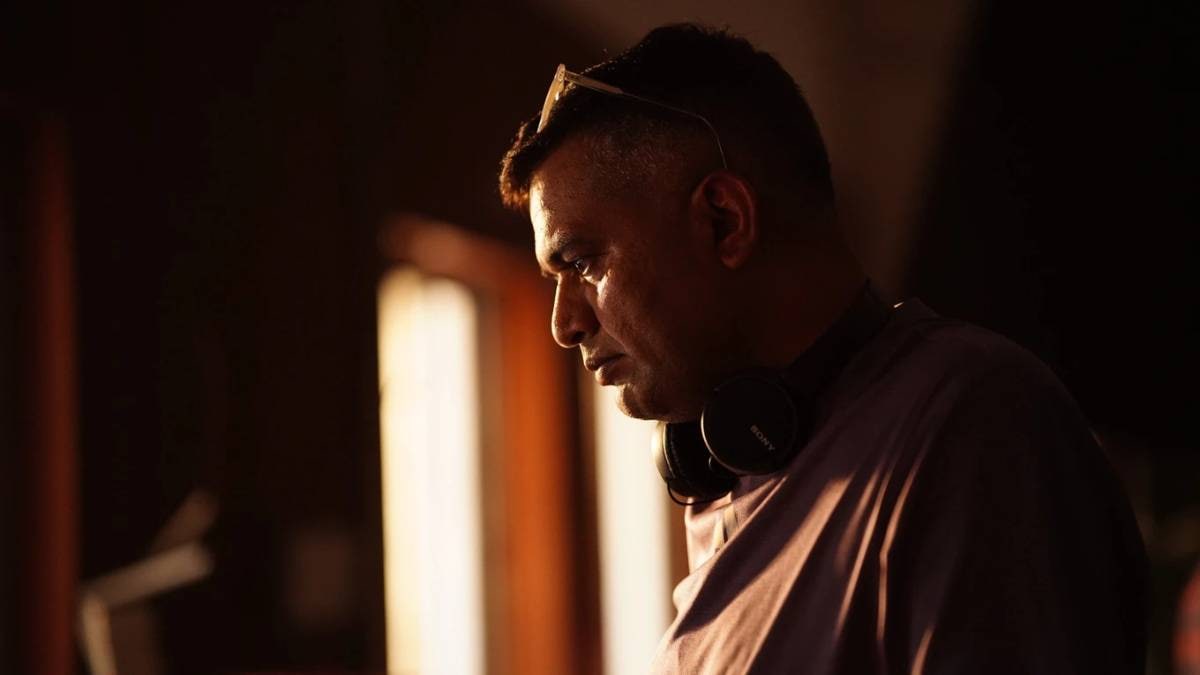
Neeraj Ghaywan. Photo by Deepak Reddy. Courtesy Dharma Productions
IN 2020 journalist Basharat Peer travelled to Devari, a village in Uttar Pradesh, persuaded by a picture on social media. Two men; one holding another on his lap as a water bottle lay nearby, unattended. The image was part of the COVID-19 visual archive in India when the government had abruptly called for a lockdown. The halt upended the lives of workers who, in a country functioning on cheap labour, had migrated to the cities. With employment gone, transportation services suspended and rising uncertainty about money and food, millions walked back to their villages for shelter. The picture was from the exodus and stirred something in Peer to find out more. The result was a New York Times essay titled Taking Amrit Home (2020) that filled in the details. The men were friends and walking back from Surat to Devari (Google map tracks the time to be more than 265 hours). Amrit Kumar had collapsed due to the heat and Mohammad Saiyub was holding him.
ALSO READ | Neeraj Ghaywan's Homebound: A Nation Unmade, A Bond Unbroken
Neeraj Ghaywan’s Homebound (2025) is an adaptation of the piece. Yet, the filmmaker goes beyond the written words to reimagine a life for these two men before the lockdown. On paper, it is already an empathetic swerve that only gets amplified during the film. Mohammad Saiyub becomes Mohammed Shoaib Ali (Ishaan Khatter) and Amrit Ku mar is Chandan Kumar (Vishal Jethwa). One is a Muslim and the other, a Dalit — both minorities in India. Ghaywan, born into a Dalit family himself, retains these people with their identities, and uses the medium of his choice to expand on their lived experiences and daily humiliation in a country battling rising bigotry.
Despite not sugarcoating the politics, Homebound unfolds as a moving story about friendship with a strong ask for humanity. This year, the film was screened at Cannes Film Festival’s Un Certain Regard section, exactly a decade after Ghaywan’s directorial debut Masaan premiered there. Since then, his sophomore feature is having a charmed festival journey. In September, the film had its North American premiere at the Toronto International Film Festival.
More applause was in store: In April, Martin Scorsese came on board as an executive producer. The association came about through Mélita Toscan du Plantier, a producer on Homebound and Masaan and was kept a secret for long. “There was a blanket ban,” Ghaywan informs, with only certain heads of the department from production privy to it. One way of maintaining the secrecy was using a pseudonym. “We referred to him as bade papa” (uncle). Homebound is also India's official entry for Oscars 2026 in the Best International Feature category.
Amidst such global serenading, this film’s own homebound journey has been patchy. On September 26, it had a theatrical release after accommodating 11 cuts from the Central Board of Film Certification (CBFC; the statutory board that regulates the public exhibition of films in India) with certain words spoken by the protagonists muted and replaced, among censoring other scenes. Post the film’s premiere at TIFF, where I watched it, and the film’s theatrical release in India, Ghaywan spoke to me about his creative process, reshaping a national disaster into a personal crisis, Scorsese’s contribution to the narrative, and if the CBFC changes have altered his vision. Edited excerpts:
How have the last couple of days (since the film’s theatrical release) been?
Manic, hectic. I am living Paul Thomas Anderson’s One Battle After Another. It started with Cannes and then Toronto. It is all good things but the amount of work and the exhaustion that comes with it is also a thing. Right now, I am busy with the release. People are not flocking to the theatres. I have to deal with that, then I have to go to the Zurich Film Festival. Post that, I will be working towards the Academy.
Is the theatrical response bothering you?
Yes and no. I mean, it is not bothering in the sense that it is the reality of the day. I am aware that viewing patterns have changed, and people would rather consume this on OTT. But I still feel it is a theatrical experience not because of the scale or anything — it doesn’t have all that — but because it is a community viewing experience. And people will have a different experience watching the film. But here we are, what do we do?
In Homebound you look at lockdown during the COVID-19 pandemic, a national tragedy, through the personal lensing of friendship. Was this driven by self-censorship or creativity?
Basharat Peer’s article had a lot of footnotes and commentary. Had I done that in the film, it would be expository. The difference in approach was driven purely by the change in medium. We cannot be too didactic or have factoids. As a filmmaker, I have always believed that the narrative needs to be at the forefront and the politics should be underlined. Like the way Satyajit Ray films are or those by the Dardenne brothers and Ken Loach. That has been my general approach.
GOOD TO KNOW | Where To Watch Homebound On OTT
I also wanted it to feel personal. When reading the article, I was most moved by Amrit’s framed picture where he looks so happy. Instantly, I went to Rilke’s quote, “Let everything happen to you. Beauty and terror. Just keep going. No feeling is final.” I put those lines on every draft of mine; it kept me going. In Hindi films we tend to have the gaze of the urban intelligentsia. It is very kind but also inadvertently condescending when members of the marginalised communities are presented only as victims of the state or circumstances. Why don’t we look at them as human beings from their point of view? They are not wearing their identity so strongly on their sleeves. The approach, therefore, has been to humanise their experiences of being marginalised.
Get your fix of the best of Indian cinema, with OTTplay's Power Play pack, for only Rs 149 per month. Grab this limited time offer now!
I went around searching for lived experiences. In the writing room, I had people from these communities. I also went back to my childhood and experiences, the complexes I carried for masquerading as a Savarna, for a long time. It instills a fear in you that you can’t shake off.
Go on…
Recently, I did a screening for my family and friends in Nagpur. One of my relatives could not watch beyond the first half. He was gutted. He shared that he too had applied for a job at the police force and was always asked about his last name. After coming back home, he would stare at a photo of Ambedkar. Back then, his daughter was little so he had to move on. I did not know this. He was shaking.
See, the idea was to make the marginalised communities not just be seen or heard but also felt. To insist that they are the co-citizens of the country. Sometimes, even when things come from a kind place, a divide exists and only lived experiences can bypass that.
Humanity occupies the centrestage in most of your work, including your directorial debut, Masaan. Is that why you gravitated to the essay in the first place?
Yes. Beyond my political identity and due to the varied experiences I have had, I have also grown to be an empath. It comes naturally to me. Right now, there is a lot of discourse in the country, and across the world there is a lot of hate. I thought one of the ways to look at it would be to empathise with the adversary. Otherwise the cycle will not stop. Maybe we need to nudge them and sit across a coffee and talk. Let us evaluate if we have gone too far. Let us take a step back and have genuine enquiry from both sides and not go forth with barbs.
In Homebound activism melds with compassion. The protagonists are subjected to persecution but also helped by strangers — like the woman who offers them water even others deny...
In the film, if a certain community member is being mean to the characters, then another person from the same community helps them. Two police officers beat up the protagonists but towards the end of the film, there are two other cops who get an ambulance for Shoaib. As the scene moves forward, their image fades and for Shoaib, the men in uniform are a reflection of what he and Chandan could have become. This trivia I haven’t shared before: The nametags on the cops — you don’t see it — feature the names of the real-life victims: Mohammad Saiyub and Amrit Kumar. There was no time, otherwise I would have taken a closer shot.
Characters use a lot of cricket analogies while talking to each other; there is also a pivotal showdown of Shoaib while watching an India-Pakistan match. Was it done because the sport, of late, has come to fan discourse of communal disharmony?
Cricket was used to make the film accessible. I want Homebound to be watched by the people it is about. That was important to me. I was okay to not go to the topmost category of a film festival but the film had to be seen here. And it is working both ways. The film is evoking visceral reactions both at festivals and theatres.
YOU MAY LIKE | How Ishaan Khatter Crowned A New Kind of Mainstream Hero
While writing a weird revelation happened. There is a scene where Shoaib comes to see Chandan and cries. Since he is morose, Chandan compares him to an “adhmari ball” (half-dead ball) the next morning and says, “Ball ka wajood toh hawa mein hi hota hain dost (a ball’s existence can only be gauged in air).” Much later when shooting the climax, I rewrote a little and it suddenly struck me that the image of a ball recurs. I hadn’t realised that this conversation had seeped into my mind.
How much is accessibility part of your writing process?
It is. A lot has gone out of the film and it is by my own choice because I wanted to make it accessible. See, we independent filmmakers will go to an A-list festival, get a standing ovation, get an award maybe and that’s about it. But what about the people you are basing the film on? If the people we want to talk about don’t get to see, then what is the point? There has been a deliberate choice to mainstreamise it. I wanted to have a different India cut but there was no time.
Can you shed light on how you made the film more mainstream?
Shoaib’s character had a love story. He goes through a lot and while writing, I wanted to include something that is his, devoid of identity. But in the edit I realised, and even Mr Scorsese advised that the story should always be about the boys. Reem Shaikh played the girl and she had done such a phenomenal job. It is probably one of my biggest career heartbreaks to let go of her. She has shown such grace that it hurts even more.
What other advice did you receive from Scorsese?
He said to keep it focussed. I had ancillary characters. Being a feminist, I did not want to make a ‘guy film’. And if the women had to come in, they could not just be manic pixie dream girls in the boys’ lives. Sudha’s character (a Dalit girl with educational aspirations, played by Janhvi Kapoor) had to have her own agency. She starts the whole thought of Educate, Agitate, Arise because she is an Ambedkarite. That forms the core of the film that is carried forward. I deliberately wanted it like that because in real life, Mohammad Saiyub (on whom Shoaib is based) did leave for Dubai. I wanted to show a way out and maybe education is the way. I understand it is a privilege but we’ve got to fight.
I was quite taken by the conversation between Chandan and his sister, Vaishali, where she gently reminds him of his gender privilege and having access to higher education unlike her.
You know in narratives when marginalised characters are at the forefront, they are portrayed as earnest to a fault. Like they can never do any wrong. But there has to be some dimensionality. So I looked back and realised that no matter which community one belongs to, the only thing common across all is patriarchy. Growing up I was favoured more as a male than my three sisters. I wanted to excise that shame. Vaishali is also my sister’s name. I have also put her somewhere in this film.
You are one of the writers of the film, as are Basharat Peer and Sumit Roy. Given the essay already exists and the essayist was in the writing room, how did the screenplay take shape?
Before this film, I had not written a full-fledged film by myself. During Masaan Varun (Grover —writer, lyricist, filmmaker) and I wrote the story together; we went to Varanasi for two months and spent time. And then he wrote the screenplay. This time I was doing it by myself. It was challenging. Basharat and I met the families. Then he had to go out of the country for an assignment. Sumit came in because it is very difficult to be self aware while writing. I needed somebody who could guide me and Sumit was very earnest. He said that he will not be able to bring in the lived experiences like me but he could help me with the cinematic grammar and arcs.
I wrote a dialogue draft and realised that I am not from Uttar Pradesh (the Indian state in which the story is based). I am a South Indian. I wanted Varun’s touch; Sreedhar Dubey, the other dialogue writer, is from that place. I wanted the vernacular authenticity to come through.
How was it meeting Amrit’s parents and Mohammad Sayub?
Sayub is in Dubai. When we started out, he was there in the village. He is sort of an introvert; he doesn't speak much. For Amrit it was heartbreaking because we went to his house and his parents couldn’t speak a word. They would only cry. I let them be. I saw their house and it is similar to what we have shown. Inside there was this half-torn Ambedkar photo that set me off.
I borrow a lot from reality because I feel imagination is limited. In this case, I reached out to more Shoaib(s) and Chandan(s). We had our own journey. For the actors too, I told them that great performances will not cut it for me. I wanted them to be as close to lived experiences as possible, otherwise it would be dishonest. It was their moral responsibility to represent the people they were playing. I told them that Shoaib and Chandan will not come to them, they have to go and search for these characters. I gave them Annihilation of Caste (by Bhimrao Ramji Ambedkar), they travelled with me to villages and hung out wearing costumes of the characters they were playing.
There has been a lot of discourse about the CBFC cuts in Homebound. Are you satisfied with the theatrical cut?
Every film goes through this cycle and CBFC has been co-operative. They heard me out and we had discussions. They have been supportive, and things haven’t been the way the media portrayed them to be. Karan (Johar, the producer) stood by like a rock. He would come to every meeting. There was politeness and empathy on both sides. It was a healthy negotiation.
With Homebound you have collaborated with a giant production house like Dharma. When an independent filmmaker does so, there is a concern about their voice being diluted. Did you feel something similar?
Absolutely not. I never felt this. Once the script was locked, I sent it to Karan. He read it twice and said he was gutted and moved. Since then he came straight to the edit table to watch the first cut. There was zero involvement. He has been only supporting. It was always about preserving the story.
Share