Home » Interview » Jugnuma Director Raam Reddy: 'I'm A Purist, But I Still Seek World-Building, And Scale'
Jugnuma Director Raam Reddy: 'I'm A Purist, But I Still Seek World-Building, And Scale'
In conversation with Subha J Rao Raam speaks about the process of making Jugnuma, the joy when his audience ‘gets’ him, and making cinema for the world while working within the indie space.
Sep 22, 2025
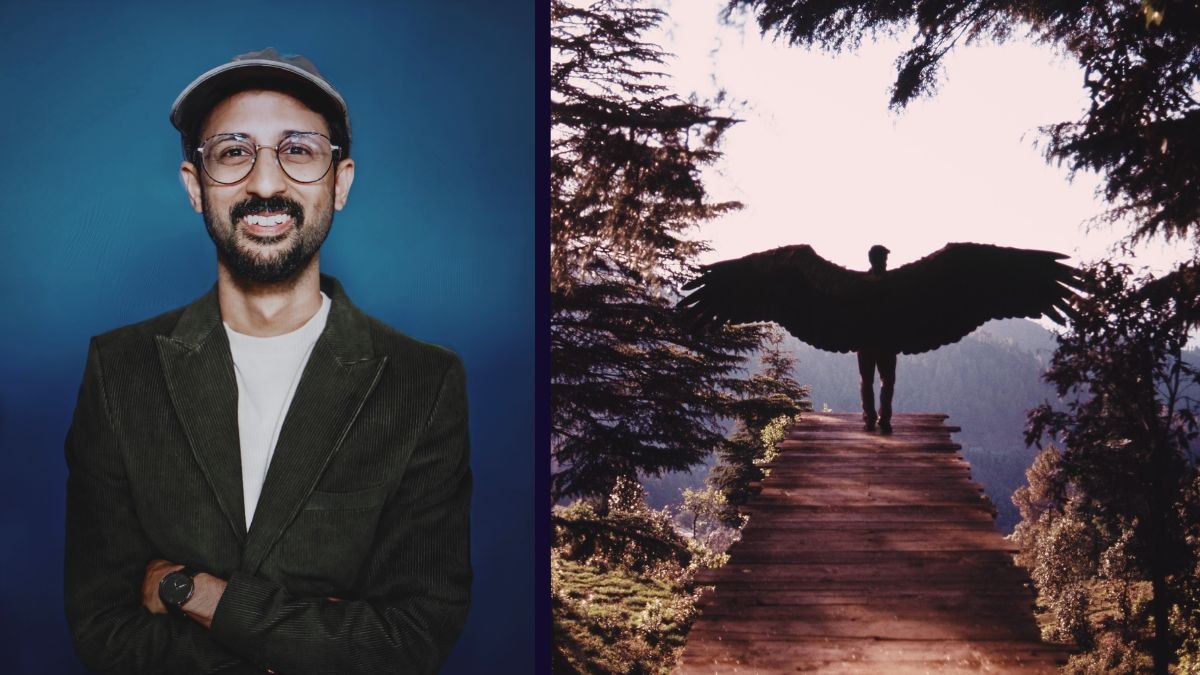
Raam Reddy (left); still from his film Jugnuma (right).
RAAM REDDY'S sophomore movie, Jugnuma (The Fable) nudges you to willingly suspend your disbelief. Wife Nandini (Priyanka Bose is a deep number) knows her husband Dev (Manoj Bajpayee) can fly, the villagers know it too, and they happily greet him as Dev makes his way to the take-off site, fortified by some cream on his shoulders. He also drives and walks, and that’s considered normal, too. Because Raam structures the initial few minutes this way, the audience occupies the space between a real-life drama and a fable, willing to swing from human behaviour to that of a superhero.
At its core, Jugnuma is about the politics of land, of labour rights, of who is the insider and who is the outsider, but this is scaffolded by visuals so surreal (cinematographer Sunil Borkar shot on Kodak film), you are sometimes tempted to widen your eyes in wonder before allowing the film to connect with you. Eventually, in the film, Nature turns teacher and marks the triumph of the human spirit.
Stream the latest films and shows with OTTplay's Power Play monthly pack, for only Rs 149.
Raam made a smashing debut with the quirky Kannada film Thithi (2015), about Century Gowda, and how the family relates to the death of the cantankerous 101-year-old man. Jugnuma arrives a decade later, and while there’s nothing common between the films, the gentle thread of philosophy is a connecting factor.
In a conversation, Raam speaks about the process of making Jugnuma the joy when his audience ‘gets’ the nuggets he’s placed in the film, making cinema for the world while working within the indie space, and why he is looking to scale up. Edited excerpts below:
Everyone who has watched the film has been awed by the visual poetry. Do you think the beauty of the landscape acts as a barrier between the story and the audience?
Ah! Interestingly, we never knew we were building such a visually rich film. For me, the visuals were meant to serve the story. If something stands out, then, probably, we have created some form of imbalance.
In this case, it may feel that way, because I was keen from the screenplay stage that we wanted to show as well as omit certain things. No character knows all that is happening, and the suspense was part of the story. The voice-over also narrates it in hindsight. There’s a conversation between the father and the colonel, but you see that from the daughter’s POV. We kept shifting the points of view.
This suspension of disbelief. Nowhere did you mention magic realism, but every flight of fancy was so real.
I feel realism is the best way to heighten the willing suspension of disbelief — it is as though you are witnessing a real world that is actually there and functioning. But magic is the other side of my passion. So in the genre of magic realism, it is as though you have a slider between completely real and completely magical; you can decide where you want to place that slider. It's a little geeky, but while writing, I drew a graph for where I wanted to be on the magic realism slider at different parts of the story — the slider starts from sub-realism, then moves to realism, then to hyper-realism, and finally to surrealism. In some spaces, magical things were more casual than even in daily life. This is what I call sub-realism. In many places, it felt like everything was normal. This was the realism. In some places, such as the handicam and village sequences, it was documentary-esque with a notion of the uncertain. This is what I call hyper-realism. And in some places, there was unapologetic magic. This was the surrealism. So moving between these subtle spaces was intentional and was a key part of the writing.
How did you react when your audience ‘got’ your references, reacted the way you hoped they would?
I was very particular while making the film. Since I know my style is somewhat closer to impressionism, I experience both joy and a certain amount of relief when people get my films the way I intend them to.
I knew I was being very brave with this film, and was going into a free-spirited literary way of dealing with narrative elements. Cinema is usually safer. I was moving between these subtle spaces, and I had to make it work as a cohesive whole. I was always very nervous because of that bravery. It was a journey to find a balance that works. After the Berlin screening, I worked with my collaborators and incorporated feedback.
The feedback that I receive now on the final version has been stunningly close to my intention. People are organically embracing the magical elements in it. It did not need that labelling at all — it's being seen as just one beautiful, cohesive story.
Let’s speak about the fireflies, which add to that air of beauty and mystique… they do very many things in the film. How did you decide this is how they are going to look?
Glad you asked me this. When we were having discussions, each one had an idea about how a firefly looked, based on where they’d seen it. But there are more than 2,000 different species of fireflies, and the glows they emit are different too. So we decided to design one that aesthetically fit the mood and emotion of the film.
You like to include a certain element of contrast in your films. We saw that in Thithi and now here. How do you use it to take your core story ahead?
I like the many layers in my creations to contrast with each other. If Thithi was a humorous film with a reflective end, this is a more serious film with a light and buoyant end. That flip is instinctive to my craft. For example, at its core, this is not a simple fairytale but also a complex socio-political film. Those contrast points heighten the elements in the film, and I believe it works in a way to make the individual elements stronger.
Raam, you’ve so far worked in the indie space. Do you see yourself operating from the space of a commercial production?
Ah, it is very difficult to answer this. I love world-building and am fascinated by the idea of making films eventually at scale. Because I got into cinema from The Lord Of The Rings. Even there, it was the adaptation of a classic that came into the studio system. I am keen on that kind of scale, but what that will mean in terms of artistry, only time will tell. I have just shifted to Mumbai, and am yet to explore this space.
We lived in the village while making Thithi. Jugnuma was a little different. There were a lot of well-known actors, a large amount of VFX, and I fought every step for the vision to be unadulterated, to stay like how it was on the page. To fight to retain purity is a daily struggle. At heart, I am a purist, and it is hard for me to change my instincts too much, but I still seek world-building and scale. So that conflict is ever-present.
Could you speak a little about your casting choices? Manoj Bajpayee as Dev, for instance, and Priyanka Bose as Nandini…
Whenever I see Manoj in any film, I never see him, but only the character. I am amazed by his ability to transform into somebody else. That is willing suspension of disbelief; he does that using his craft and mastery, and control in holding on to a character. To think Sardar Khan (Gangs of Wasseypur) and Dr Shrinivas Ramchandra Siras (Aligarh) are played by the same person! His choice was a no-brainer.
Priyanka was perfect as Nandini. You know she knows that something is happening. Nandini might not move around much, but she instinctively reads the room. The song she sings — that is a window to her inner self. She is the spiritual core of the film. She’s intuitive and yearning for something deep. Nandini is educated, but because of the time the film is set in, she’s at home, trapped in a way. She’s inherited privilege, but something is missing. Priyanka was able to showcase that.
Stream Manoj Bajpayee’s gripping performances in Daud, Satya, and Jaago now on OTTplay Premium!
Hiral Sidhu (Vanya, the daughter) was lovely as the insider who is also an outsider, and she’s one with the horse…
When someone grows up around an orchard in the hills, boarding school is an option to help them socialise. But, because of this, they are exposed to two forms of parenting — at home, and at boarding school, which is a new layer. That’s why Vanya is rebellious, she’s trying to reconcile the life of a student with the privilege that automatically comes when she’s in the estate — for example, when the elderly helper offers to take her bag. She’s drawn to the monk; she wants to escape, but she’s also searching. She finds something, she seeks something, but she ends up having an experience unlike any other. And, for that to work, that insider-outsider conundrum was key.
A word about the fireflies….
Ah, they are up to your interpretation. It could be nature teaching you something, it could be a poetic, spectacular reminder of who you really are…
Share