Big Girls Don't Cry, But You Might When You're Done Watching This Series
This is #CriticalMargin where Ishita Sengupta gets contemplative over new Hindi films and shows.
Mar 14, 2024
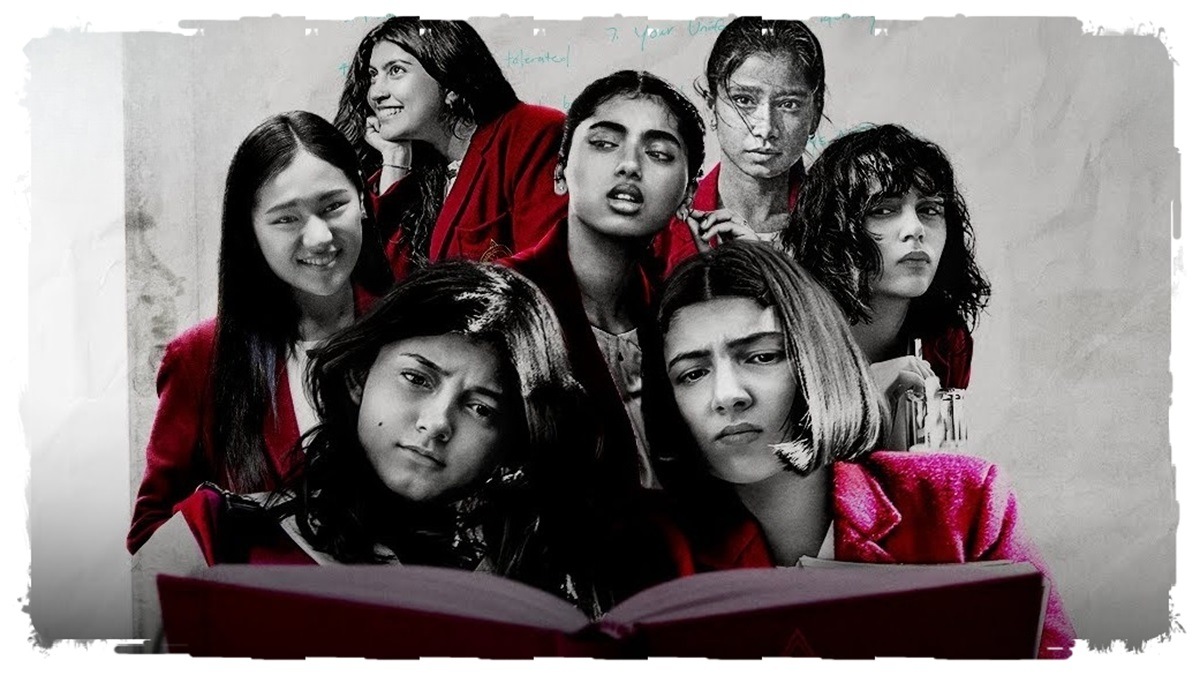
Poster detail for Big Girls Don't Cry. Prime Video India
This column was originally published as part of our newsletter The Daily Show on March 14, 2024. Subscribe here. (We're awesome about not spamming your inbox!)
***
IN the Hindi streaming landscape, stories about young adults and the many ways they navigate the precarity of their age has become a genre unto itself. The vulnerability of adolescents opens up as a ripe premise to examine a host of things and make commentaries on their profound whimsicality The result can be provocative (Class on Netflix), existential (School of Lies on Hotstar) or even frustrating (Adhura on Hotstar). Nitya Mehra’s Big Girls Don't Cry does something unimaginable with it: it makes young adults look boring.
RELATED | From Kafas to Adhura and School Of Life, YA Comes of Age on Streaming
The tropes are similar. In a boarding school at a fictional place, the interpersonal dynamic of the resident students are rendered into a mess under the watchful eyes of the teachers. With Big Girls Don't Cry (BGDC), Mehra uses this familiar backdrop to outline sisterhood in a girls’ school and focus on a few to craft a coming of age story. The problem is she and the other group of directors (Sudhanshu Saria, Karan Kapadia and Kopal Naithani are credited) take the potential of the setting and reduce it to a set of inanities, touching upon every cliche in the book. The intent turns out to be both unimaginative and unambitious with reiteration of subplots and plot turns that spark neither ingenuity nor invention.
This is not to say the occurrences depicted in the show are rare in a high school. In fact, quite the contrary. But the way the filmmakers decide to go out about them speaks volumes about their cagey hold on craft. Most things are blatant: like the school’s motto being “know thyself” which directly links to the theme of the series, or the proceedings hurtling towards the institution’s diamond jubilee celebration when every conflict is fated to be amplified and then resolved.
Mehra, a frequent collaborator of Zoya Akhtar, designs her narrative around a group of six girls where each is cherry picked either on the basis of their faith (there is Noor Hassan, a Muslim girl who comes from a lineage of freedom fighters; Jayashree Chhetry, a young princess from a state in the North East; Leah Thomas, a Malayali girl who loves to play basketball) or problems (a girl called Roohi Ahuja is the archetypal poor-rich girl who holds on to friends to look past her parents’ crumbling marriage; there is Pluggy who wants to have sex to demystify the act; and there is Kavya Yadav, a scholarship student who lies about her past to fit into her present). The selection feels too curated and too on the nose.
As a result, the upshot feels obvious. Noor (Afrah Sayed) wants to study in the US and in that quest, seeks to drop her surname. Leah (Avantika Vandanapu of Mean Girls fame) struggles to come to terms with her attraction to a fellow batchmate. JC (Tenzin Lhakyila) and Roohi (Aneet Padda), sisters from different mothers, have a boy upend their relationship. Pluggy (Dalai) spends her days plotting to lose her virginity and Kavya (Vidhushi), the outsider, lies about her past to fit in.
The neatness of the arrangement is in contrast with the way things are handled. Across the eight episodes (each almost 50 minutes long), the filmmakers introduce multiple plot points and characters but lend no patience or insight in their arc. There is a sluggish busyness in the narrative which gets worse with the makers’ refusal to see it through. Everyone has a lot going on in their lives. I get the intent behind it. When you are at the age that the characters are at (in Class 11 and 12) you have peak main-character energy. But in its bid to make everyone a protagonist, the series reduces everyone to a half-baked character. Instead of forging their own paths, they come across as people whose emotional muddiness feels less like a reaction to their age and more like a consequence of obscure writing.
For instance, two friends fight on an excursion and the next day they (and the series) behave like nothing is the matter. A climactic moment of reconciliation is scored to Rabindranath Tagore’s ‘Ekla Cholo Re’ that feels both hurried and unearned. A cutesy Mujhse Dosti Karoge! subplot plays out but the revelation (with the boy realising he loves someone else and not the one he thought he did) arrives with a bang. Even the secondary characters (actors like Suchitra Pillai, Dolly Ahaluwalia arrive and disappear at random) like the school principal (Pooja Bhatt) or the dramatics teacher (Zoya Hussain) are given enough attributes to prop them as people but are conveniently forgotten in the midst of the deluge of details.
The wheels come off completely in the last three episodes as the show builds towards more and more conflicts and rests on sweeping solutions. Each is built in a similar fashion. One friend accuses another of lying and the other lashes out with a similar accusation. At one point, it becomes difficult to keep track of who is lying and who is not, and more crucially, who is angry with whom. Granted the age is tricky but it is not tedious.
This is a pity because there is a solid set of actors on display. All the girls have distinct screen presence (particularly Vidushi) and display the capability to make something out of the show if they were given something to do with. The core of Big Girls Don't Cry where the girls imagine themselves to be more grown up than they are only to realise they are not, also counts for its main tragedy. It gets buried under the weight of the episodes and frustrates for coming out only in flashes.
There is one particular moment where Roohi visualises sitting with her parents (a terrific Mukul Chadda and Raima Sen) and calmly telling them to part because she can handle the separation. When the confrontation arrives in real life, she turns her back and runs. Noor, who desperately wants to relinquish her legacy, knows no better. Given the communal world we are living in and the age she is at, she reckons that the problem lies with her and not with those causing it. But the show is so overwrought that the onus falls on us to glean the better instances from the endless unfolding.
For instance I quite liked the bashfulness with which a young boy asks out a girl under a staircase (“Will you be my sweetheart?”) or a waxing scene among the girls being staged like a birthing moment. There is also a lovely hotel scene where two friends “practise sex” which culminates with the boy (Bodhisattva Sharma) hastily stopping for being all red. But these are too few and frankly too far apart in a show that opens with a catchy opening score and promises levity. Eight episodes later, it does not matter that big girls don’t cry. In fact, nothing does.
Big Girls Don't Cry is streaming on Prime Video India.
The views expressed in this column are those of the author and do not necessarily reflect the official policy or position of OTTplay. The author is solely responsible for any claims arising out of the content of this column.
Share