Home » News » Krantijyoti Vidyalay Marathi Madhyam ending explained: How did Shirke’s viral speech save the school and what is next for the Nagaon alumni?
Krantijyoti Vidyalay Marathi Madhyam ending explained: How did Shirke’s viral speech save the school and what is next for the Nagaon alumni?
In Krantijyoti Vidyalay Marathi Madhyam alumni save their Marathi school from demolition. This ZEE5 hit explores the struggle for cultural identity, urging parents to take pride in native language.
Mar 01, 2026
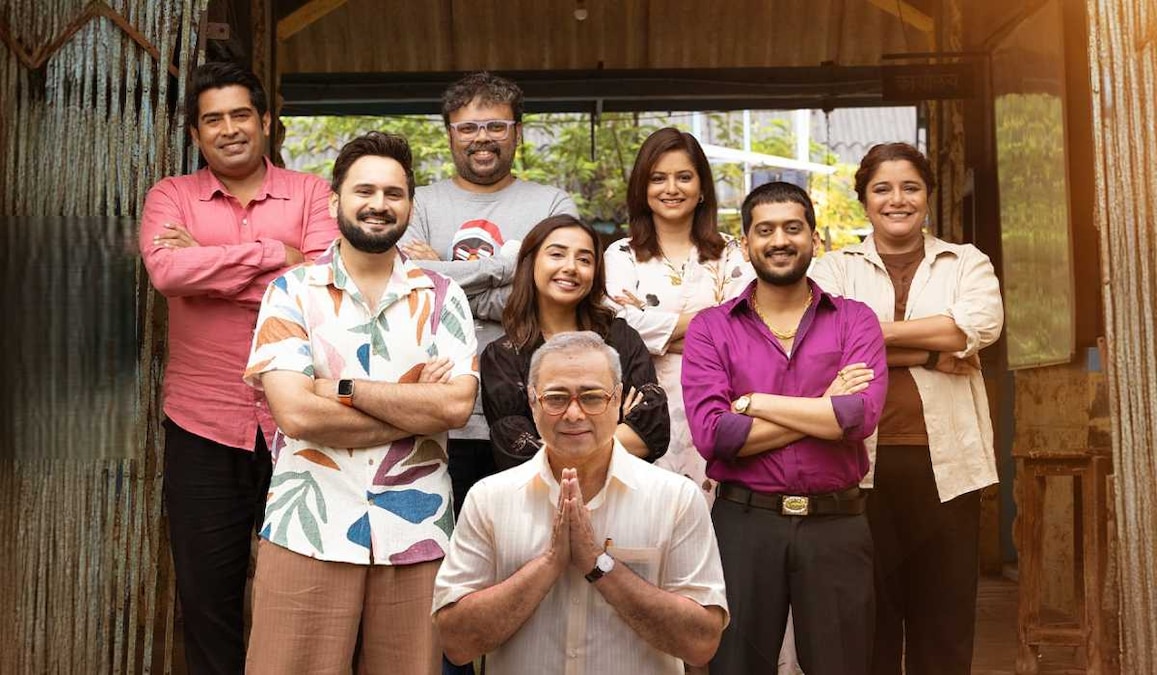
Krantijyoti Vidyalay Marathi Madhyam poster
Hemant Dhome's social drama Krantijyoti Vidyalay Marathi Madhyam has revived a national discussion on the future of vernacular education since its OTT debut on ZEE5 (OTTplay Premium) on February 27, 2026—timed significantly to coincide with "Marathi Bhasha Gaurav Din". Many are analysing the film's emotionally charged and message-driven ending, which has garnered attention from a worldwide audience following its successful theatre run that began on New Year's Day.
Experience the best of Marathi cinema by streaming the top social drama Krantijyoti Vidyalay Marathi Madhyam, the legendary classic Natsamrat, and the inspiring Ata Thambaycha Naay! all in one place on OTTplay Premium.
Who is Principal Dinkar Shirke and what is his mission?
Principal Dinkar Shirke, played by Sachin Khedekar, is a man who has devoted his life to a 90-year-old Marathi-medium institution in Nagaon, Alibaug. The demolition of the school to make way for a new international school with an English curriculum is imminent, so Shirke calls upon his former students to rally behind him in this final battle.
There is a sense of imminent loss at the beginning of the story. Once the centre of village life, Krantijyoti Vidyalay is now in a state of decline due to low enrolment and the "dilapidated" designation bestowed upon it by the government. To construct a profitable educational complex that values business over legacy, the antagonist, Jagtap (Anant Jog), a corrupt politician-developer, intends to demolish the building.
Who are the former students returning to save their alma mater?
Now grown-ups with varied lives, Principal Shirke reconnects with his beloved class of students. Amey Wagh plays the role of a local contractor named Baban; Siddharth Chandekar plays the role of an accomplished actor named Deep; Prajakta Koli plays the role of Anjali; Kshitee Jog plays Salma; Harish Dudhade plays Rakesh; and Puskharaj Chirputkar and Kadambari Kadam play Vishal and Suman, respectively.
At first, the gathering thinks the invitation is just for a regular high school reunion. Reminiscences abound throughout the film's opening half, which focuses on things like school rivalries, crushes, and the sheer delight of eating orange candies on the playground. Narkevar Bai, played by the charming but severe Nirrmitee Sawant, tells them that their alma mater isn't having a picnic; it is battling for its life. This realisation caused a dramatic change in tone.
What lies at the heart of Krantijyoti Vidyalay Marathi Madhyam's high-stakes climax?
An elaborate plot to foil Jagtap's schemes is at the heart of the film's climax. The school's significance lies in its history and its role as a cultural anchor, not in its physically "unsafe" building, as previous students have recognised.
The students escalate their demonstrations. They launch a "Save Krantijyoti" campaign that quickly gains traction, drawing on Deep's clout in the media, Salma's expertise with government processes, and Baban's local connections. When they discover that Jagtap fabricated the structural audit, it becomes clear that something is amiss. They manage to coerce the Education Minister (Jitendra Joshi, in a cameo appearance) into giving in by bringing attention to the school's impressive 90-year track record of generating successful citizens using social media.
How does Krantijyoti Vidyalay Marathi Madhyam address the debate between "Marathiness" and corporate globalisation?
The physical encounter with Jagtap signifies a symbolic struggle between "Marathiness" and corporate avarice. Jagtap argues that Marathi-medium schools, outdated and irrelevant in today's globally interconnected society, disadvantage children. In response, the students—many of whom now reside or work in English-speaking countries—show how their proficiency in their native tongue has given them the self-assurance and sense of purpose to thrive wherever life takes them. The school subsequently receives a demolition stay and heritage status, ensuring its protection.
Principal Shirke's (Khedekar) monologue to the camera at the end has been the subject of much discussion. He defies convention in a 10-minute speech that serves as the film's manifesto. He does not contend that English should be eradicated but rather that the mother tongue should be preserved. Language, he says, is more than that; it is a "repository of culture" and an instrument for communication.
What does Krantijyoti Vidyalay Marathi Madhyam define as the true "revolution" in its concluding scenes?
To wrap up, he says that the revolution, which is the Kranti in the school's name, isn't about preserving a structure, but rather about parents deciding to be proud of their language. Instead of a big party, the film closes on the first day of school, when enrolment has dramatically increased due to parents' decisions to send their children back to Marathi classes.
The school represents Maharashtra in Dhome's film. It avoids being preachy while discussing the "English-medium craze" throughout the film. It concedes that English is useful for advancing one's profession but cautions against the "erasure of the self" as a result.
Why is Salma’s character arc essential to Krantijyoti Vidyalay Marathi Madhyam's message?
Particularly essential to the conclusion is Salma's character. Coming back to save the school after experiencing bullying and feeling out of place as a student shows that the school provided opportunities for growth to everyone, regardless of whether their experience was "perfect" or not. Marathi, the film argues, is the glue that holds the diverse religious and economic communities of the state together.
The performance by Khedekar, similar to his one in Mi Shivaji Raje Bhonsle Boltoy serves as the film's anchor. The emotional core of the film is his transformation from a fragile, anxious old man into a stern orator in the closing scene. In his role as Baban, Wagh offers much-needed comic relief, and Koli, in her remarkable Marathi debut, gives the ensemble a modern twist.
How do the setting and score contribute to Krantijyoti Vidyalay Marathi Madhyam's emotional resonance?
While the second half cranks up the tension, Dhome's film takes its time to let the first half soak up the coastal splendour of Alibaug. The score composed by Harsh-Vijay, especially the song Haakamari is skilfully used in the film's last act to create the "epic-like" aspect that numerous critics have praised.
Krantijyoti Vidyalay Marathi Madhyam was a giant financial success, reportedly amassing over ₹32 crore on a relatively small budget, yielding returns exceeding 600%. Because of its transition to ZEE5 (OTTplay Premium), its audience has become much larger.
What has been the public and critical reaction since the OTT release of Krantijyoti Vidyalay Marathi Madhyam?
The film has been trending on social media since its OTT release on February 27. The film has received positive remarks from cultural activists and educators for offering a "roadmap" to preserve vernacular schools. Despite some criticism about the film's length (149 minutes) and its finish ("talky"), most people agree that it has a positive heart.
The goal of the final scene of Krantijyoti Vidyalay Marathi Madhyam is to make the viewers feel responsible for something. It implies that the preservation of the Marathi language is contingent upon community choices rather than governmental policies. The film transforms from an entertaining piece into a rallying cry, transferring the responsibility to the audience.
Krantijyoti Vidyalay Marathi Madhyam FAQs:
Q: Does Krantijyoti Vidyalay get demolished at the end of Krantijyoti Vidyalay Marathi Madhyam?
A: No, the school is saved. While the antagonist Jagtap tries to raze the building using a fraudulent "dilapidated" status report, the former students expose the document as a fake. By leveraging social media and the school's 90-year history, they successfully lobby the Education Minister to grant the institution heritage status, protecting it from future demolition.
Q: Is Krantijyoti Vidyalay Marathi Madhyam based on a true story?
A: While the characters are fictional, Krantijyoti Vidyalay Marathi Madhyam is a social commentary on the real-world crisis facing vernacular medium schools in Maharashtra. It specifically addresses the "English-medium craze" and the closure of hundreds of Marathi schools, using Nagaon as a microcosm for the broader state-wide struggle.
Q: Why was Krantijyoti Vidyalay Marathi Madhyam released on ZEE5 on February 27?
A: The ZEE5 premiere of Krantijyoti Vidyalay Marathi Madhyam was strategically timed for Marathi Bhasha Gaurav Din (Marathi Language Pride Day). This date commemorates the birth anniversary of the legendary poet Kusumagraj, aligning the film’s message of linguistic pride with a day of national cultural significance in Maharashtra.
Top 6 Must-Watch Marathi Masterpieces
Share