Lights, camera, cinema: Decoding the allure of movies within movies
With Kaantha and Vaa Vaathiyaar, Tamil cinema looks inward, revisiting its studio past, star culture, and iconic tropes while examining the labour, legacy and illusions behind filmmaking.
Dec 12, 2025
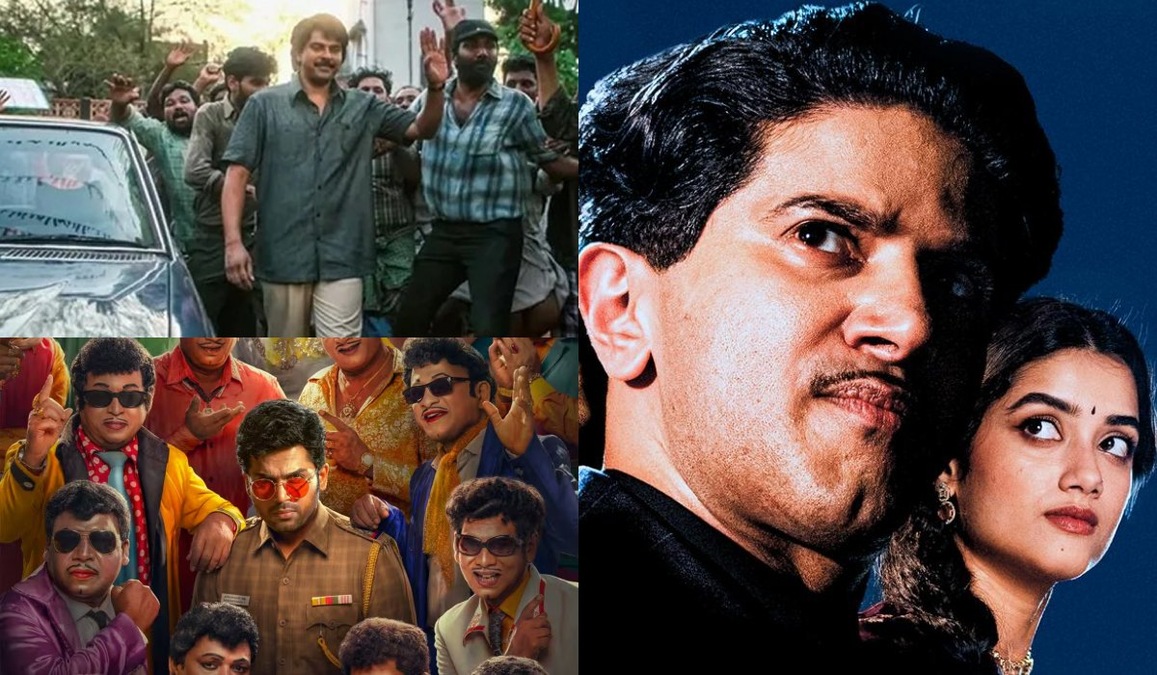
Rekhachithram, Vaa Vaathiyaar, Kaantha
They say cinema reflects society, the people, and sometimes the film industry itself. The last of these, though as true as the rest, rarely finds its way to the silver screen. As Martin Scorsese once said, “Cinema is a matter of what's in the frame and what's out,” and it becomes intriguing when cinema takes itself as muse, when film-within-film offers a peek into a world often perceived only through glitz and glamour. Tamil cinema tread this territory with films such as Kaantha, a picture-in-picture story now on Netflix with Dulquer Salmaan playing a movie star, and Vaa Vaathiyaar, starring Karthi with echoes of MGR and MN Nambiar, in the latest.
Watch latest Tamil films like Aan Paavam Pollathathu, Aaromaley and more with OTTplay Premium. Get JioHotstar, Discovery+, Sonyliv, Fancode and 25+ OTTs
Recollection of the cinema of yore
For Kaantha director Selvamani Selvaraj, films about cinema help preserve and retell the efforts that once defined the craft. “I think something like Kaantha is relevant today because it talks about what is great in filmmaking and art, the greatness in pursuing the arts. When everyone has got a microphone and camera today, it is a reminder of what it took for the art it is,” he explains.
Set in 1950s Madras, Kaantha revisits a thriving studio era through the relationship between a movie star and the director who introduced him, exploring the invisible labour behind black-and-white filmmaking. “What our masters have gone through for it to be now, and if we can have that level of dedication and sincerity to make a film, is Kaantha. The making of content, the divinity it had, and to remind viewers about it, I found that interesting. What happens between action and cut, and how it has left a mark,” says Selvamani.
Dulquer’s filmography too has often journeyed into cinema’s past and present - backwards with Mahanati, the luminous Savitri biopic, and forward with Chup: Revenge of the Artist a film inspired by Guru Dutt’s Kaagaz Ke Phool. Chup exposed the darker, inward-facing corners of cinema: an aspiring filmmaker-turned-serial-killer targeting critics who had crushed directors’ lives with scathing reviews. Director R. Balki notes that the industry carries its own flaws like any other. “There is a lot of corruption in politics or the police force. And filmmakers are quite keen on portraying corruption from other sections of society. But there is corruption and career-destroying actions in the movie industry itself, which forms Chup. It is about portraying the issues that are here,” explains the noted filmmaker
He adds that self-referential cinema often risks becoming caricature because audiences imagine the industry acts in a certain way. “But if you look at portraying cinema, depending on the story that you are trying to tell, and portray the industry, a lot closer to reality, it makes for an interesting viewing,” he says.
Commentary on cinema
This idea intersects with the approach of Selvamani and CS Amudhan, whose Thamizh Padam films spoofed Tamil cinema’s most recognisable tropes. Amudhan says it wasn’t intentional commentary but something that emerged through amplification. “I don’t know how much of a commentary Thamizh Padam is, which could be incidental. We don’t go about making a film for it to be a commentary at least. There are two approaches to writing a script; one is to string together the most popular and iconic imagery of Tamil cinema, two is the farcical elements that are generally done in the Indian industry, and when you exaggerate it, it becomes outright farcical. Those things become a commentary on the industry incidentally,” he remarks.
He adds that the spoof wasn’t limited to easy targets. “What I did differently from other spoof films is that we not only took the most spoof-able films but also went after some genuinely legendary stuff like Thalapathi, Thevar Magan and Nayakan. I have touched the classics as well with Thamizh Padam, because those are part of the public's consciousness. It is because classics will help us to connect with the public,” explains Amudhan.
Balki, meanwhile, observes how showbiz is shaped and sometimes distorted by public perception. “A PR (public perception) has been generated about the industry, that everybody is larger than life, huge egos, and how sets work. But when you supposedly break those myths and actually treat cinema as an art form, it becomes something else. Because it is in the public domain more than other art forms, I feel that it is necessary to get newer angles and lenses that people have not seen before,” says the director of The Shamitabh (a film that explored the cinema industry with Dhanush and Amitabh Bachchan).
It is in such a space that Kaantha positions itself. Calling the film-within-film approach both fascinating and demanding, Selvamani says, “A lot of people discouraged me because it is seen as a bad omen. But the fascination with that genre was always there. There is glitz and glamour that everyone touches upon, but I want to show what it takes to be that great and the perception of greatness.” Viewing cinema as an outsider-fan rather than a filmmaker, he leans into how cinema sparks a conversation, which is universal. “The love for storytelling is common. When two friends meet, somewhere the topic of cinema pops up. It can become a conversation starter. More than as a filmmaker, I have seen cinema only as a fan and audience. So, I want to see how a member of the audience would take a film to the cinema. The genre of film within film is both very interesting and challenging,” he adds.
Cinema is its best critic
For many filmmakers, films about cinema also become mirrors for introspection. Director Viji, who helmed Velli Thirai, a remake of the Malayalam flick Udayananu Tharam, saw the film as both a narrative and a self-analysis. It follows an actor and a director rising from scratch, and the moral fault lines that appear when one ascends through questionable means. “When we make films based on police or politicians, then it is a criticism of a particular section. Similarly, the cinema too needs one. There is a saying that cinema and politics go hand in hand. In politics, you have cadres, but in cinema, you have fans. I want to explore what it is to find your own faults and criticise them,” says Viji.
An insider’s view
Sometimes, cinema becomes a tool for reimagining perspectives, as seen in this year’s Malayalam film Rekhachithram which balanced crime drama with nostalgic storytelling. The film revolves around the search for a missing girl from the sets of the 1985 Mammootty film Kathodu Kathoram. Director Jofin T. Chacko recalls how the idea was seeded during a film discussion. “While watching a film, we came up with the idea of making a story of a missing person, someone who is an actor but not known. From there, we took it to pitching ideas and by then, we got the rough skeleton of what you saw,” the Malayalam filmmaker says.
“The idea of incorporating Kathodu Kathoram came naturally, and both me and co-writer Ramu Sunil are Mammootty fans. Kathodu Kathoram is also a classic film that many of us have re-watched. It has sustained for generations and we wanted to tap into that. We gave a new premise and believed that Kathodu Kathoram would give us some connectivity. Given this film is an alternate history, we thought it would work because people are curious to know trivia behind such films,” he further adds.
Jofin says they resisted leaning too heavily on meta-cinema. “When films talk about films, you are giving your audience another emotional door to walk through. With Rekhachithram, there is a mix of mystery, industry history and a new story. People want to know what is happening inside sets, the private lives of actors,” he explains. The director adds that, unlike films such as Udayananu Tharam and Mahanati, his intent was not to frame a full-blown narrative about the industry but to connect audiences to the story’s premise.
Ultimately, these filmmakers converge on a shared conviction: that cinema, despite the wonder wrapped around it, is like any other industry, only cloaked in more curiosity. Whether celebrating itself, critiquing its own workings, or offering new vantage points, cinema remains a collective space of storytelling. Or, as Selvamani describes it, an “epitome of greatness.”
Kaantha FAQs
Q. What is the platform of Kaantha OTT?
A. Kaantha is streaming on Netflix.
Q. What is Kaantha OTT release date?
A. Kaantha is available Netflix from December 12.
Q. Is Kaantha biopic of MK Thyagaraja Bhagavathar?
A. No, Kaantha is not a biopic of MK Thyagaraja Bhagavathar. It is a fictional story.
Best Tamil films of 2025 to stream
Share