Newsletter | Makoto Shinkai's Suzume & The Multiverse Of Sadness
Through Suzume Makoto Shinkai closes the door on the notion of closure itself: People need to mourn and come to terms with their grief, rather than attempt to forget the past. Prahlad Srihari writes.
Apr 24, 2023
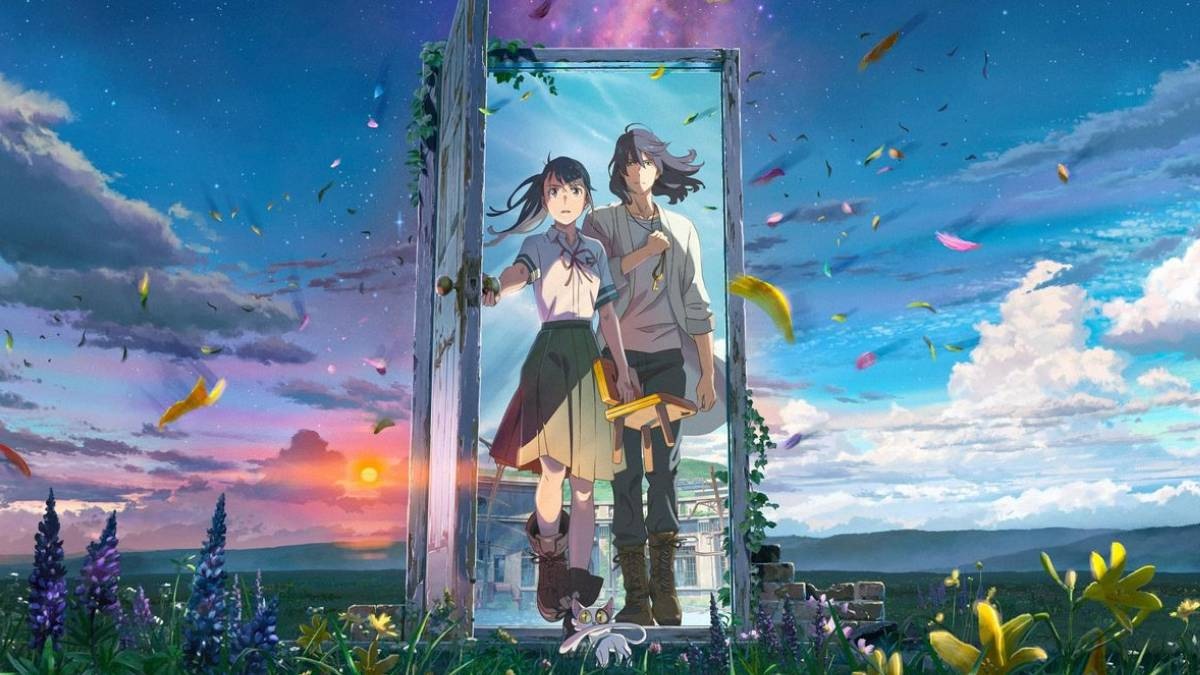
Poster for Suzume
This column was originally published as part of our newsletter The Daily Show on April 24, 2023. Subscribe here. (We're awesome about not spamming your inbox!)
***
ANCIENT GODS thunder underneath the islands of Japan in Makoto Shinkai’s animated fantasy Suzume. Magical doors hold their destructive forces at bay, with living artifacts (known as keystones) standing guard. Not sealing the doors properly, as a time-honoured ritual dictates, is to invite disaster. Giant supernatural worms of smoke and fire can burst through, cracking the Earth open, angering the ocean and wrecking everything in their path. A seaside resort long abandoned by tourists, a middle school in tatters that hasn’t seen children walk through its halls for years, and an amusement park fallen into disuse without the laughs and screams of families filling the air — each lonely place is a snapshot of worlds ravaged by disaster and frozen in time. Once living, breathing places with character and history, these now stand as memorials to communities displaced and a nation’s lingering trauma. Once sites where memories were created, these are now mere sites of remembrance.
LIVING WITH the nagging threat of natural disaster is an everyday reality for people in Japan. Shinkai employs fantasy as a buffer against this collective reality of a country. The giant worms are the inner turbulence of the national psyche reconfigured. Through successful human intervention against the giant worms, the film grants audiences a way to exorcise their fears about catastrophe. Indeed, giant monsters levelling entire cities on screen has been a mode of grieving and remembering past catastrophes, nuclear or natural, in Japan since at least Gojira (1954) and the kaiju films that followed. Shinkai builds on the tradition in his own way: by enriching fantasy with myth and teen romance.
The shadow of the Great East Japan Earthquake of 2011 (aka 3.11) hangs over Suzume just as it did in Your Name. Ecological anxieties and emotional stakes have always intertwined inextricably in Shinkai’s films. The time-bending body-swap romance between the two high-schoolers of Your Name is threatened by an incoming comet. The romance between a runaway teenage boy and an atmokinetic girl in Weathering with You is threatened by climate change. Suzume sends its titular heroine (voiced by Nanoka Hara) and a dreamy young man she falls for, on a cross-country road trip to close the doors keeping the worms from escaping — while in pursuit of a talking cat who becomes an Instagram celebrity.
If all this wasn’t strange enough already, the young man Souta (voiced by Hokuto Matsumura) is turned into a sentient three-legged chair, making Suzume the zaniest story Shinkai has dreamed up so far. What makes Shinkai such a beloved animator is his ability to take zany stories and still bring them down to Earth with sensitive coming-of-age beats. Suzume, we learn, was all but four when she lost her mother in the Tohoku earthquake, after which she was raised by her aunt Tamaki (Eri Fukatsu) in Kyushu. With each checkpoint on the journey, from Kyushu to Kobe to Tokyo to Tohoku, Suzume gets one step closer to facing the trauma of her childhood. Souta, meanwhile, struggles to live up to a family legacy, coming from a long line of “closers” tasked with sealing the portals between our world and the “Ever-After” so as to prevent disasters from destroying the country.
OTTplay Explores | 2 Animated Adventures That Deliver The Unexpected
Whether it is time travel, body-swap or parallel realms housing giant worms, fantasy allows younger generations burdened with the responsibility of taking over a planet of multiplying existential perils some hope that they could yet prevail. What’s more hopeful than watching young love being pitted against a world out of balance, and somehow triumphing? And what makes Shinkai’s romanticism so infectious is the warmth and lyricism of his animation. Suzume closes doors and opens her heart while journeying across richly detailed urban and rural landscapes hemmed by skies of blues, pinks and purples. Romanticism is tempered every now and again by the reality of nature run amok. The gentle ripples of the sea sparkling from the sunlight belies its destructive power. The long-abandoned places are subsumed by foliage as if reclaimed by the natural world. When Suzume remembers these places in their prime, poignant flashbacks overlay the past over the present. Memories are rendered three-dimensional by the painterly strokes with which Shinkai draws local communities in all their past splendour.
As Suzume makes her way home, she comes across communities scarred by tragedy and places left derelict in the fallout. Each experience along the homecoming journey — from befriending a family of innkeepers in Saijo to babysitting for a single working mom in Kobe to mending her strained relationship with her aunt — brings her closer to unsealing the past and paves the way towards healing. The end of the journey comes with teachable lessons. Suzume comes to understand there is no set timeline for mourning — be it personal or national — at the end of which we can detach ourselves from our trauma and ensure our pain doesn’t darken our doorstep ever again. Through Suzume Shinkai can be seen as closing the door on the myth of closure itself. To move forward, he suggests, the people of Japan need to mourn and learn to carry the grief rather than forget the past altogether. To endure, they have no other option but to live with a shared sense of resignation and hope.
Suzume is playing in theatres across India.
Share